Drilling & Data Management

Comprehensive Soil Profile Software & Borehole Data Management

Turn field data into engineering decisions. SETAF2018 centralizes borehole logs, SPT, and MPM test results to generate the most accurate "Idealized Soil Profile" for your project.
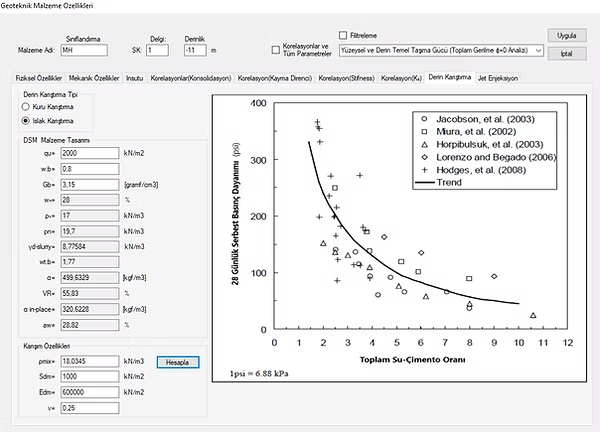
SETAF2018 Borehole Data Management
📋 AUTOMATIC IDEALIZED PROFILE

A reliable geotechnical design begins with the accurate definition of soil layers and groundwater level. SETAF2018 transfers complex field data from various locations to a digital environment, providing a consistent and high-precision subsurface model for your analyses.
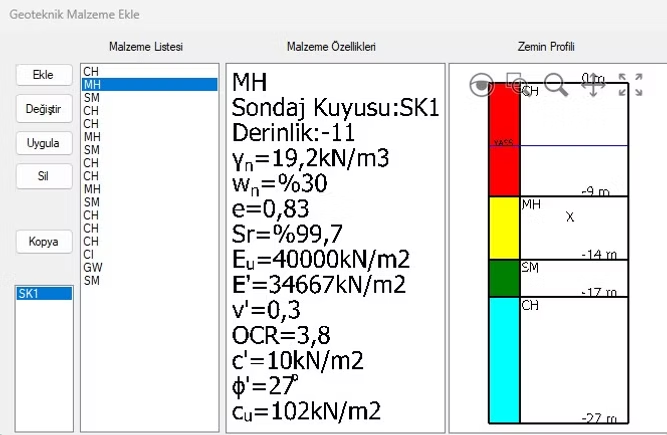
SETAF2018 Borehole Integration
COORDINATE-BASED DATA
FIELD DATA MANAGEMENT

1. Comprehensive Borehole and Field Test Integration

Define each borehole with its coordinates within the software. Create your digital archive by directly processing raw data obtained from field experiments into the system.

N
SPT (Standard Penetration Test) Ability to define SPT-N values for each depth and use them in analyses.
Pl
MPM (Pressuremeter Test) Record Menard Pressuremeter results (limit pressure, elasticity modulus) on a borehole basis.
💧
GWL Management Reflect the Groundwater Level in the model by defining it separately for each location.
SYNTHESIS AND ANALYSIS

2. Creating an Idealized Soil Profile

Synthesize variable data obtained from different borehole locations to create an "Idealized Soil Profile" that represents the entire project.
Layer Continuity Connect layer transitions between boreholes using smart algorithms.
Analysis Compatibility The created idealized profile works in full integration with all other analysis modules of the software (settlement, bearing capacity, etc.).
SETAF2018 Idealized Soil Profile
FULLY INTEGRATED ANALYSIS MODULES
SETAF2018 3D Subsurface Visualization
3D DYNAMIC MAPPING
VISUAL ANALYSIS

3. Dynamic Subsurface Visualization

Soil profile data is mapped with the 3D Terrain Model, transforming the layered structure of the subsurface into an engineering visualization.

🏗️
Layer Properties Interactively manage the thickness, slope, and material assignments specific to each layer.
📏
Cross-Section Freedom Generate technical cross-sections in any desired direction from the defined profiles and add them to your reports.
SYSTEM INTEGRATION

4. Unified Material List & Layer Management

Manage soil layers from a single central hub. Create consistent material definitions throughout the project and leverage automatic data filtering based on the specific analysis type.
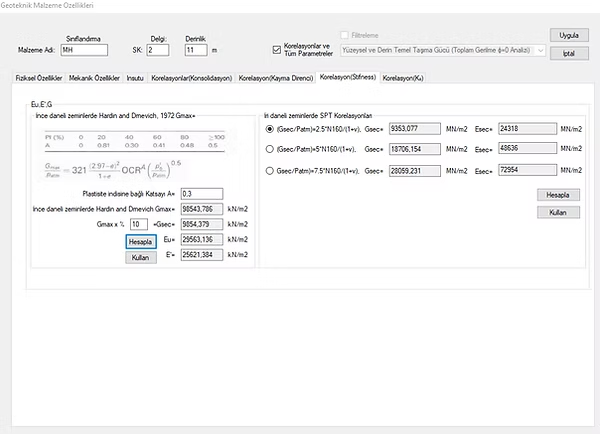
Central Data Repository A material library fully compatible with all analysis modules.
Smart Filtering Highlighting required parameters based on analysis type (Static/Seismic).
SETAF2018 Material Management Panel
100% Data Integrity
SOFTWARE ADVANTAGE

Why SETAF2018 is the Complete Soil Profile Software Solution

Traditional geotechnical workflows often force engineers to switch between multiple software packages or purchase fragmented modules just to complete a single project. SETAF2018 redefines subsurface modeling by offering a truly integrated soil profile software environment designed for fast, accurate, and cost-effective engineering decisions.

Unlike complex or modular competitors like GEO5, PLAXIS, and MIDAS, SETAF2018 streamlines your entire workflow from raw borehole data to final structural drawings:

All-in-One Integrated Workflow: Seamlessly build an idealized soil profile from raw borehole logs, SPT ( ), and Menard Pressuremeter (MPM) data. From this single subsurface model, perform comprehensive settlement, bearing capacity, excavation support (shoring), and slope stability analyses without needing third-party tools or separate module licenses.
Single File Project Structure: Keep your entire project synchronized. Soil layers, laboratory parameters, field test correlations, structural geometries, and multi-stage analysis results are stored within a single file, eliminating data mismatches and file sprawl.
Optimized for Daily Engineering Practice: While advanced FEM tools like PLAXIS or MIDAS can be overly complex for standard projects, SETAF2018 is engineered specifically for the 90% of routine engineering tasks. It delivers rapid preliminary designs and final verifications compliant with TBDY 2018 and Eurocode 7 standards.
Transparent Equation-Based Reporting: Gain complete confidence in your calculations. SETAF2018 generates detailed local engineering reports that explicitly display all underlying mathematical equations alongside traditional summary tables, making peer review and official authority approvals effortless.
INTEGRATED ECOSYSTEM

SETAF2018 vs Traditional Workflows

  • Multiple Module Purchases
  • File Sprawl & Data Mismatches
  • Single File Project Structure
  • Transparent Equation Reports
COMPLIANT WITH TBDY 2018 & Eurocode 7
BENCHMARK & ANALYSIS

How SETAF2018 Compares to Traditional Geotechnical Tools

When searching for a robust soil profile software, engineers frequently compare SETAF2018 with market alternatives such as GEO5, PLAXIS, and MIDAS. While FEM-focused tools excel at complex niche structures (%10 of projects), SETAF2018 is specifically built to deliver maximum speed, application-oriented 3D modeling, and efficiency for standard daily engineering practice (%90 of projects).

Here is how SETAF2018 transforms your subsurface data into engineering designs compared to traditional platforms:

Integrated Soil Profiling & Structural Calculations: Unlike GEO5, which relies on separately licensed standalone modules, SETAF2018 includes all calculation engines in a single platform. Create your soil profile once and seamlessly run foundation design, shoring wall calculations, and slope stability without buying extra software.
Automatic Idealized Profile Integration: Field data including SPT ( ) and Menard Pressuremeter MPM (EM, PL) tests automatically generate a dynamic subsurface model. This profile directly feeds into classical bearing capacity equations (Terzaghi, Meyerhof, Vesic), immediate/consolidation settlement models, and TBDY 2018 / Eurocode 7 compliant liquefaction checks.
Transparent Equation-Based Reporting: While competitors like GEO5, PLAXIS, and MIDAS rely almost exclusively on summary tables, SETAF2018 provides detailed local reports that explicitly display all underlying mathematical formulas and calculation steps, making technical audits and approvals straightforward.
Automated CAD Drawings & Quantities: SETAF2018 automatically generates complete project section drawings in .dwg format and material quantity takeoffs in .xlsx format directly from your soil profile model—a feature absent in most finite element tools.
EFFICIENCY RATIO

Core Target Scope

%90 Daily Engineering Workflows SETAF2018 Focus
%10 Complex Niche Finite Element PLAXIS / MIDAS
AUTOMATED OUTPUTS
.DWG Section Drawings .XLSX Quantity Takeoffs Formula-explicit Reports

Frequently Asked
Questions (FAQ)

We have answered the most frequently asked questions about SETAF2018 for you.

1. What is soil profile software, and how does SETAF2018 handle borehole data?

+
Soil profile software helps geotechnical engineers organize subsurface investigation data and visualize ground conditions across a project site. In SETAF2018, engineers can define multiple boreholes together with their soil layers, groundwater levels, and available field test data. These borehole profiles can then be modeled in 3D along with the site’s ground surface, providing a clearer representation of subsurface conditions across the project area. This 3D environment also gives engineers greater flexibility when defining idealized soil profiles, allowing the engineering model to reflect interpreted site conditions and project-specific geotechnical assumptions.

2. Can I use the soil profiles created in SETAF2018 directly for engineering design and calculations?

+
Yes, full integration between soil profiling and design calculation modules is one of the main advantages of SETAF2018. Unlike standalone profiling packages that only generate visual logs, SETAF2018 feeds your idealized soil profile directly into built-in calculation modules without requiring data re-entry. You can seamlessly run shallow and deep foundation bearing capacity calculations (Terzaghi, Meyerhof, Vesic), elastic and consolidation settlement predictions, shoring and retaining wall analyses, slope stability assessments, and TBDY 2018 / Eurocode 7 compliant liquefaction checks on the same model.

3. How does SETAF2018 assist when laboratory or field test data is incomplete?

+
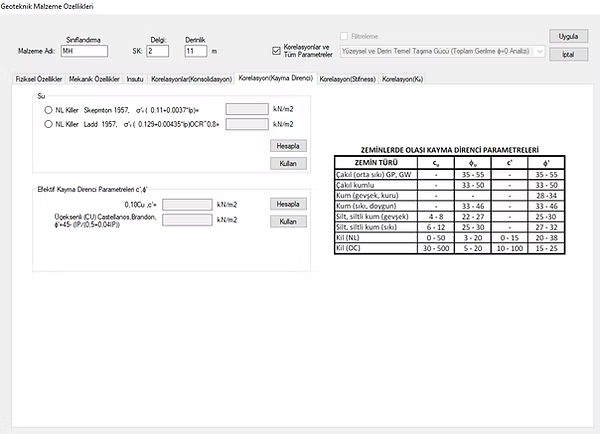
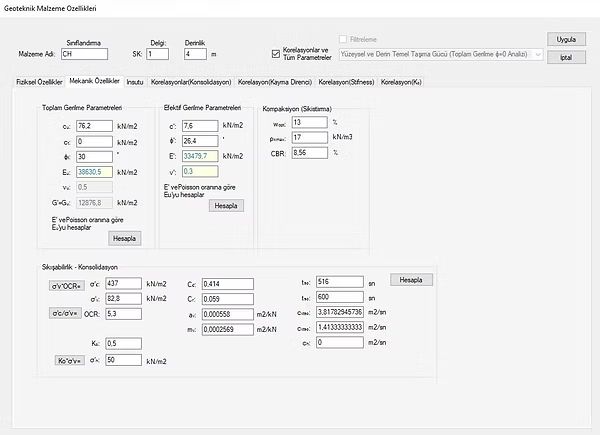
SETAF2018 includes an extensive library of built-in empirical correlations derived from established geotechnical literature (such as Skempton, Azzouz, Kulhawy & Mayne). When certain soil parameters are missing or require verification, the software can automatically estimate parameters like preconsolidation pressure (σc′), compression indices (Cc, Cr), overconsolidation ratio (OCR), undrained shear strength (Su), and elastic moduli (E′, Eu) based on basic index properties or SPT blow counts. These estimated parameters can then be assigned directly to your soil layers for preliminary or final design verifications.

4. Does SETAF2018 support ground improvement modeling within the soil profile?

+
Yes, SETAF2018 fully supports ground improvement techniques such as Deep Soil Mixing (DSM), Jet Grouting (JG), micropiles, and rigid concrete columns. The software allows you to define column geometries, binder ratios, and mixture properties, calculating the composite mechanical parameters (Ecom, νcom) of the improved soil mass. Furthermore, when evaluating liquefaction potential, SETAF2018 takes into account the "Rigid Column Group Effect," calculating how shear stresses are redistributed to stiffer columns to reduce liquefaction risk in the surrounding soil.

5. What types of reports and CAD outputs can I export from SETAF2018?

+
SETAF2018 automatically generates both comprehensive calculation reports and CAD-ready project drawings directly from your soil profile model. In addition to standard summary tables, SETAF2018 uniquely produces detailed local engineering reports that explicitly show all applied formulas, mathematical steps, and code compliance checks. For drafting and quantity survey needs, the software exports technical cross-sections and structural details in .dwg format and complete material quantity takeoffs in .xlsx format, ensuring seamless integration with CAD workflows and official submittals.
THE NEW STANDARD IN GEOTECHNICS

Tired of Bloated Software Billing You for Every Single Module Separately?

Unlike traditional geotechnical software packages, you don't have to purchase separate licenses for every calculation type.

All-in-One Architecture: From lab data to drawings in one platform.
Cost Efficiency: Localized price advantages against sky-high rates.
Zero Hidden Fees: 24/7 expert support included in the package.

WHATSAPP Global Support Team