Bearing Capacity & Settlement Analysis

SETAF2018: Advanced Mat Foundation & Settlement Analysis Software

Stop jumping between fragmented engineering modules. Calculate multi-layered ultimate bearing capacity and execute advanced 3D immediate or primary consolidation simulations in a single, unified workspace—fully compliant with Eurocode 7 (EN 1997) and international design codes.
SETAF2018: Bearing Capacity Analysis
⚖️ EUROCODE 7
ULS & SLS Unified Workflow

Integrated Bearing Capacity & Settlement Analysis Software for Foundations

In real-world geotechnical engineering, evaluating foundation stability requires a coupled approach. A foundation may satisfy ultimate limit state (ULS) requirements for bearing capacity, yet fail serviceability limit states (SLS) due to excessive deformation. SETAF2018 serves as a unified bearing capacity and settlement analysis software, bridging the gap between shear failure checks and time-dependent deformation predictions in a single, streamlined workspace

In modern geotechnical engineering, delivering numbers alone is no longer enough. Engineers need mat foundation software that produces transparent, traceable, and regulation-ready reports. SETAF2018 is an advanced geotechnical analysis platform that manages the entire workflow—from Terzaghi and Meyerhof bearing capacity calculations to settlement in full compliance with international engineering literature.
SETAF2018: Bearing Capacity Analysis
High-Precision Calculation
Expert-Level Analysis

1. Advanced Bearing Capacity Analysis for Shallow Foundations

Compare the literature's most robust bearing capacity approaches for diverse soil conditions and foundation geometries on a single screen.

Σ
Comprehensive Method Support Characteristic strength analysis using Terzaghi, Meyerhof, and Vesic equations.
📐
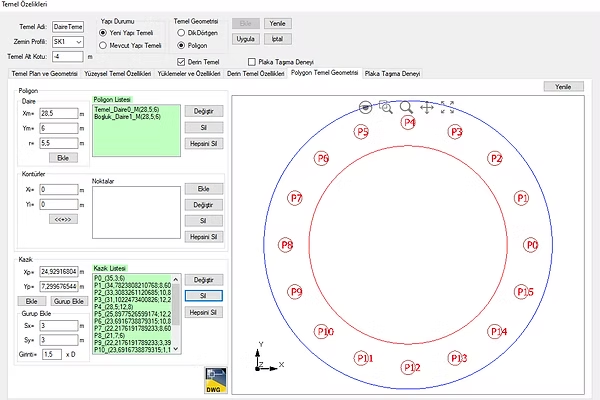
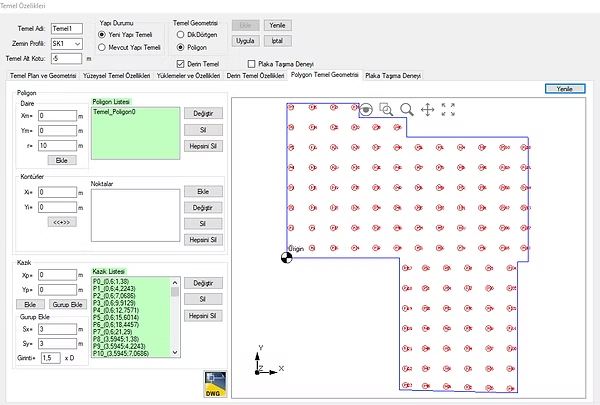
Geometric Flexibility Feature to define internal voids in circular, rectangular, and polygonal foundations.
⚙️
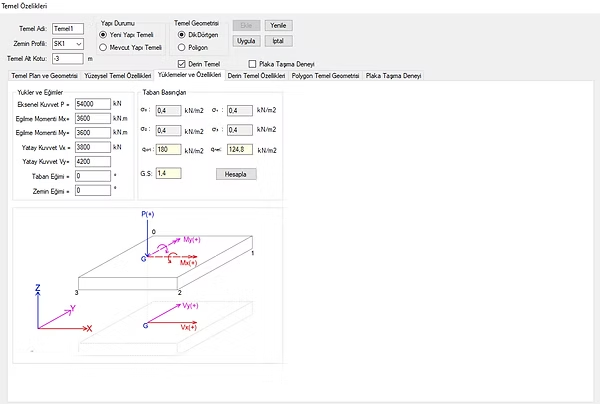
Eccentricity and Inclination High-precision calculations considering base inclination, ground slope, and eccentric loading.
Deep Foundation & Piling Systems

2. Advanced Deep Foundations and Piled Raft Design

Develop secure deep foundation projects for weak soils or areas with liquefaction risk.

Ensure foundation stability with the industry’s most widely recognized and high-precision methods.

αβλ Pile Bearing Capacity Calculation

Independently analyze end bearing and skin friction using Alpha, Beta, and Lambda methods.

Sx,y Piled Raft Interaction

Advanced algorithm support that automatically calculates pile spacing and group efficiency.

📊 Excel Integration

Instantly export all pile data in Excel format for your reporting processes.
SETAF2018 Piled Raft Design
GROUP EFFICIENCY AUTOMATION
SETAF2018 Settlement Analysis
BOUSSINESQ & MINDLIN-GEDDES
DEFORMATION ANALYSIS

3. Precise Settlement Analysis and Stress Distribution

Calculate immediate and time-dependent deformations that threaten structural safety with maximum precision, using subsurface stress increments.

📉
Consolidation Settlement Determine unit strain at every point by dividing soil layers into numerous sub-layers.
🕒
Time-Settlement Graphs Report consolidation velocity and time-dependent deformation curves with professional graphics.
ALL IN ONE

4. Integrated Ground Improvement Solutions

When ground improvement is needed under the foundation, generate solutions within the same model without requiring additional software, and instantly observe the performance increase.
🏗️
Rigid Column Applications Fully integrate Deep Mixing (DSM), Jet Grouting, and Stone Column methods with the foundation model.
📊
Combined Reporting Analyze the performance of improved and unimproved ground comparatively with technical data.
SETAF2018 Ground Improvement Analysis
PERFORMANCE INCREASE Analysis in Seconds
Geotechnical Precision Engine

Why Modern Foundation Engineering Demands Advanced Settlement Analysis Software

Calculating ultimate bearing capacity (qult) is only half the equation in foundation design. Structural safety depends equally on controlling immediate (elastic) and long-term consolidation settlements. Traditional workflows force engineers to export soil profiles and stress distributions to external spreadsheets or secondary tools—introducing manual data transfer errors.

As a comprehensive settlement analysis software, SETAF2018 calculates stress increments beneath shallow footings, raft foundations, and deep column groups automatically. It seamlessly links your site’s borehole stratification directly to non-linear stress-strain and consolidation settlement algorithms:

📊

Immediate (Elastic) Settlement (Se)

Calculates 3D elastic deformations using Boussinesq stress distribution for shallow foundations and Mindlin-Geddes theory for deep rigid inclusions, applying undrained (Eu, νu) or drained (E', ν') soil stiffness parameters.

📈

1D Consolidation Settlement (Sc)

Integrates Terzaghi’s one-dimensional consolidation theory based on laboratory e-logσ' curves. Automatically detects overconsolidation ratio (OCR), preconsolidation pressure (σ'c), and compression/recompression indices (Cc, Cr) across multiple sub-layers.

Time-Rate of Settlement & Terzaghi Corrections

Plots settlement-time curves incorporating construction period corrections (tc), helping engineers predict post-construction settlements accurately over project lifespans.

🧩

3D Settlement Profiles & Modulus of Subgrade Reaction (kv)

Derives vertical subgrade reaction moduli directly from elastic settlement profiles across rectangular, polygonal, or circular foundation geometries, serving as precise spring inputs for structural finite element software.

Advanced Settlement & Ground Improvement Capabilities

3D Stratified Settlement Modeling

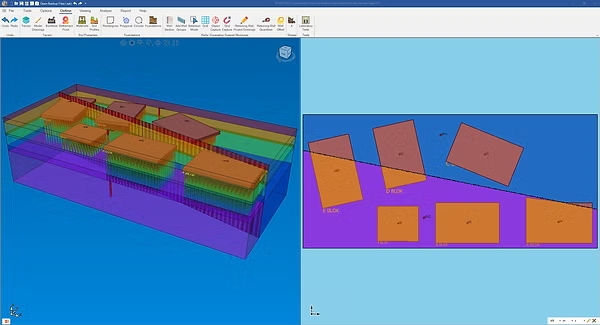
Simulate precise immediate elastic settlements and long-term primary consolidation settlements across 2 to 18 distinct, highly non-linear soil layers. Execute multi-point Boussinesq stress distribution profiles effortlessly to chart exact pressure bulb propagation under any footing geometry.

Integrated Ground Improvement Modules

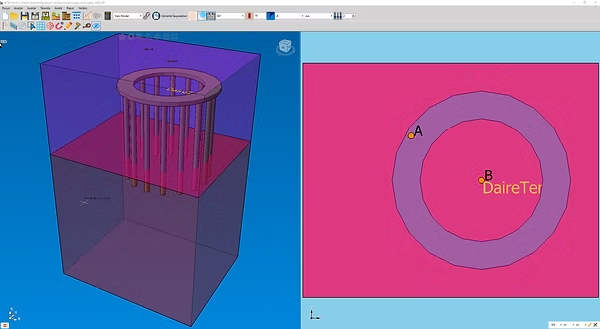
Design, position, and evaluate Jet Grouting grids or Deep Soil Mixing (DSM) columns directly inside your 3D foundation view. Instantly simulate post-improvement settlement reduction, stiffness matrix adjustments, and bearing capacity spikes without switching software.

Transparent Full-Equation Reports

Move past legacy platforms that act as unverified "black boxes". Generate comprehensive, high-analytical technical reports showcasing every single step, formula, and intermediate equation used in your iterations to guarantee effortless municipal, peer-review, and controller approval.

Verified Accuracy: 98% Correlation with Heavy Finite Element Software

Why spend hours setting up tedious mesh generation, boundary conditions, and handling complex convergence errors in heavy FEA software for standard daily projects?

In rigorous head-to-head field tests—including a complex B+GF+10 story structural layout sitting on liquefiable alluvial soil with 243 Jet Grout columns—SETAF2018 matched PLAXIS 2D settlement calculations with an outstanding 98% correlation rate ($6.27\text{ cm}$ total settlement). Get the exact same structural reliability and structural safety parameters in just a fraction of the time.

Benchmarking Daily Geotechnical Workflow

Evaluation Metric SETAF2018 SoilStructure GEO5 Modules PLAXIS / MIDAS
Daily Project Optimization (%90 of tasks) ✓ (Swift & Intuitive) ✓ (Basic Tasks Only) ✓ (Highly Fragmented) ! (Overly Cumbersome)
Integrated Improvement + Settlement ✓ (Built-in Hub) ✗ (None) ✗ (Requires Separate Apps) ✓ (Highly Complex Setup)
Full-Equation, Transparent Reports ✓ (All Equations) ✗ (Hidden Data) ✗ (Standard Tables Only) ✗ (Black Box Interface)
Application-Driven 3D Visualization ✓ (Included Natively) ✗ (2D Graphs Only) ✗ (Static / Flat View) ✓ (Heavy Embedded CAD)

Lejant: : Available | : Not Available | ! : Capable but highly complex/time-consuming

Technical Advantages for Engineers

SETAF2018 offers scientific accuracy and ease of use in the most complex projects.

Feature SETAF2018 Solution Regulation / Literature Compliance
Bearing Capacity Terzaghi, Meyerhof, Vesic Methods TBDY 2018 / Eurocode 7
Stress Calculation Boussinesq and Mindlin-Geddes Approaches International Literature
Data Management Detailed Tables and Excel Integration Transparent Calculation Report
Foundation Geometry Polygonal and Voided Foundations Flexible Architectural Adaptation

Experience the Power of SETAF in Your Projects

Download your free trial and start completing your analyses in seconds.

Frequently Asked
Questions (FAQ)

We have answered the most frequently asked questions about SETAF2018 for you.

What is mat foundation software used for in geotechnical engineering?

+
Mat foundation software is used to analyze and design large foundation systems that distribute structural loads over wide surface areas. Engineers rely on these platforms to evaluate bearing capacity, settlement behavior, stress distribution, and soil-structure interaction under complex loading conditions. Modern mat foundation software also helps automate calculations for eccentric loading, layered soil profiles, and irregular raft geometries. SETAF2018 combines bearing capacity analysis, settlement calculations, and reinforced foundation workflows within a single geotechnical engineering platform.

How does SETAF2018 improve bearing capacity analysis workflows?

+
SETAF2018 allows engineers to compare multiple bearing capacity methods such as Terzaghi, Meyerhof, and Vesic inside the same analysis environment. Instead of manually switching between spreadsheets or isolated modules, users can evaluate shallow, deep, and improved foundations within a unified workflow. The platform also supports complex foundation geometries, eccentric loading conditions, and inclined base calculations with transparent engineering outputs. This structure significantly accelerates geotechnical production workflows while maintaining compliance with Eurocode 7 and international engineering literature.

Why is settlement analysis important in foundation design?

+
Settlement analysis is critical because excessive or differential settlement can threaten the long-term performance and safety of structures. Modern geotechnical projects require engineers to evaluate both immediate deformation and time-dependent consolidation settlement before construction begins. SETAF2018 performs high-precision settlement analysis using Boussinesq and Mindlin-Geddes stress distribution approaches while allowing layered soil profiles to be modeled directly. The software also generates graphical time-settlement curves to help engineers predict long-term structural behavior more accurately.

What makes SETAF2018 different from traditional foundation design software?

+
Many traditional foundation design tools focus only on isolated calculations or simplified Winkler spring assumptions. SETAF2018 goes beyond conventional workflows by integrating bearing capacity analysis, settlement analysis, soil improvement systems, and soil-structure interaction modeling inside a single-file engineering environment. The platform also emphasizes transparent reporting instead of black-box numerical outputs, allowing engineers to review formulas, calculation steps, and engineering assumptions directly inside the reports. This integrated workflow reduces manual data transfer and simplifies municipality approval processes.

Can SETAF2018 analyze piled raft and deep foundation systems?

+
Yes. SETAF2018 includes advanced piled raft and deep foundation analysis capabilities for weak subsoils, liquefaction-prone regions, and heavily loaded structures. Engineers can independently evaluate end bearing and skin friction using Alpha, Beta, and Lambda methods while also analyzing pile-group efficiency and spacing interactions automatically. The platform supports direct integration of borehole stratigraphy, SPT profiles, and Menard Pressuremeter (MPM) data into the foundation model. This allows geotechnical and structural engineers to perform comprehensive deep foundation analysis within a single engineering workflow.

How does SETAF2018 function as a complete settlement analysis software?

+
SETAF2018 integrates stress distribution theories (Boussinesq and Mindlin-Geddes) with elasticity and Terzaghi 1D consolidation theories into a single calculation engine. Once you define your borehole log and structural foundation loads, the software automatically discretizes soil layers into sub-layers, calculates vertical stress increments at depth, and predicts both immediate elastic deformations (Se) and long-term consolidation settlements (Sc) across user-defined calculation points—all without exporting data to separate spreadsheets or external tools.

Can SETAF2018 calculate the modulus of subgrade reaction (kv) from settlement analysis?

+
Yes. Instead of relying on crude empirical rules of thumb, SETAF2018 derives the vertical subgrade reaction modulus (kv = q / ΔH) directly from calculated 3D elastic settlements across the foundation plate. It generates settlement profiles along the geometric center and axes of raft or strip footings, allowing structural engineers to input realistic, non-uniform subgrade springs into structural analysis programs (such as ETABS or SAP2000).

How are immediate (elastic) and consolidation settlements combined in SETAF2018?

+
SETAF2018 evaluates both short-term and long-term deformation behavior based on the drainage conditions assigned to each soil layer. For undrained layers, immediate elastic settlements (Se) are computed using undrained parameters (Eu, νu = 0.50). For cohesive layers, consolidation settlements (Sc) are calculated using laboratory e-logσ' parameters (Cc, Cr, σ'c). The total settlement (ΣS = Se + Sc) is determined by summing the compressions of all sub-layers beneath the foundation.

Does SETAF2018 account for the construction period in settlement-time calculations?

+
Yes. SETAF2018 applies Terzaghi’s time-rate consolidation theory while incorporating construction period corrections (tc). Since structural loads are applied gradually during construction rather than instantaneously, the software adjusts the theoretical time-settlement curves to reflect realistic post-construction settlement development over the life of the structure.

Can settlement analysis be performed for foundations supported by rigid columns or piles?

+
Yes. SETAF2018 calculates settlements for deep foundations and ground improvement systems (such as Jet Grouting, Deep Soil Mixing, and concrete piles) using two distinct approaches. Stresses transferred below the pile zone can be analyzed using Mindlin-Geddes equations, or the improved zone can be modeled using composite deformation moduli (Ecom, νcom) to compute total settlements accurately under applied structural loads.
THE NEW STANDARD IN GEOTECHNICS

Tired of Bloated Software Billing You for Every Single Module Separately?

Unlike traditional geotechnical software packages, you don't have to purchase separate licenses for every calculation type.

All-in-One Architecture: From lab data to drawings in one platform.
Cost Efficiency: Localized price advantages against sky-high rates.
Zero Hidden Fees: 24/7 expert support included in the package.

YENİ NESİL GEOTEKNİK STANDARDI

Modüllere Ayrı Ücret Ödemekten, Döviz Bazlı Hantal Yazılımlardan Sıkılmadınız mı?

Yabancı geoteknik yazılımlar gibi her analiz türü, her hesap ve her rapor için ayrı ayrı modül satın almak zorunda değilsiniz.

Kompakt Mimari: Laboratuvardan çizime tüm süreç tek platformda.
Maliyet Avantajı: Yerel lisanslama.
Sıfır Ek Ücret: 7/24 destek dahil.
WHATSAPP Global Support Team