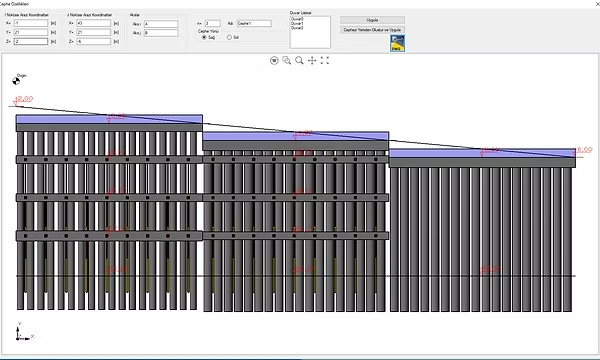
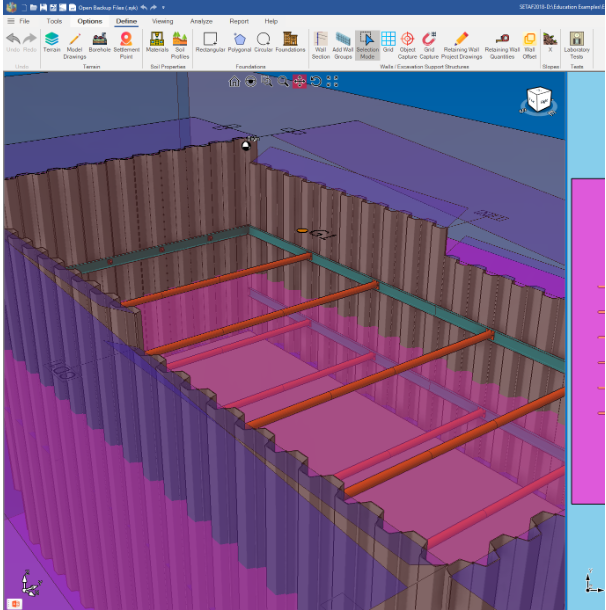
Shoring Design Software For Deep Excavation & Trenching
Design deep excavations, anchored bored piles, and sheet pile walls in seconds. Simulate complex multi-stage excavation scenarios with precise horizontal displacement, wall stability, and bending moment calculations—fully compliant with EN 1997 (Eurocode 7) and international excavation support regulations.
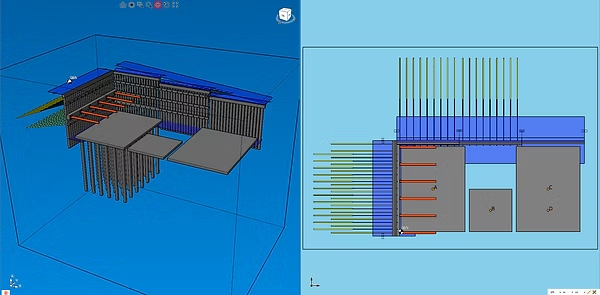
What Is Shoring Design Software?
Shoring design software is used to analyze and design temporary or permanent earth-retaining systems for trenches, deep excavations, basements, and other below-ground construction. Rather than evaluating the retaining wall alone, dedicated software must account for the interaction between soil conditions, groundwater, excavation geometry, surcharge loads, construction stages, and the structural elements supporting the excavation.
Depending on the project, a shoring system may include bored pile walls, diaphragm walls, sheet piles, prestressed anchors, soil nails, or internal struts. As excavation depth and site constraints increase, engineers also need to evaluate wall displacement, bending moments, earth pressures, anchor or strut forces, and overall and internal stability throughout the construction sequence.
SETAF2018 Workflow
SETAF2018 approaches this as a complete engineering workflow rather than a single shoring calculation. Engineers can define soil conditions and groundwater levels, model multi-stage excavation sequences and support systems, analyze soil–structure interaction, and perform the required stability and structural checks within the same project environment.
The workflow then continues beyond analysis. As an all-in-one shoring design software, SETAF2018 connects excavation analysis with structural design, engineering drawings, quantity takeoffs, and calculation reports, reducing the need to rebuild the same project across separate analysis, CAD, spreadsheet, and reporting tools.
Trenching and Shoring Software: When Is Dedicated Analysis Required?
Not every trench or excavation requires the same level of engineering analysis. The need for dedicated trenching and shoring software becomes more significant as excavation depth increases and the interaction between the ground, retaining system, groundwater, surcharge loads, nearby structures, and construction sequence becomes more complex.
The key question is not simply whether an excavation is called a trench or a deep excavation. It is how the excavation behaves as an engineered soil–structure system and what must be verified to construct it safely.
| Excavation Scenario | Typical Engineering Considerations | Software Requirement |
|---|---|---|
| Simple Excavation | Basic geometry, shallow depth, limited external constraints | Basic checks may be sufficient depending on site conditions and applicable regulations |
| Engineered Excavation | Soil profile, groundwater, surcharge loads, retaining requirements | Dedicated analysis becomes increasingly important |
| Deep or Constrained Excavation | Staged construction, retaining walls, anchors or struts, adjacent structures, seismic effects, displacement and stability | Dedicated shoring analysis and design software becomes a core part of the engineering workflow |
The distinction becomes especially important in deep or constrained excavations. The retaining system cannot always be evaluated as though the final excavation geometry appeared in a single step. Excavation changes the stress state progressively, while anchors, struts, berms, and other support elements may be introduced at different construction stages.
SETAF2018 Multi-Stage Workflow
SETAF2018 addresses these projects through a multi-stage excavation workflow. Engineers can define changing groundwater levels, surcharge loads, and excavation geometry by construction stage while evaluating the behavior of systems such as bored pile walls, diaphragm walls, sheet piles, anchors, soil nails, and steel pipe struts.
This makes the software relevant beyond a single “trench calculation.” For projects where excavation sequence, ground behavior, retaining elements, and structural response influence one another, SETAF2018 provides an integrated shoring design and analysis environment for taking the system from staged analysis through engineering checks, design, drawings, quantities, and reporting.
Achieving a balance between safety and economy in deep excavation projects requires expertise. SETAF2018 is a professional software that solves all shoring systems using a stage construction approach, with an analysis engine that realistically reflects soil-structure interaction.
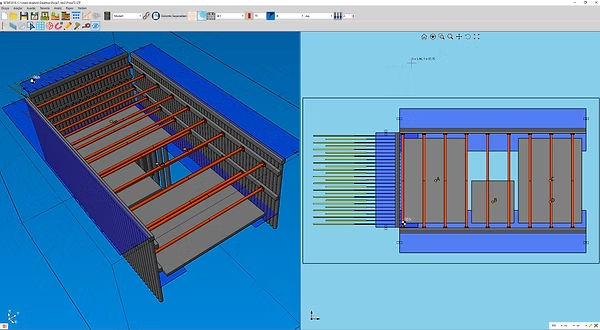
1. Piled Shoring and Diaphragm Wall Analysis
Save time by modeling reinforced concrete retaining wall systems or piled structures with advanced 3D "Wall Group" macros.
2. Professional Anchored Shoring and Prestressed Systems
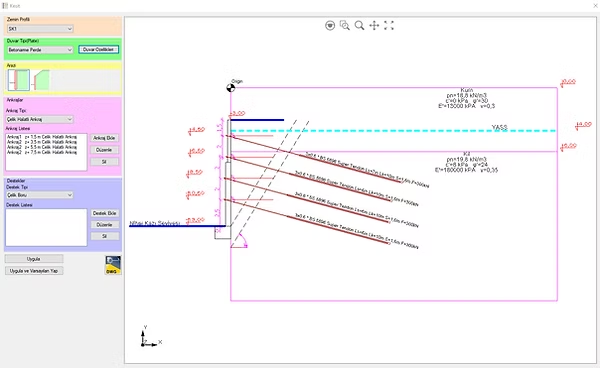
SETAF2018 performs a detailed ground anchor calculation for steel cable systems using empirical data and effective stress analyses.
Diligently control grout-soil interface pullout resistance, tendon rupture risks, and internal stability checks.
Ensure safety by performing block analyses for each excavation stage, in accordance with the Deep Excavation Regulation.
Professionally report your calculations by fully integrating them with Rankine or Coulomb earth pressure theories.
3. Soil Nail and Shotcrete Solutions
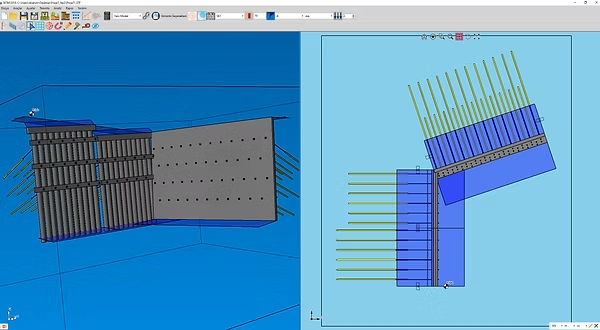
Utilize the optimized special module for reinforced concrete soil nail systems in ground improvement and shoring projects.
4. 3D Modeling, Quantity Surveying, and Automation
Create not only the calculations but also all architectural and structural details of your shoring system in a 3D environment. Fully automate the process from design to quantity surveying.
5. Advanced Deep Excavation and Marine Structure Design
Meet the Sheet Pile Wall Module, offering high rigidity for deep excavations, port/marine structures, and temporary or permanent shoring solutions. SETAF2018 handles the entire process from profile selection to 3D modeling with an integrated engineering framework.
Excavation & Shoring Design Software Capabilities
Multi-Stage Excavation Simulation
Simulate every step of your deep excavation sequence in seconds. Dynamically define variable groundwater levels (GWL), external surcharge loads, and geometric berms for each specific construction stage to monitor structural behavior over time.
Comprehensive Support & Wall Library
Model bored pile walls, diaphragm walls, sheet pile layouts (including built-in Larssen catalogs), prestressed steel strand anchors, passive soil nails, and horizontal steel pipe struts within a single-file, highly intuitive user interface.
Advanced Numerical Solvers
Analyze soil-structure interaction accurately using the Dependent Pressures Method. Incorporate industry-standard Schmitt or Chadeisson empirical methods to automatically calculate depth-dependent horizontal subgrade reaction moduli.
Rigorous Structural ULS / SLS Checks
Execute mandatory limit state verifications natively: anchor grout-to-soil pullout failure (ULS), tendon tensile failure, tendon-to-grout bond slip, base heave safety controls, and real-time wall displacement SLS checks.
Benchmark: SETAF2018 vs. Heavy Enterprise Alternatives
| Shoring Evaluation Metric | SETAF2018 | GEO5 Sheeting Check | PLAXIS 2D / 3D |
|---|---|---|---|
| Multi-Stage Excavation Analysis | ✓ (Saves Hours) | ✓ (Standard Model) | ! (Slow Mesh Generation) |
| All-in-One Shoring + CAD Output | ✓ (.dwg Generated) | ✗ (Requires Separate CAD) | ✗ (Raw Graphical Tables) |
| Transparent Formula Reports | ✓ (Full Equations) | ✗ (Standard Tables Only) | ✗ (Black Box Output) |
| 1-Year Full Access License | $$500 (Flat-Rate) | ✗ (Expensive Module Fees) | ✗ (High Enterprise Cost) |
Why spend days dealing with tedious mesh optimization, convergence errors, and complex model setups in heavy Finite Element Analysis (FEA) software for your standard deep excavation projects?
In rigorous cross-software benchmarking conducted for anchored shoring systems in stiff Istanbul clays (Esenyurt & Nuri Öztürk Projects Data), SETAF2018’s maximum bending moments, lateral anchor forces, and horizontal wall displacements perfectly aligned neck-and-neck with PLAXIS 2D results—delivering elite structural reliability in a fraction of the time.
Technical Comparison and Advantages
Ensure 100% compliance with regulations and full automation in your deep excavation projects.
| Analysis Scope | SETAF2018 Capability | Standard / Literature Compliance |
|---|---|---|
| Shoring Types | Anchored, Piled, Soil-Nailed, Diaphragm | Excavation Support Structures Reg. |
| Strategic Methods | Schmitt, Chadeisson, Mononobe-Okabe | International Literature |
| Stabilities | Overall Stability, Internal Stability (Block), Base Heave | TBDY 2018 / Eurocode 7 |
| Structural Outputs | Automatic Reinforcement Design and Quantity Schedule | TS500 |
Digitize Your Shoring Projects with SETAF
Complete complex calculations in seconds, eliminate the burden of quantity surveying and reporting.
Frequently Asked
Questions (FAQ)
Find technical answers to the most common questions about SETAF2018.