SETAF2018: Advanced Slope Stability Software
Rapidly identify critical failure surfaces in complex terrain geometries with integrated 2D limit equilibrium analysis, reinforcement systems, and transparent geotechnical reporting.
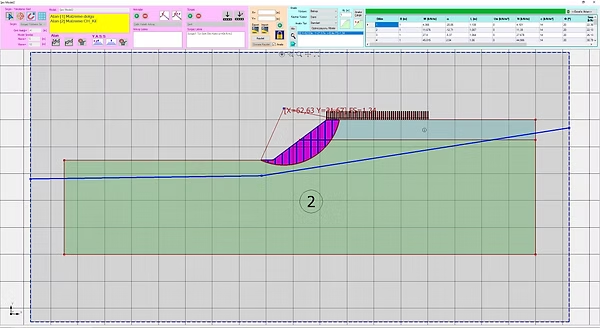
Natural and engineered slopes require precise modeling, rapid iterations, and reliable slope stability software to ensure long-term safety. SETAF2018 automatically optimizes the critical slip surface with the lowest Factor of Safety (FS) under both static and pseudo-static seismic conditions using advanced limit equilibrium methods.
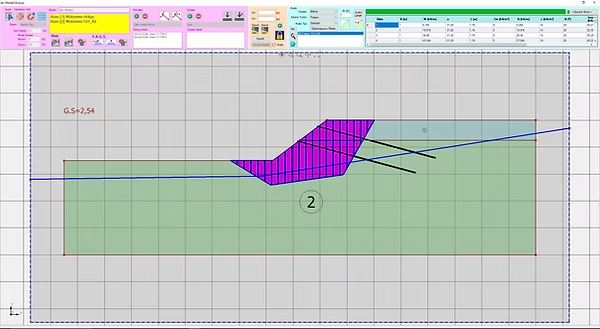
1. Flexible Slope Modeling and Parametric Data Entry
Have full control while defining terrain shape and soil layers. Put an end to manual trial-and-error processes.
2. Limit Equilibrium Methods: Bishop and Fellenius
Calculate safety factors (FS) accurately using the most reliable and accepted slice methods in geotechnical literature.
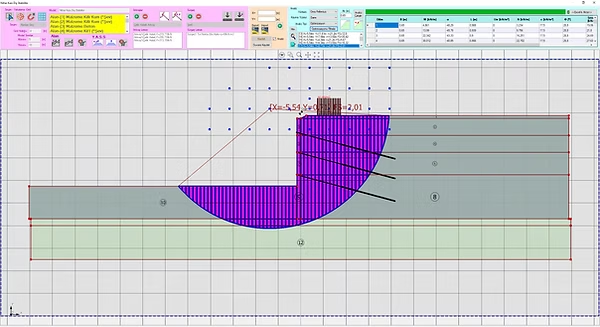
3. Reinforcement Elements: Anchor and Soil Nail
Mathematically demonstrate the contribution of structural elements used to strengthen an existing structure to stability, and include it in your report.
4. Transparent Reporting and Traceable Iterations
Each stability analysis conducted is ready to be presented to the regulatory authorities and is turned into professional technical reports. The calculation process is no longer a "black box".
Streamline Geotechnical Workflows with a Proven Slope Stability Program
Modern geotechnical projects demand more than isolated calculations. Engineers must manage soil profiles, groundwater conditions, loading scenarios, reinforcement systems, and reporting requirements while maintaining confidence in every design decision. SETAF2018 brings these workflows together in a single slope stability software platform, helping engineering teams reduce manual effort and focus on evaluating real project risks.
From initial terrain modeling to final documentation, the software for slope stability analysis supports the complete engineering process. Users can define layered soil conditions, groundwater levels, surcharge loads, and complex geometries before automatically searching for the critical failure surface with the lowest Factor of Safety (FS). This integrated approach helps engineers perform reliable slope stability analysis while significantly reducing repetitive modeling tasks.
Unlike many slope stability programs that provide only numerical outputs, SETAF2018 emphasizes transparency throughout the calculation process. Bishop and Fellenius limit equilibrium methods, reinforcement contributions, iteration results, and safety factor calculations can all be documented in clear technical reports suitable for project reviews and regulatory submissions.
Whether evaluating natural slopes, excavation support systems, reinforced embankments, or engineered earth structures, SETAF2018 provides the modeling flexibility, optimization capabilities, and reporting tools required by modern geotechnical professionals looking for dependable slope analysis software.
Why SETAF2018 Over Legacy Slope Stability Software?
Selecting the right slope stability software is not only about obtaining a Factor of Safety value. Modern geotechnical projects require transparent calculations, rapid optimization, reinforcement modeling, and reporting structures that can withstand technical review. While many traditional solutions rely on manual iterations or proprietary calculation workflows, SETAF2018 is designed to provide engineers with greater visibility into every stage of the analysis process.
| Feature | Legacy "Black-Box" Systems | SETAF2018 |
|---|---|---|
| Calculation Transparency | Limited visibility into assumptions and iterations | Fully traceable calculations and technical reports |
| Slip Surface Search | Manual trial-and-error workflows | Automatic critical slip surface optimization |
| Slope Stability Analysis | Often limited to basic workflows | Advanced slope stability analysis with Bishop and Fellenius methods |
| Seismic Analysis | Static analysis only in many cases | Static and pseudo-static seismic analysis |
| Reinforcement Modeling | Separate tools or complex workflows | Integrated anchor and soil nail analysis |
| Reporting | Non-standard or limited outputs | Professional PDF reports suitable for review and approval |
| Design Optimization | Time-consuming manual comparisons | Rapid evaluation of multiple stabilization alternatives |
| Engineering Productivity | Repetitive data entry and iterations | Streamlined geotechnical workflow management |
For organizations searching for a reliable slope stability program, the ability to combine modeling, optimization, reinforcement evaluation, and transparent reporting within a single platform can significantly reduce engineering effort while improving confidence in design decisions.
Typical Slope Stability Analysis Workflow with SETAF2018
SETAF2018 is designed to streamline the complete geotechnical analysis process, from initial site characterization to final technical reporting. Rather than switching between spreadsheets, separate calculation tools, and manual documentation workflows, engineers can perform the entire slope stability analysis within a unified environment.
Step 1: Define Site and Soil Conditions
Input terrain geometry, soil layers, groundwater levels, surcharge loads, and geotechnical parameters. Complex slope geometries and layered ground conditions can be modeled efficiently.
Step 2: Build the Engineering Model
Create the slope profile and define project-specific conditions, including static or pseudo-static seismic loading scenarios.
Step 3: Run Automatic Critical Surface Search
The software automatically evaluates thousands of potential failure mechanisms to identify the critical slip surface associated with the lowest Factor of Safety (FS).
Step 4: Evaluate Stabilization Alternatives
Analyze anchors, soil nails, surcharge modifications, and other reinforcement solutions to compare their impact on overall slope performance.
Step 5: Optimize the Design
Review safety factors, failure mechanisms, and reinforcement effectiveness to determine the most efficient and economical design solution.
Step 6: Generate Traceable Technical Reports
Export professional documentation containing analysis assumptions, calculation procedures, iteration results, safety factors, and graphical outputs suitable for internal review, clients, and regulatory authorities.
This workflow enables engineers to move from raw geotechnical data to auditable design documentation using a single stability analysis software platform.
Technical Advantages for Engineers
Discover scientific accuracy and reporting speed in complex structure and slope analyses.
Manage Slope Stability with SETAF
Identify the most critical sliding surfaces in seconds and instantly generate your verifiable reports.
Frequently Asked
Questions (FAQ) About Slope Stability
We have answered the most frequently asked questions about SETAF2018 for you.