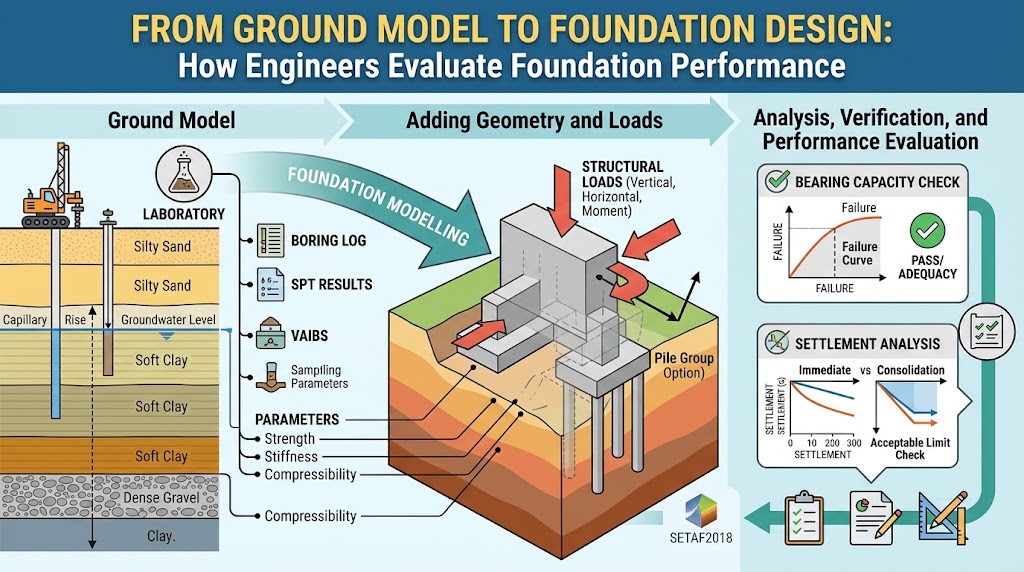
A foundation model cannot be defined by footing or pile geometry alone. The behaviour of a foundation depends on the ground supporting it, the loads transferred from the structure, groundwater conditions, and the way stresses and deformations develop within the soil. A foundation that provides adequate resistance against failure may still be unsuitable if the resulting settlement exceeds acceptable limits.
The information needed to evaluate this behaviour usually comes from two different sides of the project. Site investigation provides borehole data, soil stratigraphy, groundwater observations, field and laboratory test results, and interpreted engineering parameters. Structural design provides foundation locations, dimensions, vertical and horizontal loads, moments, and other relevant loading conditions. Foundation modelling brings these inputs together so that they can be evaluated as a single engineering system.
The basic relationship can be expressed as:
Ground Conditions + Foundation Geometry + Structural Loads → Foundation Performance
From there, the engineer must determine whether the selected foundation has sufficient bearing resistance, how much immediate or consolidation settlement may develop, and whether the design remains adequate under the applicable loading and groundwater conditions. For deep foundations, the model must additionally represent how loads are transferred through shaft and tip resistance and how individual piles interact within the foundation system.
This makes foundation analysis an interconnected workflow rather than a collection of independent calculations:
Ground Model → Foundation Geometry → Loads → Analysis → Verification → Design Documentation
Integrated geotechnical engineering environments such as SETAF2018 are designed around this relationship. Soil profiles, groundwater conditions, foundation geometry, and loading can remain connected as the project progresses into shallow or deep foundation analysis, bearing-capacity and settlement calculations, design verification, drawings, and engineering reports.
The purpose of the foundation model is therefore not to create the most detailed representation possible, but to represent the soil–foundation–load system with sufficient engineering accuracy to support a defensible design decision.
What Is a Foundation Model in Geotechnical Engineering?
In geotechnical engineering, a foundation model is an engineering representation of the foundation and the ground supporting it. Its purpose is to combine the conditions below the structure with the geometry and loading of the foundation so that engineers can evaluate how the complete system is expected to perform.
Depending on the project, the model may include:
- soil stratigraphy and layer boundaries
- groundwater conditions
- strength, stiffness, and compressibility parameters
- foundation geometry and embedment depth
- vertical and horizontal loads and moments
- assumptions specific to the selected analysis method
A foundation model is therefore more than a CAD representation or 3D visualization of a footing. A structural foundation element without information about the supporting soil cannot describe ground response, just as a soil profile without foundation geometry and loading cannot determine foundation performance.
The engineering value of the model comes from representing the interaction between the applied loads, foundation geometry, and supporting ground. This interaction determines the stresses transferred into the soil and provides the basis for evaluating capacity and deformation.
The required level of detail also depends on the engineering question. A bearing-capacity assessment primarily requires parameters describing soil strength and resistance, whereas settlement analysis depends more strongly on stiffness, compressibility, stress distribution, and drainage conditions. Both analyses may use the same physical soil profile, but they do not necessarily use the same engineering parameters or assumptions.
A useful foundation model therefore contains the information necessary to represent the governing behaviour—not simply the greatest amount of available data.
Foundation Modelling Starts With the Ground Model
Before foundation geometry or structural loads can be evaluated, the supporting ground must be represented in a form suitable for engineering analysis. This begins with the site investigation, where boreholes, soil descriptions, sampling, field tests, laboratory results, and groundwater observations provide discrete information about subsurface conditions.
Data from multiple boreholes is interpreted to establish soil stratigraphy and the elevations of individual layers across the project area. In-situ tests such as the Standard Penetration Test (SPT) and Menard Pressuremeter Test (MPM) can provide additional information with depth, while laboratory testing helps characterize the strength, deformation, and compressibility of the soils encountered. Together, these inputs form the ground model on which the foundation analysis is built.
Defining Engineering Soil Parameters
Each interpreted layer must be assigned parameters appropriate to the analysis being performed. These may include unit weight, cohesion, friction angle, undrained shear strength, deformation modulus, Poisson’s ratio, and consolidation or compression parameters.
Importantly, soil parameters should be selected according to the behaviour being analysed rather than treated as universal properties for every calculation. Bearing-capacity analysis is primarily concerned with soil strength and resistance, whereas settlement calculations require an appropriate representation of stiffness, compressibility, and stress changes within the ground. The same soil layer may therefore require different engineering parameters depending on the question being evaluated.
Groundwater Conditions
Groundwater is also an integral part of the foundation model. Its position influences porewater pressure and effective stress, while soils below the groundwater table must be represented using appropriate saturated and submerged unit weights.
These changes can affect bearing-capacity calculations, stress distribution, and settlement behaviour. For deep foundations, groundwater conditions may also influence the effective stresses relevant to shaft and tip resistance calculations. Accurately representing groundwater conditions and soil unit weight is therefore necessary before the ground model can provide a reliable basis for foundation design.
Adding Foundation Geometry and Structural Loads
Once the ground model has been established, the foundation itself must be introduced to define the engineering system being analysed. For shallow foundations, this typically includes foundation width, length, embedment depth, foundation elevation, and thickness where it is relevant to the analysis or subsequent structural design.
Structural actions must then be applied to this geometry. Depending on the project and design situation, these may include axial or vertical loads, horizontal loads, and moments, considered under the relevant load combinations. The relationship between these actions and the foundation dimensions determines how loads are transferred to the supporting ground.
Foundation geometry directly influences this response. Increasing the width or length can reduce average contact pressure while also changing the depth and distribution of stress increases within the soil. Foundation dimensions and embedment can affect bearing resistance and settlement, while moments can introduce eccentricity, producing non-uniform base pressures and potentially reducing the effective dimensions available for bearing-capacity calculations.
The significance of these relationships becomes clear when different foundation systems are placed on the same soil profile. A small isolated footing, a continuous or strip foundation, a raft, and a pile-supported foundation can produce very different stress distributions, deformation patterns, and governing design checks despite being supported by the same underlying ground.
Foundation performance is therefore a property of the soil-foundation-load system, not of the soil or foundation considered independently. A useful foundation model must preserve this relationship so that changes in geometry or loading are reflected consistently in the subsequent bearing-capacity, settlement, and design-verification calculations.
Bearing Capacity Is the First Question, Not the Only One
One of the first questions in foundation design is whether the supporting ground can safely resist the applied loading. In simple terms, the engineer compares the pressure imposed by the foundation with the resistance available from the ground under the relevant design conditions.
Bearing capacity depends on the interaction of several factors. Soil strength parameters such as cohesion and friction angle influence the available resistance, while unit weight, foundation width, and embedment depth affect the failure mechanism that can develop beneath the foundation. Groundwater can modify effective stresses and unit weights, while inclined or eccentric loading may change the effective foundation dimensions and the pressure distribution at the base.
Established approaches such as Terzaghi, Meyerhof, and Vesić provide frameworks for evaluating bearing capacity while accounting for these conditions through different formulations and correction factors. The objective is not simply to calculate a single ultimate value, but to move from the estimated soil resistance toward the resistance used for engineering verification:
Ultimate Bearing Capacity → Characteristic / Design Resistance → Applied Foundation Pressure → Adequacy Check
The selected foundation can then be evaluated by comparing the applicable design resistance with the pressure generated under the relevant loading condition. Changes in foundation dimensions, embedment, groundwater, or load eccentricity may require these bearing capacity calculations to be repeated as the design develops.
However, sufficient bearing resistance establishes only one aspect of foundation performance. A foundation can satisfy bearing-capacity requirements and still experience unacceptable settlement. For this reason, capacity and deformation should be treated as complementary design checks within the same foundation model rather than as alternative measures of whether a foundation is adequate.
Settlement Often Controls Foundation Performance
Bearing capacity establishes whether the ground has sufficient resistance against failure, but foundation performance can be governed by deformation long before that resistance is fully mobilized. Settlement analysis therefore considers how the supporting soil responds as foundation loads generate additional stresses below the base.
Immediate / Elastic Settlement
Immediate settlement develops as the soil deforms under the applied foundation load. Its magnitude depends on factors such as foundation pressure, foundation dimensions, soil deformation properties, and the distribution of stress with depth.
For shallow foundations, stress increases within the ground can be evaluated using established approaches such as Boussinesq stress distribution. The influence of the applied load generally decreases with depth, but the depth and extent of the stressed zone depend on the foundation geometry. This means that changing foundation width or load intensity can alter both the magnitude and distribution of settlement even when the underlying soil profile remains unchanged.
Consolidation Settlement
In compressible soils, particularly saturated fine-grained layers, foundation loading can also produce time-dependent consolidation settlement. An increase in total stress initially generates excess porewater pressure; as this pressure dissipates, effective stress increases and the soil compresses.
The resulting settlement depends on the magnitude of the stress increase, the thickness and compressibility of the affected layers, and the relevant consolidation characteristics. Settlement analysis must therefore consider not only how much deformation may occur but, where appropriate, how that deformation develops with time.
This distinction is fundamental to foundation modelling: capacity asks whether the ground can support the load; settlement asks whether it can support that load with acceptable deformation. A reliable foundation design must satisfy both questions using parameters and analysis methods appropriate to the behaviour being evaluated.
When the Foundation Model Extends Below a Shallow Footing
Foundation modelling is not limited to evaluating stresses immediately beneath a shallow footing. When near-surface soils cannot provide adequate capacity or acceptable settlement performance, the foundation system may extend deeper into the ground through piles or micropiles. The engineering model must then represent how loads are transferred through multiple soil layers rather than only through the foundation base.
Piles and Micropiles
For piles and micropiles, the model considers the element geometry, the soil layers along the shaft, the conditions at the pile tip, and the applied axial load. Load resistance generally develops through two principal mechanisms:
Skin Resistance + Tip Resistance → Axial Pile Capacity
Because a pile can pass through several different strata, each layer may contribute differently to shaft resistance. The soil conditions at the pile tip similarly influence the available end-bearing resistance. The complete capacity therefore depends on the interaction between pile geometry and the stratigraphy along its embedded length.
Pile Groups
Foundations commonly contain multiple piles acting together rather than a single isolated element. Individual pile capacity cannot automatically be multiplied by the number of piles to describe the behaviour of the complete system.
Pile spacing, arrangement, group effects, and settlement behaviour may influence how loads are distributed and how the pile group interacts with the surrounding ground. The foundation model must therefore distinguish between individual-element resistance and overall group performance.
Negative Skin Friction
Pile loading can also increase when surrounding compressible soil settles relative to the pile. This relative downward movement can mobilize negative skin friction, producing an additional drag force along part of the pile shaft.
Negative skin friction is therefore a load effect rather than an additional source of foundation resistance. Where relevant, it should be incorporated into the deep-foundation model when evaluating pile demand, capacity, and overall performance.
Ground Improvement Can Become Part of the Foundation Model
When the natural ground cannot provide the required bearing performance or settlement control, improving the soil may become part of the foundation solution. Techniques such as Deep Soil Mixing (DSM), Jet Grouting, and other rigid-column systems introduce engineered elements into the ground, changing the way loads are transferred beneath the foundation.
At this point, the engineer is no longer evaluating the original soil profile alone. The foundation model must represent a modified system:
Original Ground + Improvement Elements → Composite / Modified Foundation System
The introduced columns can alter the stiffness and load-transfer characteristics of the treated ground, potentially influencing bearing behaviour, settlement, and the distribution of loads between the natural soil and improvement elements. Their geometry, spacing, material properties, and relationship with the surrounding soil therefore become relevant parts of the engineering model.
Different ground-improvement methods should not, however, be treated as mechanically identical. A DSM column, jet-grouted element, and other rigid inclusion may differ in material behaviour, installation method, geometry, and interaction with the surrounding ground. The modelling approach should reflect the particular system being designed.
This is another area where integrated geotechnical modelling becomes useful. When the original soil profile, groundwater conditions, foundation geometry, structural loads, and ground-improvement elements remain within the same project environment, engineers can evaluate how a proposed improvement scheme changes the foundation system without separating the improved-ground analysis from the underlying geotechnical model.
How Do Engineers Decide Whether a Foundation Model Is Adequate?
A completed calculation does not, by itself, demonstrate that a foundation model is adequate. Verification requires engineers to consider whether both the results and the assumptions behind them provide a reasonable representation of the actual foundation system.
Is Bearing Resistance Sufficient?
The available bearing resistance must be compared with the demand generated by the foundation under the applicable design conditions. This check should reflect the defined soil properties, foundation dimensions, embedment, groundwater conditions, and effects such as load eccentricity where relevant. A satisfactory result indicates adequate resistance for the analysed condition, but it does not establish acceptable foundation performance on its own.
Is Settlement Acceptable?
Foundation deformation must be evaluated separately from capacity. Depending on the soil profile, this may include immediate settlement, consolidation settlement, or both. Engineers should consider the predicted magnitude of settlement and, where relevant, its development with time and its implications for the supported structure.
Are the Assumptions Consistent With the Site Data?
The model should remain traceable to the available investigation. Borehole information, interpreted layer boundaries, groundwater observations, and selected engineering parameters should support the conditions represented in the analysis. Additional numerical precision cannot compensate for assumptions that are inconsistent with the site data.
Does the Analysis Method Represent the Foundation System?
The selected calculation method must also correspond to the behaviour being investigated. A shallow foundation bearing-capacity model, for example, cannot represent the load-transfer mechanisms of a pile foundation, while pile-group behaviour should not automatically be inferred from isolated pile capacity.
Verification means checking both the numerical result and the engineering assumptions that produced it. An adequate foundation model is therefore one in which the ground conditions, parameters, geometry, loading, and analysis method collectively provide a defensible basis for the design decision.
Does Foundation Modelling Require Finite Element Analysis?
No. Finite element analysis is one approach to foundation modelling, but it is not required for every foundation design problem. The appropriate analysis method depends on the behaviour being investigated, the complexity of the soil–foundation system, and the level of detail required for the engineering decision.
Classical Analytical Methods
Many routine foundation problems can be evaluated using established analytical or empirical methods. These include bearing-capacity equations, settlement calculations, and pile-capacity methods based on soil properties, foundation geometry, and loading conditions. Such approaches remain useful when their underlying assumptions appropriately represent the foundation system being analysed.
Soil–Structure and Spring-Based Approaches
In structural foundation models, soil response can also be represented through subgrade reaction parameters or equivalent springs where appropriate. This allows foundation–soil interaction to be incorporated into structural analysis without representing the surrounding soil as a complete continuum. The selected spring parameters and modelling assumptions must still be consistent with the ground conditions and expected behaviour.
Continuum Finite Element Modelling
Continuum FEM becomes particularly valuable when the engineering problem requires a more detailed representation of nonlinear soil behaviour, advanced constitutive models, complex soil–structure interaction, staged construction, or detailed deformation patterns. These models can provide information that simpler approaches are not intended to capture, but they also require appropriate constitutive parameters, boundary conditions, and engineering interpretation.
Model sophistication should be selected according to the engineering question. Using a more computationally complex method does not automatically produce a more reliable foundation design.
This distinction is also relevant to software selection. SETAF2018 supports foundation engineering through established analytical methods and related numerical engineering approaches rather than positioning itself as an advanced nonlinear continuum FEM platform. Its focus is on connecting the ground model with practical foundation analysis, verification, and design workflows.
A Practical Foundation Design Workflow
Foundation design develops through a sequence of connected decisions rather than independent calculations. The ground model establishes the conditions beneath the structure, but foundation geometry and loading determine how those conditions translate into stresses, resistance, and deformation. Results from one stage may therefore require the engineer to revisit decisions made earlier in the process.
A practical workflow can be represented as:
Define Boreholes & Soil Profile
↓
Establish Groundwater Conditions
↓
Select Engineering Parameters
↓
Define Foundation Geometry
↓
Apply Structural Loads
↓
Check Bearing Capacity
↓
Calculate Settlement
↓
Evaluate Design Adequacy
↓
Revise if Required
↓
Prepare Drawings & Engineering Report
Iteration is an important part of this process. Increasing foundation width, for example, may reduce average contact pressure while simultaneously changing bearing resistance, stress distribution with depth, and predicted settlement. A revised groundwater level can alter effective stresses and unit weights, while a different interpretation of the soil profile may affect both capacity and deformation calculations.
The same principle applies when the foundation solution itself changes. If a shallow foundation cannot satisfy the required performance criteria, the engineer may need to evaluate a different geometry, a deep foundation, or a ground-improvement solution using the relevant analysis methods.
Foundation design is therefore an iterative engineering workflow rather than a sequence of unrelated calculations. Keeping the ground model, foundation definition, loads, analyses, and resulting design outputs connected helps ensure that revisions are carried consistently through the project. This creates the basis for an integrated software workflow in which analysis, verification, and documentation can develop from the same underlying engineering model.
How SETAF2018 Connects Ground Modelling and Foundation Design
SETAF2018 approaches foundation analysis by keeping the foundation connected to the geotechnical model from which its design parameters are derived. Instead of treating soil characterization, foundation calculations, and project outputs as separate tasks, the same underlying project information can support the workflow from initial modelling through design verification and documentation.
From Boreholes to Foundation Geometry
Engineers can define multiple boreholes, soil layers, groundwater conditions, SPT and Menard Pressuremeter (MPM) profiles, and user-defined soil properties within the project model. Foundation geometry and loading conditions can then be introduced relative to these ground conditions. Plan and 3D perspective views provide a way to examine the spatial relationship between boreholes, soil profiles, foundations, and other project elements without making visualization the purpose of the model itself.
Shallow Foundation Analysis
For isolated, continuous/strip, and raft foundations, the defined ground and foundation information can be carried into bearing-capacity and settlement calculations. SETAF2018 incorporates established approaches including Terzaghi, Meyerhof, and Vesić, together with SPT-based methods where applicable. Stress increases used in settlement analysis can be evaluated using the Boussinesq approach.
This allows the workflow to extend beyond calculating an isolated bearing-capacity value. Available design resistance can be compared with the applied foundation base pressure to evaluate whether the selected foundation is adequate for the defined condition.
Deep Foundations and Ground Improvement
When the selected foundation solution changes, the same underlying ground information can continue into the relevant analysis workflow. SETAF2018 supports piles and micropiles, pile groups, DSM and Jet Grouting systems, and other rigid-column applications. Deep-foundation calculations can account for skin and tip resistance using approaches such as the α, λ, and β methods, while Mindlin–Geddes can be used in settlement-related stress calculations. Negative skin friction and subgrade reaction parameters can also be evaluated where relevant.
From Analysis to Engineering Deliverables
The workflow continues beyond calculation results. SETAF2018 can produce engineering reports, tables and graphs, foundation drawings, reinforcement details where applicable, quantities, and other project documentation, with DWG and XLSX outputs available for applicable drawings and tables.
The practical advantage is not simply performing more calculations in one program. It is maintaining continuity between the ground model, foundation assumptions, engineering analysis, design verification, and final project documentation.
Common Foundation Modelling Mistakes
Even when established analysis methods are used, a foundation model can produce misleading results if its inputs and assumptions do not represent the actual engineering problem. Several common modelling mistakes are particularly important to recognize.
Using One Parameter Set for Every Analysis
Soil strength, stiffness, and compressibility describe different aspects of soil behaviour. Parameters selected for bearing-capacity calculations should not automatically be reused for settlement or deformation analysis. Each parameter set should be appropriate to the behaviour and drainage condition being evaluated.
Ignoring Groundwater
Groundwater affects porewater pressure, effective stress, and the unit weights used below the groundwater table. An incorrect groundwater assumption can therefore influence bearing resistance, settlement calculations, and deep-foundation behaviour.
Checking Capacity but Not Settlement
Adequate bearing resistance does not guarantee acceptable performance. A foundation may remain safely below its bearing capacity while experiencing settlement that exceeds the allowable limits of the supported structure. Capacity and deformation should therefore be verified separately.
Using a Single Borehole to Represent a Variable Site
A borehole describes conditions at one investigation location. Where stratigraphy varies across the site, relying on a single profile may overlook changes in layer elevations, soil properties, or groundwater conditions beneath different foundations.
Ignoring Load Eccentricity
Moments and eccentric loading can produce non-uniform base pressures and reduce the effective foundation dimensions used in bearing calculations. Evaluating only an average vertical pressure may therefore misrepresent the actual foundation condition.
Treating Individual Pile Capacity as Pile-Group Performance
The capacity of an individual pile cannot necessarily be multiplied by the number of piles to represent the complete foundation. Pile spacing, group effects, load distribution, and settlement behaviour may also govern system performance.
Trusting Software Output Without Reviewing Assumptions
A completed calculation does not validate the model behind it. Foundation analysis software can perform calculations consistently, but the engineer remains responsible for whether the ground model, parameters, loading conditions, and selected methods adequately represent the foundation being designed.
A Foundation Model Should Connect Ground Conditions With Performance
A useful foundation model does more than represent foundation geometry and produce a calculation result. It establishes a consistent relationship between the conditions identified during site investigation, the foundation system selected by the engineer, the loads transferred from the structure, and the response expected from the supporting ground.
The engineering workflow is therefore not simply:
Foundation Geometry → Calculation
It is:
Ground Conditions → Foundation → Loads → Ground Response → Verification → Documentation
The most reliable model is not necessarily the most computationally complex. Its value depends on whether the available site data, engineering parameters, groundwater assumptions, foundation geometry, loading conditions, and selected analysis methods are appropriate for the question being evaluated. Bearing resistance, settlement, pile behaviour, and ground improvement may each require different calculations while remaining connected to the same underlying ground model.
SETAF2018 is structured around this type of engineering workflow, connecting soil and groundwater information with shallow and deep foundation analyses, ground-improvement systems, design verification, and engineering documentation within the same project environment.
Ultimately, foundation modelling is useful when it provides a traceable and defensible path from what is known about the ground to how the proposed foundation is expected to perform.
Frequently Asked Questions About Foundation Modelling
What is a foundation model in geotechnical engineering?
In geotechnical engineering, a foundation model is an engineering representation of the foundation, the ground supporting it, and the loads transferred between them. It combines information such as soil stratigraphy, groundwater conditions, engineering soil parameters, foundation geometry, and structural loading to evaluate foundation performance. In this context, the term should not be confused with “foundation models” used in artificial intelligence. A geotechnical foundation model is specifically concerned with how a foundation interacts with the ground under the relevant design conditions.
What information is needed to model a foundation?
Foundation modelling typically requires borehole data, interpreted soil stratigraphy, groundwater observations, field and laboratory test results, and engineering parameters assigned to the relevant soil layers. The engineer must also define foundation dimensions, embedment depth, foundation elevation, and structural loads such as vertical forces, horizontal forces, and moments where applicable. The exact inputs depend on whether the model is being used for bearing capacity, settlement, pile behaviour, or another foundation analysis. The available investigation data should support the level of detail represented in the model.
What is the difference between bearing capacity and settlement?
Bearing capacity and settlement address two different aspects of foundation performance. Bearing capacity considers whether the supporting ground has sufficient resistance to carry the applied foundation load without a bearing failure. Settlement considers how much the soil deforms under that loading, including immediate and, where relevant, time-dependent consolidation settlement. A foundation can have adequate bearing resistance while still experiencing unacceptable deformation, so both conditions generally need to be evaluated.
How does groundwater affect foundation design?
Groundwater influences porewater pressure, effective stress, and the appropriate soil unit weights used in geotechnical calculations. These changes can affect bearing resistance and the stress conditions used in settlement analysis. For deep foundations, groundwater may also influence the effective stresses relevant to shaft and tip resistance calculations. The groundwater condition used in the foundation model should therefore represent the applicable design situation rather than being treated as an isolated adjustment after the analysis.
How are shallow foundations modelled?
A shallow-foundation model combines the ground profile with foundation geometry, embedment, groundwater conditions, and structural loads. Engineers can then evaluate whether the available bearing resistance is sufficient for the applied base pressure and calculate the resulting settlement. Isolated footings, strip or continuous foundations, and raft foundations can produce different stress distributions even when they are placed on the same soil profile. The modelling approach should therefore reflect both the ground conditions and the geometry of the specific foundation system.
How are pile foundations modelled?
Pile-foundation modelling considers the soil layers along the pile shaft, the conditions at the pile tip, pile geometry, and the applied loads. Axial resistance generally develops through a combination of shaft or skin resistance and tip resistance, with different soil layers potentially contributing differently to the total capacity. For pile groups, engineers may also need to consider pile arrangement, group effects, load distribution, and settlement rather than simply multiplying individual pile capacity by the number of piles. Negative skin friction should also be considered where surrounding soil settlement can generate additional downward drag forces.
Does foundation modelling require finite element analysis?
No. Foundation modelling can use analytical, empirical, spring-based, or finite element approaches, depending on the engineering problem. Established bearing-capacity, settlement, and pile-capacity methods can be appropriate for many routine foundation analyses, while subgrade-reaction or spring models can represent soil response in certain structural applications. Continuum FEM becomes useful when detailed nonlinear soil behaviour, advanced constitutive models, complex soil–structure interaction, or detailed deformation analysis needs to be represented. The appropriate level of modelling complexity should be selected according to the engineering question rather than assuming FEM is necessary for every foundation design.