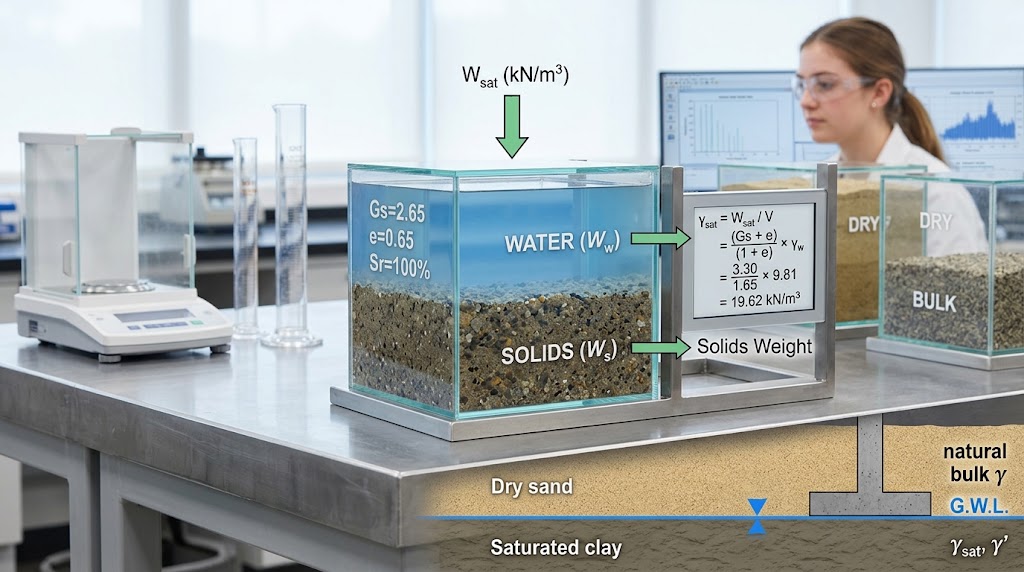
Saturated unit weight of soil (γsat) is the unit weight of a soil when all of its voids are completely filled with water (degree of saturation, Sr = 100%). Expressed in kN/m³, it represents the combined weight of soil solids and pore water per unit volume under fully saturated conditions. Saturated unit weight is a fundamental parameter in geotechnical engineering because it directly affects bearing capacity, settlement, effective stress, earth pressure, and slope stability analyses, particularly for soils below the groundwater table.
The saturated unit weight is calculated using:
γsat = Wsat / V
where Wsat is the total weight of the saturated soil (soil solids + water) and V is the total volume of the soil sample. In engineering practice, γsat is obtained from laboratory testing or calculated from soil phase relationships using parameters such as the specific gravity of soil solids and the void ratio.
What Is the Saturated Unit Weight of Soil?
The saturated unit weight of soil (γsat) is the total weight per unit volume of soil when all void spaces are completely filled with water, corresponding to a degree of saturation of Sr = 100%. In this condition, both the weight of the soil solids and the water contained within the pores contribute to the total weight.
The basic saturated unit weight formula is:
γsat = Wsat / V
where:
- γsat = saturated unit weight of soil, typically expressed in kN/m³
- Wsat = total weight of the saturated soil, including soil solids and pore water
- V = total volume of the soil
Unlike dry unit weight, which considers only the weight of soil solids, saturated unit weight includes the water occupying the entire void space. This makes γsat particularly important when evaluating soil conditions at or below the groundwater table.
Saturated Unit Weight Formula
In soil phase relationships, the saturated unit weight can be calculated from the specific gravity of soil solids and the void ratio using:
γsat = [(Gs + e) / (1 + e)] × γw
This form is particularly useful when the soil’s phase properties are known, because it avoids the need to measure the total saturated weight directly.
Parameters Used in the Formula
- Gs = specific gravity of soil solids, defined as the ratio of the density of soil solids to the density of water.
- e = void ratio, representing the ratio of void volume to the volume of soil solids.
- γw = unit weight of water, typically taken as 9.81 kN/m³.
- Sr = degree of saturation, representing the percentage of the void space filled with water. For saturated soil, Sr = 100% or 1.0.
Saturated Unit Weight Calculation Example
Assume:
Gs = 2.65
e = 0.65
γw = 9.81 kN/m³
Using the equation:
γsat = [(2.65 + 0.65) / (1 + 0.65)] × 9.81
First, calculate the numerator:
2.65 + 0.65 = 3.30
Then calculate the denominator:
1 + 0.65 = 1.65
Therefore:
γsat = (3.30 / 1.65) × 9.81
γsat = 2.00 × 9.81
γsat = 19.62 kN/m³
The saturated unit weight of the soil is therefore 19.62 kN/m³. This means that one cubic meter of the fully saturated soil has a weight of approximately 19.62 kN.
Typical Saturated Unit Weight of Soil
The saturated unit weight varies depending on the soil’s mineral composition, density, and void ratio. While the values below provide useful engineering references, laboratory or field testing should always be used for design calculations.
| Soil Type | Typical Saturated Unit Weight, γsat (kN/m³) |
| Loose Sand | 18–20 |
| Dense Sand | 20–22 |
| Silt | 18–21 |
| Soft Clay | 17–19 |
| Stiff Clay | 19–21 |
| Gravel | 20–23 |
Note: These values represent typical ranges found in geotechnical practice and should be considered estimates rather than design parameters. The actual saturated unit weight depends on factors such as soil gradation, mineralogy, void ratio, organic content, and groundwater conditions. For engineering design, γsat should be determined from laboratory testing, field measurements, or site-specific geotechnical investigations.
Saturated vs Dry vs Bulk vs Submerged Unit Weight
Several types of soil unit weight are used in geotechnical engineering, each representing a different moisture condition and serving a specific purpose in design and analysis. Choosing the correct unit weight is essential for accurately calculating total stress, effective stress, bearing capacity, and settlement.
| Condition | Symbol | Meaning | Primary Engineering Use |
| Bulk (Total) Unit Weight | γ | Weight of soil in its natural moisture condition, including soil solids and the water present in the pores. | Total stress calculations above or near the groundwater table |
| Dry Unit Weight | γd | Weight of soil solids only, with no contribution from pore water. | Compaction control, density measurements, and soil phase relationships |
| Saturated Unit Weight | γsat | Weight of fully saturated soil where all voids are filled with water (Sr = 100%). | Bearing capacity, settlement, and total stress calculations below the groundwater table |
| Submerged (Buoyant) Unit Weight | γ′ | Effective unit weight of saturated soil after accounting for the buoyant effect of water. | Effective stress, slope stability, and earth pressure analyses |
The primary difference between γsat and γ′ is that saturated unit weight represents the actual weight of the saturated soil, whereas submerged unit weight represents the effective weight acting within the soil skeleton after buoyancy is considered. As a result, γ′ is commonly used in effective stress analyses and is calculated as:
γ′ = γsat − γw
where γw is the unit weight of water (approximately 9.81 kN/m³).
Saturated Unit Weight vs Submerged Unit Weight
Although the terms are often used interchangeably, saturated unit weight (γsat) and submerged unit weight (γ′) describe two different engineering concepts.
The saturated unit weight refers to the weight of soil when all of its void spaces are completely filled with water (Sr = 100%). It represents the actual total unit weight of the saturated soil and is commonly used in total stress calculations.
The submerged unit weight, also known as the buoyant unit weight, represents the effective weight of saturated soil below the groundwater table after the buoyant force of water is considered. It is widely used in effective stress, bearing capacity, slope stability, and earth pressure analyses.
The relationship between the two is:
γ′ = γsat − γw
where:
- γ′ = submerged (buoyant) unit weight
- γsat = saturated unit weight
- γw = unit weight of water (approximately 9.81 kN/m³)
Example Calculation
Assume:
- γsat = 20.00 kN/m³
- γw = 9.81 kN/m³
Then:
γ′ = 20.00 − 9.81
γ′ = 10.19 kN/m³
This means that although the saturated soil has an actual unit weight of 20.00 kN/m³, only 10.19 kN/m³ contributes to the effective stress within the soil skeleton because the surrounding groundwater provides an upward buoyant force. This distinction is why γsat is used for total stress calculations, while γ′ is used when evaluating the mechanical behavior of soils below the groundwater table.
How Does the Groundwater Table Affect Soil Unit Weight?
The position of the groundwater table determines which unit weight should be used in geotechnical calculations. Using the correct unit weight is essential for accurately evaluating stresses, bearing capacity, settlement, and slope stability. The void ratio that appears in these phase relationships is also the quantity tracked through an oedometer test, which is where compressibility parameters are obtained.
- Above the groundwater table: Soil is typically in its natural moisture condition, so the bulk (natural) unit weight (γ) is generally used.
- Below the groundwater table: The soil is assumed to be fully saturated (Sr = 100%), and the saturated unit weight (γsat) is used for total stress calculations.
- For effective stress calculations: The submerged (buoyant) unit weight (γ′) is used because it accounts for the upward buoyant force exerted by groundwater.
However, in modern geotechnical engineering, effective stress is often calculated directly using Terzaghi’s effective stress principle:
σ′ = σ − u
where:
- σ′ = effective stress
- σ = total vertical stress
- u = pore water pressure
This equation shows that the stress carried by the soil skeleton is equal to the total stress minus the pressure exerted by the pore water. As pore water pressure increases below the groundwater table, the effective stress decreases, directly influencing the soil’s shear strength, bearing capacity, compressibility, and settlement behavior.
For this reason, groundwater level is one of the most important inputs in geotechnical design, as it determines both the appropriate unit weight and the effective stress acting within the soil mass.
Why Saturated Unit Weight Matters in Geotechnical Engineering
The saturated unit weight is more than a laboratory property—it is a key input in many geotechnical engineering calculations. Selecting the correct unit weight ensures that stresses, loads, and soil behavior are evaluated under realistic groundwater conditions.
Effective Stress Calculations
Below the groundwater table, soil is assumed to be fully saturated. While the saturated unit weight (γsat) is used to calculate total stress, the soil’s mechanical behavior depends on effective stress, which is determined using Terzaghi’s principle:
σ′ = σ − u
where:
- σ′ = effective stress
- σ = total stress
- u = pore water pressure
As groundwater increases pore water pressure, the effective stress carried by the soil skeleton decreases. This reduction directly influences shear strength, compressibility, and deformation.
Bearing Capacity
Bearing capacity calculations require realistic estimates of the stresses acting beneath a foundation. When the groundwater table is close to or below the foundation level, the soil beneath the footing is treated as saturated, making γsat an important input for determining overburden pressure and evaluating foundation performance. Many bearing capacity methods also account for the reduction in effective stresses caused by groundwater.
Settlement Analysis
Settlement predictions depend on the stress increase applied to the soil and the resulting change in effective stress. Since saturated soils experience pore water pressure, γsat is used to establish the initial stress conditions, while effective stress calculations determine the amount of compression expected under structural loading.
Earth Pressure and Excavation Support
The lateral pressure acting on retaining walls, basement walls, and excavation support systems is significantly influenced by groundwater conditions. When soil behind a retaining structure is saturated, engineers must consider both the weight of the saturated soil and the hydrostatic water pressure. Ignoring saturation can lead to an underestimation of earth pressures and unsafe structural designs.
Slope Stability
Groundwater is one of the most critical factors affecting slope stability. Saturation increases the total weight of the soil while simultaneously increasing pore water pressure, which reduces effective stress and shear strength. For this reason, accurate saturated unit weight values are essential when analyzing natural slopes, embankments, earth dams, and cut slopes under wet conditions.
How SETAF2018 Handles Saturated Unit Weight in Geotechnical Calculations
In practice, saturated unit weight is not an isolated soil property—it directly influences engineering calculations. SETAF2018 follows a workflow that begins with soil properties, continues with unit weight calculations, accounts for groundwater conditions, performs the selected geotechnical analysis, and generates a comprehensive engineering report.
Within the soil properties module, users can define parameters such as void ratio, porosity, degree of saturation, and unit weight of soil solids. Based on these inputs, SETAF2018 can automatically calculate the dry, saturated, and submerged unit weights using standard soil phase relationships. Alternatively, users may manually enter unit weight values when laboratory or site-specific data are available.
These values are then used throughout subsequent analyses. For example, during shallow foundation bearing capacity calculations, SETAF2018 automatically considers the groundwater level when selecting the appropriate unit weight. If the groundwater table reaches the ground surface, the software can apply the submerged unit weight where required. For other groundwater conditions, it calculates the appropriate corrected unit weight according to the groundwater depth and incorporates it into the selected bearing capacity method. This allows engineering calculations and reports to reflect realistic site conditions without requiring repetitive manual adjustments.
Frequently Asked Questions About Saturated Unit Weight of Soil
What is the typical saturated unit weight of soil?
The saturated unit weight of soil typically ranges from 17 to 23 kN/m³, depending on the soil type, density, mineral composition, and void ratio. Loose sands and soft clays generally have lower saturated unit weights, while dense sands and gravels tend to have higher values. These ranges provide useful references but should not be used directly for engineering design. Site-specific laboratory or field testing is recommended whenever possible.
How do you calculate saturated unit weight from void ratio?
When the void ratio and specific gravity of soil solids are known, the saturated unit weight can be calculated using the soil phase relationship:
γsat = [(Gs + e) / (1 + e)] × γw
where Gs is the specific gravity of soil solids, e is the void ratio, and γw is the unit weight of water. This equation assumes the soil is fully saturated (Sr = 100%) and is commonly used in geotechnical engineering calculations.
What is the difference between saturated and submerged unit weight?
The saturated unit weight (γsat) is the total unit weight of soil when all voids are filled with water. The submerged (buoyant) unit weight (γ′) represents the effective unit weight of saturated soil below the groundwater table after accounting for the buoyant effect of water. The relationship between them is:
γ′ = γsat − γw
Saturated unit weight is typically used for total stress calculations, whereas submerged unit weight is commonly used in effective stress and stability analyses.
Is saturated unit weight always greater than dry unit weight?
Yes. Saturated unit weight is always greater than dry unit weight because it includes the weight of both the soil solids and the water occupying the void spaces. Dry unit weight considers only the weight of the soil solids, while saturated unit weight represents the maximum unit weight the soil can have without changing its volume.
Which unit weight should be used below the groundwater table?
The appropriate unit weight depends on the type of analysis being performed. Saturated unit weight (γsat) is generally used when calculating total stresses, while submerged unit weight (γ′) or the effective stress equation (σ′ = σ − u) is used for analyses involving effective stress, such as bearing capacity, settlement, earth pressure, and slope stability. Modern geotechnical software automatically applies the appropriate unit weight based on groundwater conditions and the selected engineering method.