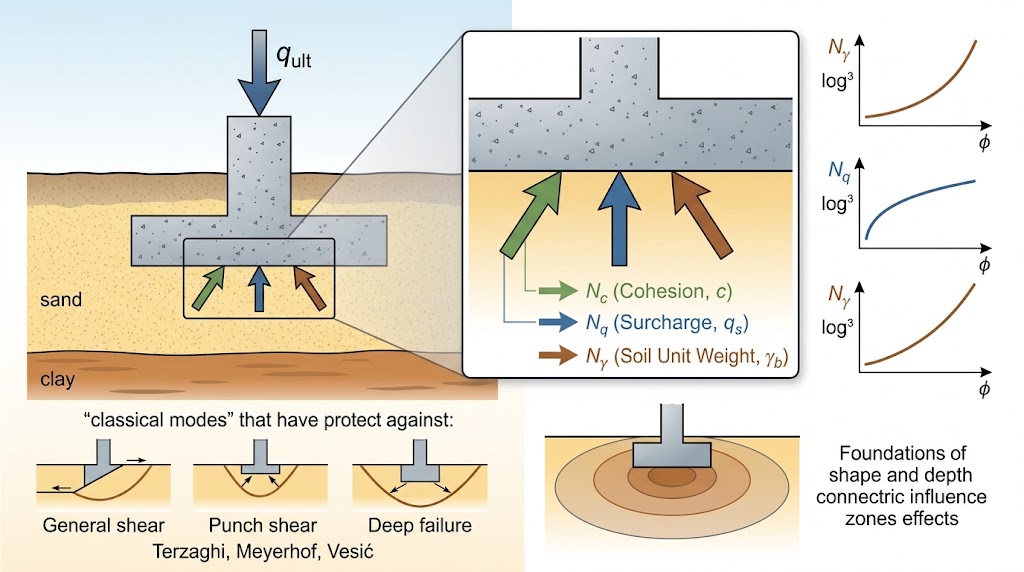
Bearing capacity describes the ability of soil to support foundation loads without experiencing shear failure or excessive deformation. In classical foundation design, this resistance is commonly expressed through bearing capacity factors—dimensionless coefficients used within bearing capacity equations to represent different components of soil resistance. The three primary factors are Nc, Nq, and Nγ, which are associated with cohesion, surcharge, and soil unit weight, respectively. Their values depend mainly on the soil’s angle of internal friction (φ) and the calculation method being used. As a result, methods such as Terzaghi, Meyerhof, and Vesić can produce different bearing capacity factors, particularly different Nγ values, even for the same friction angle.
What Are Bearing Capacity Factors?
Bearing capacity factors are dimensionless coefficients used in classical bearing capacity equations to represent different components of soil resistance beneath a foundation. The three main factors are Nc, Nq, and Nγ. Nc represents the contribution of soil cohesion, Nq represents the contribution of surcharge or overburden pressure at foundation level, and Nγ represents the contribution of the soil’s unit weight below the footing.
A simplified form of the ultimate bearing capacity equation can be written as:
qult = cNc + qNq + 0.5γBNγ
where c is cohesion, q is surcharge pressure, γ is soil unit weight, and B is foundation width.
In practical design, however, bearing capacity calculations are rarely limited to these three terms alone. Depending on the selected method, additional shape, depth, load inclination, eccentricity, and other correction factors may also be applied.
In SETAF2018’s Terzaghi implementation, Nc, Nq, and Nγ are determined using the effective friction angle φ′ for effective-stress analysis. The calculation also considers foundation geometry, corrected B′ and L′ dimensions, embedment conditions, and the influence of the groundwater level on the relevant bearing-capacity terms.
H2: How Does the Friction Angle Affect Nc, Nq and Nγ?
The angle of internal friction (φ) is one of the most influential parameters in bearing capacity calculations because it directly affects the values of Nc, Nq, and Nγ. As the friction angle increases, all three bearing capacity factors increase, but they do so nonlinearly rather than at a constant rate. This means that relatively small increases in φ at higher values can produce significantly larger increases in calculated bearing capacity.
Among the three factors, Nγ is the most sensitive to changes in friction angle. At lower friction angles, its contribution is relatively small, but as φ approaches 35° to 45°, Nγ increases rapidly, making the soil unit weight term a much larger component of the ultimate bearing capacity equation. In contrast, Nc and Nq also increase with friction angle but at a more gradual rate. This behavior explains why granular soils with higher friction angles often exhibit substantially greater bearing capacity than soils with lower shear strength.
The table below presents Vesić’s bearing capacity factors, illustrating how the coefficients vary as the friction angle increases.
| φ (°) | Nc | Nq | Nγ |
| 0 | 5.14 | 1.0 | 0.0 |
| 10 | 8.3 | 2.5 | 1.2 |
| 20 | 14.8 | 6.4 | 5.4 |
| 25 | 20.7 | 10.7 | 10.8 |
| 30 | 30.1 | 18.4 | 22.4 |
| 35 | 46.1* | 33.3* | 48.1* |
| 40 | 75.3 | 64.2 | 109.4 |
| 45 | 133.9* | 134.9* | 271.8* |
Values for 35° and 45° are interpolated from Vesić equations for illustration. If your design follows a specific standard or software implementation, use the corresponding published values or software-generated results.
Bearing Capacity Factors in Different Methods
Although Nc, Nq, and Nγ represent the same three components of soil resistance in all classical bearing capacity equations, their numerical values and the way they are applied vary between design methods. Each theory is based on different assumptions regarding soil behavior, failure mechanisms, and correction factors. As a result, the calculated ultimate bearing capacity for the same foundation and soil conditions may differ depending on whether the Terzaghi, Meyerhof, or Vesić method is used.
Terzaghi Bearing Capacity Factors
Terzaghi’s bearing capacity theory is one of the earliest and most widely adopted methods for shallow foundation design. It expresses the ultimate bearing capacity as the sum of three resistance components associated with cohesion (Nc), surcharge (Nq), and soil unit weight (Nγ). The method is primarily intended for vertically loaded shallow foundations and forms the basis of many modern design approaches.
The simplified equation is:
qult = cNc + qNq + 0.5γBNγ
In Terzaghi’s formulation, Nc is determined using the soil friction angle beneath the footing, Nq represents the contribution of the effective overburden pressure at foundation level, and Nγ accounts for the influence of the soil beneath the foundation. Shape factors can also be applied for rectangular footings, while the method assumes that the embedment ratio satisfies Df/B ≤ 1.
In SETAF2018, the Terzaghi method uses the effective friction angle (φ′) to determine Nc, Nq, and Nγ during effective-stress analyses. The software also considers corrected B′ and L′ dimensions for eccentric loading and adjusts the soil unit weight term according to the position of the groundwater table, producing a more realistic bearing capacity evaluation.
Meyerhof Bearing Capacity Factors
Meyerhof expanded Terzaghi’s original theory by introducing additional correction factors that make the method applicable to a wider range of practical foundation problems. Besides the three bearing capacity factors Nc, Nq, and Nγ, the Meyerhof method incorporates shape, depth, and load inclination factors, allowing engineers to evaluate foundations subjected to more realistic loading conditions.
Although the bearing capacity factors follow the same general trend as Terzaghi’s values, the overall bearing capacity equation is modified to account for foundation geometry, embedment depth, and inclined loading. These additions make the method particularly suitable for foundations where ideal assumptions of vertical loading and simple geometry are not fully satisfied.
Within SETAF2018, the Meyerhof implementation supports effective foundation dimensions (B′ and L′), optional application of the Re reduction factor, and user-defined horizontal loads for calculating load inclination factors. These parameters allow the calculated bearing capacity to better reflect the actual geometry and loading conditions of the foundation.
Vesić Bearing Capacity Factors
Vesić’s method builds upon Meyerhof’s approach while introducing a revised formulation for the Nγ factor, which generally produces higher values at larger friction angles. As a result, differences between the Terzaghi, Meyerhof, and Vesić methods become increasingly noticeable for dense granular soils, where the soil unit weight component contributes significantly to the overall bearing capacity.
Like Meyerhof’s method, Vesić considers shape, depth, and load inclination effects, making it suitable for detailed engineering analyses. While Nc and Nq remain relatively similar to Meyerhof’s values, the revised Nγ formulation often leads to higher calculated ultimate bearing capacities, particularly when the soil has a high angle of internal friction.
In SETAF2018, the Vesić method also considers the base adhesion parameter required for calculating load inclination factors. This enables the software to account for additional resistance mechanisms and produce bearing capacity results consistent with Vesić’s theoretical framework.
Terzaghi vs. Meyerhof vs. Vesić Bearing Capacity Factors
Selecting a bearing capacity method is just as important as selecting the correct soil parameters. Although Terzaghi, Meyerhof, and Vesić all use the same three bearing capacity factors—Nc, Nq, and Nγ—they differ in their assumptions, correction factors, and treatment of loading conditions. These differences can produce different design bearing capacities for the same foundation, especially when foundation geometry, load eccentricity, or inclined loads are involved.
| Method | Nc / Nq / Nγ | Shape Effects | Load Inclination | Eccentricity | Typical Use |
| Terzaghi | ✓ | ✓ | Limited | ✓ | Classical shallow foundation analysis |
| Meyerhof | ✓ | ✓ | ✓ | ✓ | General foundation design |
| Vesić | ✓ | ✓ | ✓ | ✓ | Detailed bearing capacity analysis |
There is no universally superior set of bearing capacity factors. The most appropriate method depends on the project’s soil conditions, foundation geometry, loading characteristics, and the design standard being followed. Terzaghi remains a reliable choice for conventional shallow foundations, while Meyerhof extends the theory with additional correction factors for more realistic loading conditions. Vesić further refines the formulation, particularly the Nγ term, making it well suited for detailed analyses involving granular soils. Engineering software such as SETAF2018 supports multiple bearing capacity methods, allowing engineers to select the approach that best matches the project’s design assumptions rather than relying on a single equation for every situation.
Bearing Capacity Factors for φ = 0 Soils
For undrained soil conditions, where the angle of internal friction (φ) is assumed to be zero, the bearing capacity equation becomes significantly simpler. Under this assumption, the contribution of soil friction is eliminated, leaving the foundation capacity to depend primarily on the soil’s undrained shear strength (Su or cu) and the Nc factor.
The corresponding bearing capacity factors are:
| Parameter | Value (φ = 0) |
| Nc | 5.14 (Terzaghi) |
| Nq | 1.0 |
| Nγ | 0.0 |
Since Nγ = 0, the soil unit weight term disappears from the bearing capacity equation. Likewise, because Nq = 1, the surcharge contribution is simplified. As a result, the calculated bearing capacity is governed primarily by the soil’s undrained shear strength and the cohesion component represented by Nc.
This assumption is commonly used for saturated cohesive soils under short-term loading conditions, where drainage does not occur during loading. In SETAF2018’s implementation of the Terzaghi method, the same approach is adopted for φ = 0 analyses, with Nγ taken as 0 and Nq taken as 1 in accordance with the undrained total-stress formulation
What Else Affects Foundation Bearing Capacity?
While Nc, Nq, and Nγ are fundamental to classical bearing capacity equations, they are only part of the overall design process. The actual bearing capacity of a foundation is also influenced by several site and foundation-specific parameters.
Soil Shear Strength
The soil’s cohesion (c), angle of internal friction (φ), and undrained shear strength (Su) determine how much resistance the soil can mobilize under loading. These properties directly influence the selected bearing capacity factors and the governing design method.
Foundation Width and Shape
Foundation geometry affects how stresses are distributed within the soil. Parameters such as foundation width (B), length (L), and footing type—strip, rectangular, or circular—are incorporated into shape correction factors in most bearing capacity methods.
Foundation Embedment Depth
The embedment depth (Df) influences the surcharge acting at foundation level and can significantly increase bearing capacity. Many design methods also apply depth correction factors for embedded foundations.
Groundwater Level
A high groundwater table reduces the effective stress and the effective unit weight of soil, lowering the contribution of the Nγ term and potentially reducing the calculated bearing capacity.
Load Inclination and Eccentricity
Inclined or eccentric loads create non-uniform stress distributions beneath the footing. Modern bearing capacity methods apply correction factors or effective foundation dimensions to account for these loading conditions.
Soil Density and Unit Weight
Dense granular soils generally provide higher bearing capacity than loose soils because they develop greater shear resistance. The soil unit weight (γ) also contributes directly to the soil-weight component of the bearing capacity equation.
In SETAF2018, users directly define the foundation shape, width (B), length (L), and embedment depth (Df) as part of the shallow foundation analysis, allowing these parameters to be incorporated into the selected bearing capacity method.
Bearing Capacity Factors for Deep Foundations
Unlike shallow foundation design, deep foundation capacity is not determined directly by the classical bearing capacity factors Nc, Nq, and Nγ. Instead, the ultimate capacity of a pile or pile group is evaluated by combining tip resistance (end bearing) and shaft resistance (skin friction). The calculation method depends on both the soil type and the drainage conditions, making the design process fundamentally different from that of shallow footings.
For drained soil layers, shaft resistance is commonly evaluated using the β method, which relates shaft friction to the effective vertical stress and soil properties. In undrained cohesive soils, shaft resistance is typically calculated using either the α method or the λ method, depending on the selected design approach and available soil parameters. Tip resistance is then combined with shaft resistance to determine the total pile capacity.
When pile groups are used, engineers must also account for pile group efficiency, since the capacity of a group is not always equal to the sum of the individual pile capacities. Interaction between adjacent piles may reduce or, in some cases, increase the overall group resistance.
SETAF2018 incorporates these established deep foundation methods into its bearing capacity analysis workflow. For drained layers, shaft resistance is calculated using the β method, while undrained layers can be analyzed using either the α or λ method, depending on the user’s selection. For pile groups, the software evaluates group efficiency using either the Converse–Labarre geometric method or the Terzaghi block approach, providing a practical framework for both single-pile and pile-group design.
Calculating Bearing Capacity with SETAF2018
Instead of manually selecting bearing capacity factors from reference tables and applying multiple correction factors by hand, SETAF2018 enables engineers to define the project conditions and perform bearing capacity analyses using established geotechnical design methods. The workflow begins with the input of the soil profile, material properties, foundation geometry, and loading conditions, after which the appropriate calculation method can be applied based on the project requirements.
For shallow foundations, SETAF2018 supports the Terzaghi, Meyerhof, and Vesić methods, as well as SPT-based bearing capacity calculations. During the analysis, the software automatically considers parameters such as foundation shape, effective dimensions (B′ and L′), embedment depth, groundwater level, load eccentricity, and other method-specific correction factors. These inputs are incorporated into the selected bearing capacity formulation to calculate both the characteristic bearing resistance and the design bearing resistance.
For deep foundations, SETAF2018 applies recognized methods for shaft and tip resistance, including the α, β, and λ approaches, while also evaluating pile group efficiency where applicable. This allows both shallow and deep foundation systems to be analyzed within the same engineering workflow.
After completing the calculations, the software performs a bearing capacity verification by comparing the calculated design bearing resistance with the foundation’s applied base pressure, helping engineers quickly assess whether the design satisfies the required safety criteria. Detailed engineering reports, calculation summaries, and supporting outputs can then be generated directly from the completed analysis.
Frequently Asked Questions About Bearing Capacity Factors
What are Nc, Nq, and Nγ bearing capacity factors?
Nc, Nq, and Nγ are dimensionless coefficients used in classical bearing capacity equations to represent different sources of soil resistance beneath a foundation. Nc accounts for soil cohesion, Nq represents the effect of surcharge or overburden pressure, and Nγ reflects the contribution of the soil’s unit weight. Their values vary depending on the soil’s friction angle and the selected bearing capacity method, such as Terzaghi, Meyerhof, or Vesić.
How does the friction angle affect bearing capacity factors?
The angle of internal friction (φ) has a significant influence on bearing capacity factors. As the friction angle increases, Nc, Nq, and Nγ all increase, but not at the same rate. In particular, Nγ rises rapidly at higher friction angles, making the soil unit weight term much more influential in the overall bearing capacity calculation for dense granular soils.
Why are Terzaghi and Vesić bearing capacity factors different?
Although both methods use Nc, Nq, and Nγ, they are derived from different theoretical assumptions and mathematical formulations. The largest difference is typically found in the Nγ factor, where Vesić’s method generally predicts higher values at larger friction angles. As a result, the calculated ultimate bearing capacity may differ even when the same soil properties and foundation geometry are used.
What are the bearing capacity factors when φ = 0?
For undrained analyses where the soil friction angle is assumed to be φ = 0, the bearing capacity factors simplify considerably. In Terzaghi’s method, Nq = 1 and Nγ = 0, meaning the soil weight contribution is eliminated from the equation. Under these conditions, the bearing capacity depends primarily on the soil’s undrained shear strength and the Nc factor.
Which bearing capacity method should be used for foundation design?
There is no single bearing capacity method that is suitable for every project. The appropriate choice depends on factors such as soil conditions, foundation geometry, loading characteristics, and the applicable design standard. Terzaghi is commonly used for conventional shallow foundations, while Meyerhof and Vesić incorporate additional correction factors that make them better suited for more complex foundation and loading conditions.