An isolated footing is a shallow foundation designed to transfer the load from an individual column, pier, or structural support to the underlying soil. Also commonly referred to as a pad footing, spread footing, or isolated pad foundation, it distributes a concentrated structural load over a larger area so that the ground can safely support it.
Although the geometry of an isolated footing may appear simple, its design involves more than placing a concrete base beneath a column. A satisfactory foundation must balance three connected requirements: applied structural loads, available soil bearing resistance, and acceptable settlement. Meeting only the bearing-capacity requirement does not necessarily mean the footing will perform adequately.
The dimensions and embedment depth of an isolated footing therefore depend not only on column loads, but also on the soil profile, groundwater conditions, foundation geometry, load eccentricity, soil stiffness, and allowable deformation. A reliable design must evaluate these factors together rather than treating footing sizing as a standalone calculation.
What Is an Isolated Footing?
An isolated footing is a type of shallow foundation that supports an individual column, pier, or other concentrated structural load. Rather than transferring that load directly to a relatively small area of soil, the footing spreads it over a wider base so that the stresses transmitted to the ground remain within acceptable limits.
Isolated footings may be constructed from reinforced or non-reinforced concrete and can have square, rectangular, or circular geometries depending on the loading conditions, column arrangement, and project requirements. Their plan dimensions are determined primarily by the relationship between the applied load and the resistance available from the supporting ground.
For preliminary sizing, the required footing area can be approximated as:
Required footing area ≈ Applied vertical load / Allowable bearing pressure
For example, a 400 kN vertical load and an allowable bearing pressure of 200 kPa would suggest an initial footing area of approximately 2 m².
However, this relationship provides only a preliminary footing size. Final design must also consider load eccentricity and moments, groundwater conditions, soil stratification, bearing resistance, and both total and differential settlement. As a result, an isolated footing that appears adequate based on bearing pressure alone may still require different dimensions once its overall geotechnical performance is evaluated.
Isolated Footing, Pad Footing and Spread Footing: Are They the Same?
The terms isolated footing, pad footing, and spread footing are often used interchangeably, but their meanings can vary slightly depending on engineering practice and regional terminology. An isolated footing supports a single column or concentrated structural load, while pad footing or pad foundation commonly refers to the same type of foundation.
The term spread footing describes the principle of spreading a concentrated structural load over a larger area of ground. For this reason, an isolated footing beneath a column can also be described as a spread footing. In many practical contexts, isolated footing, isolated pad footing, and pad foundation therefore refer to essentially the same foundation concept.
However, spread foundation can also be used as a broader term for shallow foundations that distribute structural loads near the ground surface. Depending on the classification being used, this may include both isolated footings and continuous or strip footings.
The important distinction is therefore not the terminology itself, but how the foundation receives and transfers structural loads to the supporting soil.
Types of Isolated Footings
Isolated footings can be classified according to their cross-sectional shape and the way their thickness changes between the supported column and the footing edges. The most common forms are pad or flat, sloped, and stepped footings. The appropriate configuration depends on structural loads, required footing dimensions, material use, and construction requirements.
Pad or Flat Footing
A pad or flat footing has a constant thickness across its plan area and is the most straightforward form of isolated footing. It is commonly constructed from reinforced concrete and may be square, rectangular, or circular. Its simple geometry generally makes reinforcement detailing, formwork, and construction relatively straightforward.
Sloped Footing
A sloped footing is thicker near the column and gradually reduces in thickness toward its edges. This geometry places more material around the highly stressed column-footing connection while reducing concrete volume where the full depth is not required. Sloped footings can therefore provide more efficient material use, although their geometry requires more careful construction than a flat footing.
Stepped Footing
A stepped footing achieves the change in depth through a series of horizontal steps rather than a continuous slope. It can accommodate greater depth around the supported column while reducing the section toward the edges. However, additional formwork and construction complexity mean stepped configurations are less straightforward than conventional flat footings.
Square vs. Rectangular Isolated Footings
A square isolated footing is typically suitable when loading and geometric conditions are relatively symmetrical. A rectangular isolated footing may be preferred when available space differs between directions or when unequal moments, eccentric loading, or site boundaries influence the required dimensions. The final geometry should therefore reflect both the structural loading and the geotechnical response of the supporting ground.
When Is an Isolated Footing Suitable?
An isolated footing is generally suitable when individual columns are sufficiently spaced and their loads can be transferred safely to competent near-surface soils without requiring excessively large foundation areas. It is particularly practical when column loads are moderate, ground conditions are reasonably uniform, and adjacent footings can remain separate without overlapping.
However, bearing capacity alone does not determine whether an isolated footing is suitable. A footing may have sufficient resistance against bearing failure while still experiencing excessive total settlement or unacceptable differential settlement relative to other foundations. Both resistance and deformation must therefore be considered when selecting the foundation system.
Ground variability is especially important. Changes in soil stiffness, layer thickness, groundwater conditions, or compressible strata across a site can cause individual footings carrying similar loads to settle differently. Column spacing and footing dimensions must also be considered because heavily loaded or closely spaced columns may require footing areas that overlap, making a combined, strip, or raft foundation more appropriate.
In practice, isolated footings are most suitable when load magnitude, column spacing, soil resistance, settlement behavior, and ground uniformity collectively support independent foundations. The decision should therefore be based on the overall ground–foundation response rather than on a single allowable bearing pressure value.
What Information Is Needed to Design an Isolated Footing?
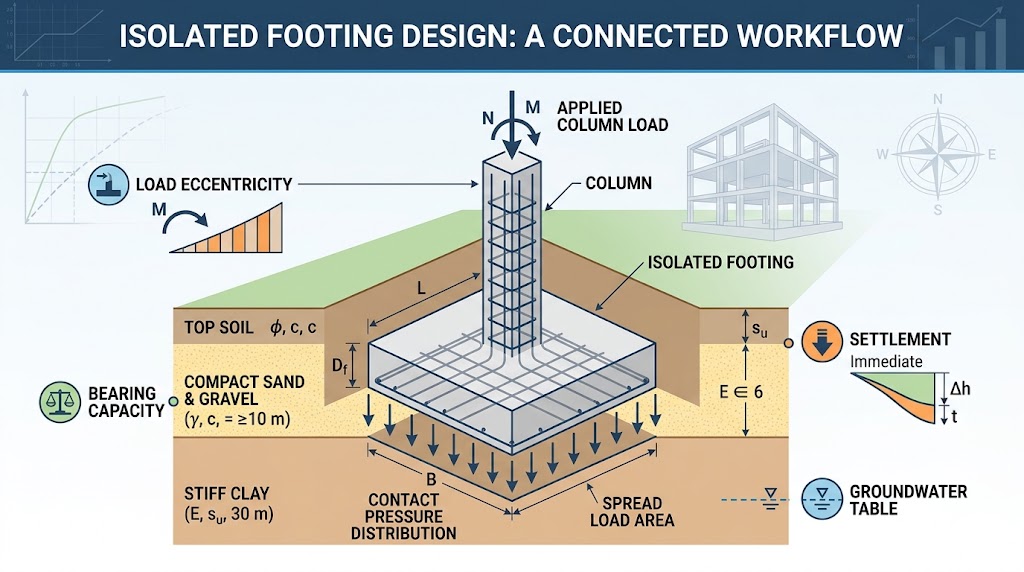
A reliable isolated footing design requires more than a column load and an assumed soil bearing pressure. The analysis should connect ground conditions, foundation geometry, and structural loads so that bearing resistance and settlement are evaluated using the same engineering model.
Ground Conditions
The ground model should represent the borehole stratigraphy, soil layer thicknesses, and groundwater conditions beneath the foundation. Relevant parameters may include soil unit weight (γ), cohesion (c), friction angle (φ), undrained shear strength (su), and deformation modulus (E). Where compressible soils are present, consolidation parameters may also be required. SPT results and other field or laboratory data can provide additional information for defining the engineering properties of individual layers.
Foundation Geometry
The footing model must define its width (B), length (L), embedment depth (Df), thickness, and foundation elevation, together with the dimensions and position of the supported column. These variables influence both the stresses transferred to the ground and the resulting bearing and settlement response.
Structural Loads
Applied loading typically includes the vertical force, horizontal forces, and moments about both axes (Mx and My). Relevant load combinations should also be considered because changes in load magnitude and eccentricity can alter contact pressures and effective foundation behavior.
An isolated footing model should therefore connect ground conditions → foundation geometry → structural loads before bearing capacity or settlement is evaluated.
How Is an Isolated Footing Designed?
Isolated footing design is an iterative process in which the ground model, foundation geometry, and applied loads are evaluated together. A preliminary footing size may provide a starting point, but the final dimensions should satisfy both bearing resistance and settlement requirements under the relevant loading conditions.
1. Build the Ground Model
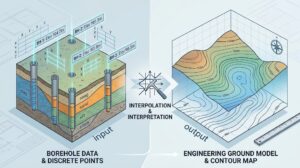
Define the soil profile beneath the foundation using borehole data, layer boundaries, groundwater conditions, and the geotechnical parameters required for analysis. The model should represent changes in strength and stiffness with depth rather than assuming uniform ground where significant stratification exists.
2. Define the Footing Geometry
Specify the footing width (B), length (L), embedment depth (Df), elevation, and column position. These dimensions determine the contact area and influence both bearing resistance and stress distribution within the ground.
3. Apply Foundation Loads
Apply the relevant vertical load (N), horizontal forces, and moments (M) together with the appropriate load combinations. Loads should be considered at the foundation level.
4. Check Bearing Capacity
Calculate the ground’s bearing resistance and compare it with the design actions transmitted through the footing. Foundation dimensions can be revised if adequate resistance cannot be achieved.
5. Calculate Settlement
Evaluate deformation under the applied loads. Depending on the soil profile, this may include immediate settlement and consolidation settlement, as well as differences in settlement between foundation locations.
6. Check Eccentricity and Contact Pressure
Moments and eccentric loading can produce non-uniform contact pressures beneath the footing. The resulting pressure distribution and effective loaded area should therefore be checked rather than assuming uniform pressure.
7. Verify and Iterate the Design
Finally, verify bearing resistance, settlement, and applicable serviceability requirements together. If any criterion is not satisfied, the geometry or foundation solution should be revised and recalculated.
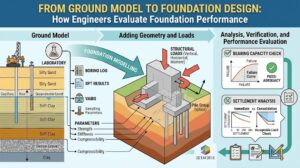
In practice, isolated footing design is therefore a connected workflow: Ground Model → Geometry → Loads → Bearing Capacity → Settlement → Verification.
Bearing Capacity of an Isolated Footing
The bearing capacity of an isolated footing represents the ability of the supporting ground to resist the stresses transferred through the foundation without reaching a bearing failure condition. It is not a fixed soil property; the calculated resistance depends on the interaction between the ground conditions, footing geometry, and applied loading.
Important factors include the footing width and length, embedment depth, soil unit weight, cohesion, friction angle, and groundwater conditions. Load inclination and eccentricity can also influence the available resistance by changing the way stresses are transferred beneath the footing. For this reason, bearing capacity should be evaluated for the actual foundation and loading conditions rather than selected as a single generic value for the soil.
Terzaghi Method
The Terzaghi bearing capacity method provides a classical framework for estimating the ultimate bearing resistance of shallow foundations using contributions associated with cohesion, surcharge, and soil unit weight.
Meyerhof Method
The Meyerhof method extends the bearing capacity framework by incorporating additional effects associated with foundation shape, embedment depth, and loading conditions. This makes it useful when footing geometry and load characteristics need to be represented more explicitly.
Vesic Method
The Vesic method provides another established formulation for shallow-foundation bearing capacity, using bearing capacity factors and correction factors to represent foundation and ground conditions.
SETAF2018 supports isolated and other shallow-foundation bearing capacity calculations using established methods including Terzaghi, Meyerhof, and Vesic. This allows the bearing check to remain connected to the defined soil profile, foundation geometry, groundwater conditions, and loads rather than being performed as a standalone calculation. The resulting bearing resistance can then be evaluated alongside settlement and other foundation design requirements.
Settlement of an Isolated Footing
A footing can satisfy bearing-capacity requirements and still perform poorly because of excessive settlement. Bearing capacity addresses resistance against failure, whereas settlement concerns how much the foundation and supported structure deform under load. Both criteria must therefore be evaluated during isolated footing design.
Settlement depends on the magnitude and distribution of foundation loads, footing dimensions, stress increases within the soil, layer thicknesses, groundwater conditions, and the stiffness and compressibility of the underlying materials.
Immediate Settlement
Immediate settlement develops as the soil deforms in response to an applied foundation load. Its magnitude is strongly influenced by soil stiffness and by the distribution of stress beneath the footing. For shallow foundations, stress increases can be determined using approaches such as the Boussinesq solution, allowing the deformation of the affected soil layers to be evaluated.
Consolidation Settlement
Consolidation settlement is particularly important where cohesive or compressible soil layers are present. Loading generates excess pore-water pressure, and settlement develops progressively as this pressure dissipates and effective stress increases. Unlike immediate settlement, consolidation is therefore time-dependent, meaning that satisfactory short-term behavior does not necessarily indicate acceptable long-term performance.
In SETAF2018, stress increases caused by shallow-foundation loads can be calculated using the Boussinesq solution and used directly in settlement analysis. The workflow can account for immediate or undrained settlement and, where applicable, consolidation settlement. Consolidation parameters and permeability information can also be used to evaluate settlement–time behavior, connecting the calculated deformation to its development over time.
Footing size should therefore not be selected from bearing capacity alone; it should be iterated until both resistance and deformation criteria are satisfied.
How Do Eccentric Loads Affect an Isolated Footing?
The load transferred from a column does not always act through the centroid of an isolated footing. Moments, horizontal forces, column position, or geometric constraints can create eccentricity, changing how the load is distributed across the soil–foundation interface.
Under a centrally applied vertical load, contact pressure can be relatively uniform. As eccentricity increases, however, the pressure distribution becomes non-uniform: contact pressure increases toward one edge of the footing while decreasing toward the opposite edge. This can increase the maximum pressure acting on the soil and reduce the effective area available to resist the applied load.
Eccentric loading can therefore influence several aspects of foundation performance, including bearing resistance, footing rotation, and differential settlement. If eccentricity becomes sufficiently large, maintaining full contact between the footing and supporting ground may also become a design consideration.
Footing geometry can be adjusted in response to these conditions. A rectangular isolated footing, for example, may be more appropriate than a square footing where unequal moments, eccentric column loads, or site boundaries require different dimensions in each direction.
However, changing the footing dimensions is not always sufficient. Where eccentricity, required foundation area, or interaction with adjacent footings becomes excessive, an isolated footing may no longer be the most appropriate foundation solution.
Isolated Footing vs. Strip Footing vs. Raft Foundation
Isolated, strip, and raft foundations are all shallow foundation systems, but they differ in how structural loads are collected and distributed to the ground. The appropriate solution depends on column or wall arrangement, applied loads, available bearing resistance, settlement behavior, and the interaction between adjacent foundations.
| Foundation | Typical Use | Load Transfer | Suitable When |
| Isolated footing | Individual column or pier | Localized | Columns are sufficiently separated and near-surface ground can support individual footings |
| Strip footing | Load-bearing wall or series of closely spaced supports | Linear | Loads need to be distributed continuously along a line |
| Raft foundation | Multiple columns or most/all of the structure | Large area | Individual footings would overlap or broader settlement control is required |
An isolated footing is often the most economical solution when individual column loads can be supported independently. As column spacing decreases or the required footing dimensions increase, separate foundations may begin to overlap. A strip footing can then provide continuous support along one direction, while a raft foundation distributes loads from multiple structural elements across a much larger portion of the building footprint.
Ground conditions can change this decision even when the structural arrangement remains the same. Weak or compressible layers, variable soil stiffness, groundwater conditions, and differential settlement requirements may make a larger shared foundation preferable.
Foundation selection should therefore come from ground–structure interaction, not simply from structural layout.
Advantages and Limitations of Isolated Footings
Isolated footings can provide a simple and economical foundation solution, but their efficiency depends strongly on the relationship between structural loads, column spacing, and ground conditions.
| Advantages | Limitations |
| Simple geometry makes design and construction relatively straightforward. | Closely spaced columns may cause individual footings to overlap. |
| Efficient for supporting separated columns and concentrated loads. | Variable ground conditions can increase the risk of differential settlement. |
| Usually requires less excavation and material than larger continuous foundation systems. | Heavy column loads may require very large footing dimensions. |
| Individual footing dimensions can be adapted to different column loads. | Eccentric loads and large moments can reduce the efficiency of the available bearing area. |
| Can be economical where competent soil occurs relatively close to the ground surface. | Soft or compressible layers may produce unacceptable settlement even when bearing resistance is adequate. |
The main advantage of an isolated footing is therefore not simply that it is inexpensive or easy to construct. It is that foundation area can be provided locally where individual structural loads occur, avoiding a continuous foundation where one is unnecessary.
Its limitations become more significant when foundations grow larger, ground stiffness varies across the structure, or settlement begins to control the design. In these situations, a strip, combined, or raft foundation may provide a more appropriate response than designing increasingly large individual footings.
Modelling Isolated Footings in SETAF2018
In SETAF2018, isolated footing analysis can be incorporated into a broader geotechnical model rather than performed as a separate calculation. The workflow connects Soil Profile → Foundation Geometry → Loads → Bearing Capacity → Settlement → Verification → Report, allowing changes in one part of the model to remain connected to the overall foundation assessment.
Engineers can define boreholes, soil stratigraphy, groundwater conditions, and the mechanical properties of individual soil layers before introducing rectangular or polygonal foundation geometries and their applied loads. Multiple foundations can be included within the same project, which is particularly important for settlement analysis because stress increases from surrounding foundations may influence settlement at a selected point.
For shallow foundations, SETAF2018 supports bearing-capacity calculations using established methods including Terzaghi, Meyerhof, and Vesic. Stress increases beneath shallow foundations can be calculated using the Boussinesq solution, providing input for immediate settlement calculations and, where applicable, consolidation and settlement–time analyses.
The same project environment can also accommodate piles and rigid-column ground improvement systems when shallow foundations alone do not provide an adequate solution. This allows alternative foundation or improvement strategies to be evaluated without separating the ground model from the engineering problem.
SETAF2018 does not treat the isolated footing as an isolated calculation. The footing remains connected to the ground model, surrounding foundations, settlement points, and project reporting workflow. Analysis results can subsequently be presented through engineering tables, graphs, calculation reports with equations, and project documentation, creating a traceable path from ground conditions to the final design assessment.
From Footing Calculation to an Engineering Deliverable
A foundation analysis should provide more than final values for bearing capacity and settlement. For an engineering calculation to remain transparent and verifiable, the assumptions, ground parameters, calculation methods, intermediate results, and final checks should also be documented.
This means the engineering workflow should preserve the connection between the soil profile, foundation geometry, applied loads, equations, calculated values, tables, graphs, and design conclusions. Such documentation becomes particularly important when calculations need to be reviewed, revised after a design change, or incorporated into a larger geotechnical report.
SETAF2018 supports this workflow through different levels of reporting. Local Reports can present individual analyses and design calculations together with the equations used, while broader geotechnical reports can combine project data, analysis and design tables, explanatory text, and images. Engineers can therefore document not only the final result but also how that result was obtained.
This makes the isolated footing calculation part of a traceable geotechnical design process rather than a standalone numerical check.
Common Isolated Footing Design Mistakes
Even when an isolated footing appears straightforward, simplifying the interaction between the foundation and the ground can lead to an inadequate design. Common mistakes include:
- Sizing the footing from allowable pressure alone: Dividing the column load by an allowable bearing pressure can provide an initial area, but it should not be treated as the final foundation size.
- Ignoring settlement after bearing capacity passes: Adequate bearing resistance does not guarantee acceptable performance. Immediate, consolidation, and differential settlement may still govern the design.
- Using one soil parameter for a layered ground profile: Soil strength and stiffness can vary considerably with depth. Simplifying a stratified profile into a single representative value may misrepresent both resistance and deformation.
- Ignoring groundwater conditions: Groundwater affects effective stress and can influence bearing resistance, settlement behavior, and the soil parameters applicable to the calculation.
- Ignoring eccentricity and neighbouring foundations: Moments can produce non-uniform contact pressures, while nearby foundations can create overlapping stress zones within the ground. Settlement at one location may therefore be influenced by loads from multiple foundations.
A reliable design should evaluate the isolated footing as part of the overall ground–foundation system, rather than checking each footing independently of its surrounding conditions.
Conclusion
An isolated footing may have relatively simple geometry, but reliable design requires more than selecting a foundation area from the applied column load. The complete engineering process connects Ground Conditions → Geometry → Loads → Bearing Resistance → Settlement → Verification. Each stage influences the next, and a change in soil conditions, loading, or footing dimensions can affect both resistance and deformation.
For this reason, bearing capacity and settlement should not be treated as independent calculations. They should form part of a consistent ground–foundation model in which assumptions, inputs, analysis methods, and design checks remain connected.
SETAF2018 brings this process together by integrating the ground model, shallow-foundation calculations, settlement analysis, and engineering reporting within the same project environment. Engineers evaluating an isolated footing can use SETAF2018 to move from soil data and foundation geometry to bearing-capacity, settlement, and documented design checks within a single workflow.
FAQ
What is an isolated footing?
An isolated footing is a shallow foundation designed to support an individual column, pier, or concentrated structural load. It spreads the applied load over a larger area of soil so that bearing resistance and settlement remain within acceptable limits. Isolated footings are commonly square or rectangular, although other geometries can also be used.
Is a pad footing the same as an isolated footing?
In most engineering contexts, pad footing, pad foundation, and isolated footing refer to the same basic foundation concept: a separate shallow foundation supporting an individual column or concentrated load. The term spread footing is also frequently used, although spread foundation can sometimes describe a broader category of shallow foundations that distribute loads over the ground.
How is the size of an isolated footing calculated?
A preliminary footing area can be estimated by dividing the applied vertical load by the allowable bearing pressure of the ground. However, this provides only an initial foundation size. Final dimensions should also account for bearing resistance, settlement, load eccentricity, moments, groundwater conditions, soil stratification, and applicable design requirements.
What is the difference between an isolated footing and a raft foundation?
An isolated footing typically supports one column independently, whereas a raft foundation extends beneath multiple columns or a large portion of the structure. Isolated footings are often suitable when columns are sufficiently separated and competent ground exists near the surface. A raft may become more appropriate when individual footings would overlap, loads are high, or settlement control requires loads to be distributed across a larger area.
How is the bearing capacity of an isolated footing calculated?
Bearing capacity is calculated using the soil properties, footing dimensions, embedment depth, groundwater conditions, and applied loading. Parameters such as unit weight, cohesion, and friction angle contribute to the available ground resistance. Established approaches including Terzaghi, Meyerhof, and Vesic can be used to calculate shallow-foundation bearing capacity under the relevant design conditions.
How is settlement of an isolated footing calculated?
Settlement analysis evaluates the deformation caused by foundation-induced stress increases within the underlying soil layers. Immediate settlement depends largely on stress distribution and soil stiffness, while consolidation settlement develops over time in compressible soils as excess pore-water pressure dissipates. The analysis should therefore reflect the actual soil profile, foundation loading, groundwater conditions, and relevant deformation or consolidation parameters.
When should an isolated footing not be used?
An isolated footing may be unsuitable when columns are closely spaced, individual footings would overlap, near-surface soils are weak or highly compressible, or unacceptable differential settlement is expected. Very heavy loads or significant eccentricity and moments can also make individual footings inefficient. In these situations, combined, strip, raft, piled, or other foundation solutions may need to be evaluated.