The Unified Soil Classification System (USCS) is a procedure that places a soil in one of a fixed set of groups, each identified by a letter symbol and a group name, on the basis of its particle size distribution, plasticity and organic content. In its laboratory form it is standardised as ASTM D2487.
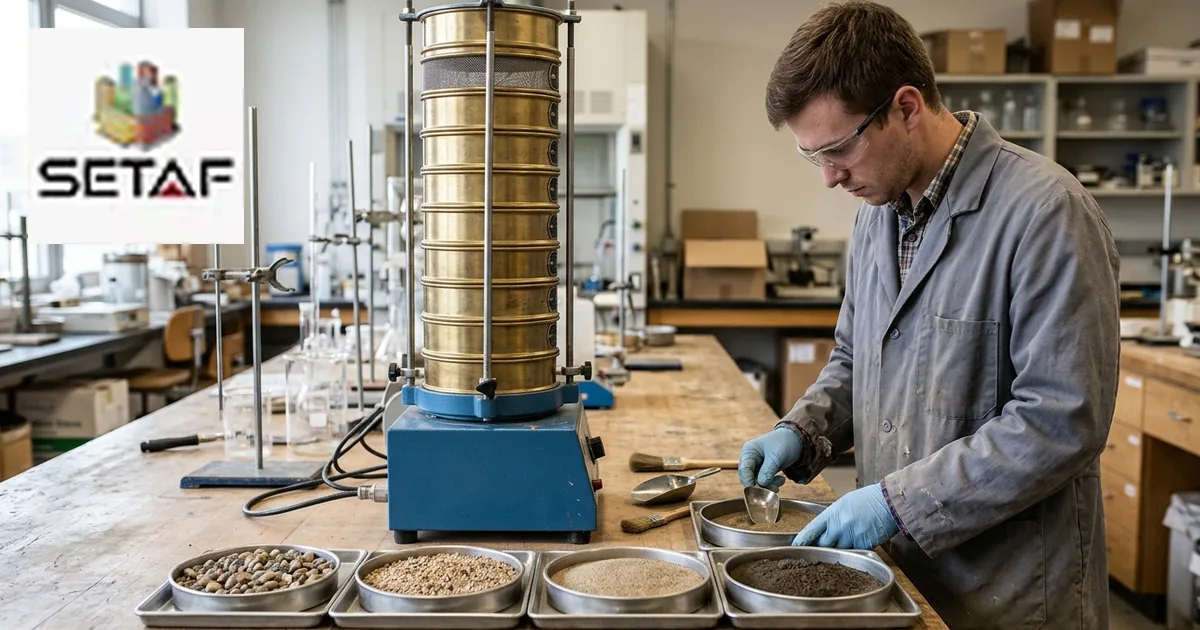
The procedure is a short chain of decisions. The fraction passing the 0.075 mm sieve separates coarse-grained from fine-grained soils, gradation coefficients and fines content refine the coarse groups, and the position of the Atterberg limits on the plasticity chart sets the fine groups.
For the engineer, the symbol is a compact record of what each layer contains. It signals which correlations, tests and construction concerns deserve attention first.
It does not describe behaviour. The symbol says what a soil is, while the tests behind it say how it will respond.
What Is the Unified Soil Classification System?
The system grew out of the Airfield Classification System that Casagrande (1948) developed for the US Army Corps of Engineers. In 1952 the Corps and the US Bureau of Reclamation adopted a modified version under the name Unified, and ASTM later standardised it as D2487 for laboratory classification and D2488 for visual-manual description.
Each symbol combines a primary letter and a qualifier. The primary letters are G for gravel, S for sand, M for silt, C for clay and O for organic soil, with Pt reserved for peat. The qualifiers are W and P for well and poorly graded coarse soils, and L and H for low and high liquid limit in fine soils. ASTM D2487 also attaches a group name, such as “lean clay with sand”.
The standard applies to the material passing the 75 mm sieve; cobbles and boulders are reported separately.
How Is a Soil Split Into Coarse-Grained and Fine-Grained?
At the No. 200 sieve, with an opening of 0.075 mm, and at 50 per cent by dry mass.
If more than half of the soil is retained on the No. 200 sieve, the soil is coarse-grained. If half or more passes, it is fine-grained, and its behaviour is governed by the fines, the material passing that sieve, whether silt or clay.
A coarse-grained soil is then divided at the No. 4 sieve, with an opening of 4.75 mm. If more than half of the coarse fraction is retained on the No. 4 sieve, the soil is a gravel; otherwise it is a sand. The comparison is made within the coarse fraction, not the whole sample.
The fines content has to be measured by washing, using ASTM D1140 or the washing step of ASTM D6913. Dry sieving leaves clay coating the grains and underestimates the fines.
How Are Gravels and Sands Classified?
By fines content first and, for nearly clean soils, by gradation.
Gradation: Cu and Cc
Gradation is described by two coefficients read from the particle size distribution curve. The coefficient of uniformity measures the spread of grain sizes:
Cu = D60 / D10
The coefficient of curvature measures the shape of the curve between those points:
Cc = D30² / ( D10 · D60 )
where D10, D30 and D60 are the particle diameters, in mm, at which 10, 30 and 60 per cent of the soil by mass is finer, and Cu and Cc are dimensionless.
ASTM D2487 classes a gravel with less than 5 per cent fines as well graded, GW, when Cu ≥ 4 and 1 ≤ Cc ≤ 3. A sand with less than 5 per cent fines is well graded, SW, when Cu ≥ 6 and 1 ≤ Cc ≤ 3. A clean soil that fails either condition is poorly graded, GP or SP.
Poorly graded covers both uniform soils, with a low Cu, and gap-graded soils, which may have a high Cu but a Cc outside the range.
For a sand with D10 = 0.15 mm, D30 = 0.45 mm and D60 = 1.2 mm, Cu is 8.0 and Cc is 1.13. Both criteria are met, and with less than 5 per cent fines the soil is SW, well-graded sand.
Fines Content and Dual Symbols
The fines content decides whether gradation or plasticity governs the symbol. Below 5 per cent fines, the soil is clean and the symbol is GW, GP, SW or SP. Above 12 per cent, the Atterberg limits of the fines are plotted on the plasticity chart, and the soil is GM or SM if the fines classify as ML or MH, and GC or SC if they classify as CL or CH. Fines in the CL-ML zone give GC-GM or SC-SM.
Between 5 and 12 per cent fines, ASTM D2487 requires a dual symbol recording both gradation and the nature of the fines: GW-GM, GW-GC, GP-GM, GP-GC, SW-SM, SW-SC, SP-SM or SP-SC. The sand of the previous example with 8 per cent silty fines becomes SW-SM, well-graded sand with silt. A sand containing 15 per cent or more gravel is also named “with gravel”.
A dual symbol is not an indecisive classification. It is a precise statement that the fines content lies between 5 and 12 per cent.
It differs from a borderline designation written with a slash, such as CL/CH, which ASTM D2488 uses when a description could fit either group.
How Are Silts and Clays Classified?
By the position of the liquid limit and plasticity index on the plasticity chart. The limits are measured on the fraction passing the 425 µm sieve according to ASTM D4318, and the plasticity index chart is treated separately.
A liquid limit of 50 separates low-plasticity soils, qualifier L, from high-plasticity soils, qualifier H. The A-line separates clays from silts:
A-line: PI = 0.73 · ( wL − 20 )
where PI is the plasticity index and wL the liquid limit, both as water content in per cent. Below a liquid limit of about 25.5, the A-line is replaced by a horizontal line at PI = 4.
The U-line marks the approximate upper limit of results observed for natural soils:
U-line: PI = 0.9 · ( wL − 8 )
with the same symbols, and with a vertical segment at wL = 16 up to PI = 7. A point above it usually indicates a testing error.
For a liquid limit below 50, ASTM D2487 classifies a soil as CL, lean clay, when the plasticity index exceeds 7 and the point plots on or above the A-line, and as ML, silt, when the plasticity index is below 4 or the point plots below the A-line. Between plasticity indices of 4 and 7, on or above the A-line, lies the CL-ML zone, silty clay. For a liquid limit of 50 or more, a point on or above the A-line is CH, fat clay, and a point below it MH, elastic silt.
The A-line matters more than the plasticity index alone: a soil with wL = 45 and PI = 22 plots above the A-line, where PI would be 18.25, and is CL. A soil with wL = 55 and the same PI plots below it, where PI would be 25.55, and is MH.
Group names add the coarse content: 15 to 29 per cent retained on the No. 200 sieve gives “with sand” or “with gravel”, whichever predominates, and 30 per cent or more gives the prefix “sandy” or “gravelly”.
Organic Soils and Peat
Organic fine-grained soils are identified by a test on the liquid limit rather than by their organic content. If the liquid limit of an oven-dried specimen is less than 0.75 times that of an undried specimen, the soil is organic: OL for a liquid limit below 50 and OH for 50 or more, named organic clay or organic silt according to the position relative to the A-line.
Drying changes organic colloids irreversibly, while most mineral clays recover their plasticity on rewetting. The test therefore detects organic matter that affects plasticity; organic content itself is measured separately, for example by loss on ignition under ASTM D2974.
Highly organic soils, consisting primarily of organic matter, dark in colour and with an organic odour, are given the symbol Pt. They are identified by visual and manual examination, and peat samples can be classified further under ASTM D4427.
Here the symbol is a direct warning: OL, OH and Pt layers are highly compressible and creep under sustained load.
Reading a Group Symbol
The notes are qualitative: they indicate what to investigate, not values to design with.
| Group symbol | Description | Typical engineering note |
|---|---|---|
| GW | Well-graded gravel | Free-draining; compacts well |
| GP | Poorly graded gravel | Free-draining; gap-graded material may be internally unstable |
| GM | Silty gravel | Lower permeability; moisture-sensitive in compaction |
| GC | Clayey gravel | Low permeability; generally stable when compacted |
| SW | Well-graded sand | Free-draining; good compacted fill |
| SP | Poorly graded sand | Loose saturated layers warrant liquefaction screening |
| SM | Silty sand | Erodible; frost-susceptible; hard to compact when wet |
| SC | Clayey sand | Low permeability; strength sensitive to water content |
| ML | Silt | Dilatant; erodible and prone to piping |
| CL | Lean clay | Low permeability; moderate compressibility |
| MH | Elastic silt | Often micaceous or diatomaceous; high compressibility |
| CH | Fat clay | High compressibility; shrink–swell potential |
| OL / OH | Organic silt or clay | Compressible; secondary compression |
| Pt | Peat | Very high compressibility and creep |
Field Description vs Laboratory Classification
They use the same symbols but rest on different evidence.
ASTM D2488, the visual-manual procedure, estimates proportions by eye and identifies fines by hand tests of dry strength, dilatancy, toughness and plasticity. It underlies the description written on a boring log during drilling.
ASTM D2487 requires a particle size analysis and, where fines are present, Atterberg limits. Only laboratory data can reliably separate 4 from 6 per cent fines, establish Cu and Cc, or place a point on the correct side of the A-line.
Good practice marks which symbols are visual estimates, and the geotechnical report explains how they were reconciled.
Why Do Two Laboratories Classify the Same Soil Differently?
Because the system has sharp boundaries and the soils do not.
Every USCS decision is a threshold, from the 5, 12 and 50 per cent fines limits to the A-line, and a soil close to one can change symbol within normal test repeatability.
Coarse soils segregate during splitting. Washed and dry sieving give different fines contents, and preparing a liquid limit specimen from air-dried rather than moist soil lowers the limits of some clays, enough to move a point across the A-line or the 50 per cent boundary. Substituting fall cone results for ASTM D4318 adds a method difference that grows with plasticity.
Two different symbols for the same layer are not necessarily a contradiction. They may be two accurate readings of a soil that sits on a boundary.
The practical response is to compare the numbers behind the symbols and treat a soil near a boundary as borderline in design.
USCS, AASHTO and EN ISO 14688 Compared
AASHTO M 145 rates highway subgrades in groups A-1 to A-7; EN ISO 14688-1 and -2 set out identification and classification principles used in Europe, with descriptive names rather than fixed symbols.
| System | Basis | Used mainly for | Main limitation |
|---|---|---|---|
| USCS (ASTM D2487) | Fines at 0.075 mm (50 per cent); gravel–sand at 4.75 mm; Cu, Cc; plasticity chart | General geotechnical engineering | Sharp thresholds; composition, not state |
| AASHTO (M 145) | Fines at 0.075 mm (35 per cent); gravel–sand at 2 mm; limits; group index | Highway subgrades and pavements | Coarse resolution for foundation design |
| EN ISO 14688-2 | Silt–sand at 0.063 mm; sand–gravel at 2 mm; plasticity; organic content | Ground investigation reporting in Europe | No universal symbol set |
Translation is not one-to-one: a soil with 40 per cent fines is coarse-grained in the USCS but a silt-clay material in AASHTO, so grading and limits should be reported in full.
What Can a Group Symbol Not Tell the Engineer?
Almost everything that depends on the state of the soil in the ground.
The classification tests are run on disturbed material, so the symbol is blind to density, stress history, structure, cementation, sensitivity, fissuring and layering. A loose and a dense SP sand share a symbol and little else. The same holds for a soft and a stiff CL.
The friction angle of a sand follows from its density and particle shape, assessed through the SPT N value and other in-situ tests, so the friction angle of the soil comes from those data and from shear tests. Undrained strength and compressibility need their own tests.
Some soils are misrepresented outright: crushable carbonate sands classify like silica sands, and interbedded deposits may average to a symbol that describes no individual layer.
A group symbol is a description, not a design parameter. Strength, stiffness and compressibility come from tests on the soil, not from its name.
Common Errors in Soil Classification
| Error | Consequence |
|---|---|
| Fines content measured by dry sieving | Clayey sand reported as clean sand |
| Gravel–sand split computed on the whole sample | Wrong primary letter in gravelly sands |
| Dual symbol omitted for 5–12 per cent fines | Gradation or fines character lost from the log |
| Plasticity index used without the A-line | Elastic silt reported as clay, or the reverse |
| Field description reported as laboratory classification | False confidence in borderline layers |
| Air-dried liquid limit specimen not reported | Organic or residual soil misclassified |
| Design parameters taken from the symbol alone | Strength or compressibility misjudged |
Where SETAF2018 Fits
SETAF2018 does not assign USCS group symbols. The symbol remains the engineer’s interpretation of the laboratory results, and the program carries the index properties on which that interpretation rests.
In the Physical Properties tab of each material, the natural water content, liquid limit, plastic limit, shrinkage limit and fines content are entered, and the Calculate button derives the plasticity index and liquidity index. The sieve curve and the values of D10, D30 and D60 stay in the laboratory record, while consolidation parameters come from the laboratory testing module.
Materials are assigned to borehole layers, by depth or through the Layer Properties window, with no limit on boreholes or layers. Each layer also has a name and a description, so the logged soil description travels with the layer.
The natural water content, liquid limit and plastic limit are plotted against depth on one graph, with the plasticity index on another, so a layer logged as a single group can be checked for consistency with depth.
The same values enter the calculations. The Skempton (1957) correlation estimates the undrained strength of normally consolidated clay from the plasticity index and vertical effective stress. In the liquefaction checks, the screening of coarse-grained soils under the Turkish Building Earthquake Code (TBDY 2018) uses the plasticity index and fines content, the fines content adjusts the corrected SPT blow count, and soils with more than 50 per cent fines are checked with the Adapazarı criterion, using the liquidity index or wn / wL, the liquid limit, the plasticity index and the clay content.
Because the index properties belong to the material, each layer carries the evidence behind its classification into every check that uses the shared soil profile.
Frequently Asked Questions
What is the USCS?
It is the Unified Soil Classification System, standardised in ASTM D2487, which assigns a soil a group symbol and group name from its particle size distribution, Atterberg limits and organic content. It developed from the airfield classification of Casagrande (1948).
What is the difference between USCS and AASHTO classification?
Purpose and boundaries. The USCS serves general geotechnical work and divides coarse from fine soils at 50 per cent passing 0.075 mm. AASHTO M 145 rates highway subgrades from A-1 to A-7, divides at 35 per cent and puts the gravel–sand boundary at 2 mm rather than 4.75 mm.
What does a dual symbol such as SP-SM mean?
It means a coarse-grained soil with 5 to 12 per cent fines. SP-SM is a poorly graded sand whose fines classify as silt, named “poorly graded sand with silt”. The first symbol records the gradation and the second the character of the fines.
What is the A-line?
It is the line PI = 0.73 · ( wL − 20 ) on the plasticity chart that separates clays, plotting on or above it, from silts, plotting below it. Below a liquid limit of about 25.5 it is replaced by a horizontal line at PI = 4.
How are Cu and Cc calculated?
From the particle size distribution curve: Cu = D60 / D10 and Cc = D30² / ( D10 · D60 ), where D10, D30 and D60 are the sizes at which 10, 30 and 60 per cent of the soil is finer. Well-graded gravel needs Cu ≥ 4 and well-graded sand Cu ≥ 6, both with 1 ≤ Cc ≤ 3.
Is field description enough to classify a soil?
No. A visual-manual description under ASTM D2488 gives a useful estimate, but only laboratory particle size analysis and Atterberg limits under ASTM D2487 can reliably establish the fines content, Cu, Cc and the position relative to the A-line. Visual estimates should be identified as such.
Can a group symbol be used to select design parameters?
No. The symbol describes composition, not density, stress history or structure, so soils sharing a symbol can differ widely in strength and compressibility. Typical ranges by group serve plausibility checks and very early studies; design values come from in-situ and laboratory testing.
How are organic soils classified in the USCS?
By the oven-drying test. A fine-grained soil whose oven-dried liquid limit is less than 0.75 times its undried value is OL, for a liquid limit below 50, or OH, for 50 or more. Highly organic soils such as peat are identified visually and given the symbol Pt.