Geotechnical engineering is evolving toward a framework where geotechnical statistics and high-fidelity modeling enhance our traditional design methods. This shift is not about moving away from the efficiency of 2D section analysis—which remains the backbone of shoring and retaining wall design—but rather about empowering these calculations with probabilistic methods. By quantifying the inherent variability of soil properties, engineers can now calculate the actual probability of failure ($P_f$) as a rigorous supplement to static factors of safety.
While 2D analysis remains the industry standard for its computational speed and practical application in tools like GEO5 and SETAF2018, the technical demand lies in managing the increasing complexity of data. As we begin to incorporate spatial variability and random field theory to understand ground fluctuations, the “modular bottleneck” of traditional software has reached a breaking point. While the industry has long relied on fragmented standards, many firms are now searching for a more integrated GEO5 alternative that can bridge the gap between rapid 2D production and modern scientific evolution without sacrificing workflow speed.
The primary reason professionals seek GEO5 alternatives lies in the “modular bottleneck” that characterizes traditional workflows. Managing dozens of separate files and manually transferring data between disconnected modules for slope stability, pile foundations, or retaining walls is a significant drain on a modern office’s resources. When every design change requires opening multiple programs and manually re-syncing soil profiles, the risk of human error increases and the “billable hours” spent on administrative tasks skyrocket. Furthermore, the lack of an automated pipeline from analysis to project drawings often leaves engineers stuck in a loop of manual drafting and report compilation that feels increasingly outdated in a BIM-centric world.
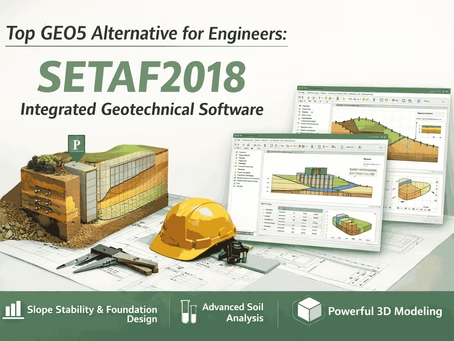
This is where SETAF2018 redefines the landscape as a holistic, production-oriented solution designed to bridge the gap between complex analysis and practical application. Unlike fragmented systems, it offers a unified environment where 3D geotechnical modeling and rigorous design calculations exist within a single file structure, ensuring that your data remains consistent from the first borehole log to the final Bill of Quantities (BOQ). By integrating the transparency of automated geotechnical reporting—where every equation is visible and traceable—with a direct pipeline to CAD-ready drawings, SETAF2018 serves as a powerful alternative for those who need to deliver 100% compliant, authority-ready projects in a fraction of the time. It is a tool built not just for the calculation, but for the entire lifecycle of a geotechnical project.
Why Modern Engineering Offices Seek a GEO5 Alternative
To understand why a shift is occurring, one must first recognize what GEO5 represents. As a long-standing suite of individual programs, GEO5 has traditionally served as a reliable toolkit for specific geotechnical tasks—ranging from analytical slope stability to complex FEM analysis and foundation design. It is a modular standard that has defined the industry for decades by offering deep, specialized solutions for isolated engineering problems. However, as project delivery speeds increase and BIM (Building Information Modeling) becomes a global requirement, the very nature of this modularity has become the primary reason firms search for a GEO5 alternative.
The “Modular vs. Integrated” pain point is not just about software architecture; it is about the cost of fragmented data. In a traditional modular workflow, the engineer is the “manual bridge” between separate programs:
- Disconnected Data Silos: In GEO5, you often buy and operate separate modules for excavation design, pile foundations, and settlement. If a soil parameter changes in the borehole log, the engineer must manually update and re-sync that data across every single opened module.
- The “Multiple File” Burden: Managing dozens of individual project files for a single site creates a high risk of version-control errors and administrative fatigue.
- Lack of a 3D-to-2D Pipeline: Perhaps the most significant bottleneck is the “Drafting Gap.” Most traditional tools end their journey at the calculation result. The engineer is then left to manually translate those coordinates and reinforcement requirements into CAD software. There is no automated bridge that transforms a 3D geotechnical model directly into professional project drawings or a detailed bill of quantities (BOQ).
When we look at the 90% of mainstream geotechnical work—such as shoring systems, standard foundations, and soil improvement—the need for a “Drafting Assistant” is as critical as the “Analytical Engine.” This is where the demand for a more holistic, production-oriented approach arises. Firms are no longer just looking for a calculator; they are looking for an integrated ecosystem that eliminates the manual “copy-paste” culture between analysis, reporting, and drafting. By moving toward a single-file structure that automates the drawing pipeline, engineers can reclaim the time previously lost to repetitive data entry and focus back on high-level design and reliability analysis.
SETAF2018 vs. GEO5: A Strategic Comparison (The Integrated GEO5 Alternative)
The choice between these two platforms represents a choice between two different workflows. While GEO5 provides a deep library of standalone tools, SETAF2018 is built as a singular environment where the analysis, the report, and the CAD drawing are part of the same DNA.
Unified Workflow: The Power of the Single File
The most immediate benefit of SETAF2018 is its Single File Structure. In a standard GEO5 project, an engineer might have five different modules open—Slope Stability, Cantilever Wall, Spread Footing, etc.—each with its own file and data set.
- Data Integrity: In SETAF, your soil profiles, water table levels, and 3D topography are centralized. If you adjust a soil layer’s friction angle ($\phi$) or cohesion ($c$), every dependent analysis—from shoring stability to foundation settlement—updates globally.
- Efficiency: This eliminates the need to manually export and import data between modules, reducing the risk of “transcription errors” that can compromise a project’s safety.
Equation-Based Reporting: Transparent “White-Box” Analysis
For many engineers, the “Killer Feature” of SETAF2018 is its Equation-Based Reporting. Most global geotechnical software, including GEO5, provides “Black-Box” outputs: you get the final tables and graphs, but the intermediate steps remain hidden.
- Authority Approvals: SETAF2018 generates reports that include the actual mathematical formulas, variable substitutions, and step-by-step calculations.
- Verification: This transparency is crucial when submitting reports to municipalities or third-party checkers. Instead of asking the reviewer to “trust the software,” you provide a traceable path that proves compliance with standards like TBDY 2018 or Eurocode 7.
Application-Oriented 3D Modeling
While high-end FEM suites like PLAXIS or MIDAS offer 3D capabilities for research and complex non-linear analysis, they are often disconnected from the “application” phase. SETAF2018 takes a different approach:
- Drafting Integration: The 3D model isn’t just for visualization; it is the source for automated project drawings. It generates plan views and cross-sections that are ready for CAD.
- Metraj & BOQ: It automatically calculates the Bill of Quantities (BOQ), providing instant data on concrete volumes, steel weights, and excavation areas. This transforms the software from a “calculator” into a “production assistant.”
Technical & Strategic Comparison Table
| Feature | SETAF2018 | GEO5 | PLAXIS / MIDAS |
| Workflow Structure | Single Integrated File | Fragmented Modules | Integrated FEM |
| Reporting Style | Step-by-step Equations | Summary Tables | Numerical Results |
| 3D Output | CAD Drawings & BOQ | Analysis Only | Mesh/Stress Analysis |
| Ease of Use | High (Production Focus) | Moderate (Modular) | Low (Steep Learning Curve) |
| Pricing (Approx.) | $500 / Year | Varies by Module | High / Enterprise |
Experience the Integrated Workflow
Efficiency in geotechnical design is best understood through practice. If you are tired of juggling multiple modules and manual report editing, you can explore how a unified environment changes your project timelines.
Try SETAF2018 for Free – Download the Demo Version
At a competitive price point of approximately $500 per year, SETAF2018 offers a high-return investment for firms looking to modernize their 90% “daily bread” projects—shoring, foundations, slope stability, and soil improvement—without the overhead of overly complex FEM systems.
Deep Dive: Where SETAF2018 Outperforms the Giants
In the geotechnical world, there is a clear distinction between “Research Tools” and “Production Tools.” When we look at the data, SETAF2018 carves out a unique space by automating the secondary and tertiary tasks that traditionally take up 70% of an engineer’s time.
Dominating the “90% Market” (Standard Structures)
Most geotechnical offices spend the vast majority of their time on standard structures: shoring systems, retaining walls, and typical foundations. Before comparing paid suites, it is worth establishing what free and open-source geotechnical software covers for that routine work and what it leaves to the engineer.
- The Traditional Gap: While GEO5 handles these calculations excellently, the workflow often stops at the “Result.” The engineer then has to manually draft the sections and calculate the concrete and steel quantities.
- The SETAF Advantage: SETAF2018 treats the calculation as only half the job. It provides a near-complete automated output, designed to bring a project from analysis to the site in record time. Once the analysis is verified, the software instantly generates professional Project Drawings and a detailed Bill of Quantities (BOQ). While most projects are delivered directly to authorities or the construction site with the software’s native output, SETAF2018 typically handles 90% to 100% of the drafting workload automatically. This leaves the engineer with only minor, user-specific refinements in CAD, if any. You aren’t just getting a “Check” on a calculation; you are getting a comprehensive project package that is virtually ready for submission, drastically reducing the time spent on manual drafting.
BIM & 3D Modeling for “Application,” Not Just “Research”
High-end Finite Element Method (FEM) tools like PLAXIS or MIDAS are incredible for research-grade non-linear analysis. However, their 3D models are often “locked” within the analysis environment.
- Research Focus: In heavy FEM, the 3D model is a mesh used to calculate stresses and strains. It is difficult to export this into a usable CAD format for a contractor.
- Application Focus: SETAF2018 approaches 3D Geotechnical Modeling with the end goal in mind. The 3D environment is used to establish spatial relationships between boreholes, excavations, and foundations. This model then feeds directly into the drawing engine, creating plan views and cross-sections that a site foreman can actually use. It turns 3D data into BIM-ready actionable intelligence.
Absolute Compliance: Eurocode 7 Integration
For engineering firms, regulatory compliance is the non-negotiable foundation of every project. While global standards like Eurocode 7 are the benchmark for international work, local regulations often require a deeper level of integration.
- The Global Standard vs. Local Reality: GEO5 is a world-class tool with extensive support for Eurocode and numerous national annexes. However, for firms operating in regions with highly specific seismic codes—such as Turkey’s TBDY 2018—global tools can sometimes require manual overrides or external spreadsheets to align seismic parameters, soil categories, and liquefaction triggering assessments with local authority expectations.
- The Native Advantage: SETAF2018 is engineered to speak the language of both worlds. It provides full compliance with Eurocode 7 for international projects while offering a “native-level” integration of TBDY 2018. This means seismic earth pressure coefficients and dynamic analysis are pre-configured to pass through local authority checks (such as Municipalities or Ministry audits) without the typical back-and-forth regarding code-compliant methodology.
By bridging the gap between global engineering logic and local regulatory nuances, SETAF2018 ensures that your reports are not just mathematically correct, but “audit-ready” for both domestic and international markets.
The “White-Box” Advantage in Reporting
As highlighted in our comparison, the ability to generate a Design Report that displays every single equation is both a psychological and professional win. Reviewers in the public sector are often skeptical of “Software Results” that offer no traceability.
- Transparent Design Calculations: When SETAF2018 performs analytical design tasks—such as bearing capacity or slope stability—it prints the actual Terzaghi or Meyerhof equations with your project’s specific variables substituted in. This removes the “Black-Box” stigma, transforming the software from a hidden calculator into a transparent extension of the engineer’s own expertise.
- Data-Driven Analytical Precision: For complex matrix-based calculations, such as detailed settlement profiles or structural wall analyses where closed-form equations are not applicable, SETAF2018 focuses on high-fidelity data visualization and rigorous output tables. This ensures that while the “math” remains behind the high-performance engine for matrix operations, the results are presented with maximum clarity for audit purposes.
This “White-Box” approach for design reports is a game-changer for authority approvals. Instead of asking a reviewer to “trust the software,” you provide a traceable path that proves compliance with standard engineering logic.
Final Verdict: Selecting the Right GEO5 Alternative for Your Firm
Choosing between these platforms ultimately depends on the “Job-to-be-Done” in your daily operations. Both tools are mathematically rigorous, but they serve different professional philosophies.
Choose GEO5 if:
- Niche Specialization: You handle highly specific, one-off geotechnical problems (such as redi-rock walls or specific bridge abutment designs) that require a standalone, specialized module.
- Modular Preference: You prefer purchasing tools ala-carte and don’t mind the manual data transfer between separate programs.
- Global Research: Your primary focus is on theoretical exploration rather than rapid project delivery and drafting.
Choose SETAF2018 as your primary GEO5 Alternative if:
- Production Speed: You want to complete 90% of your mainstream projects—including shoring, foundations, and soil improvement—in half the time by eliminating “modular fragmentation.”
- End-to-End Automation: You need a tool that doesn’t stop at the calculation but automatically generates professional CAD drawings and a precise Bill of Quantities (BOQ).
- Audit-Ready Transparency: You want to move away from “Black-Box” results and provide reviewers with transparent, equation-based reports that are fully compliant with both Eurocode 7 (EN 1997) for international projects and TBDY 2018 (Turkish Building Earthquake Code) for regional requirements. By displaying the actual mathematical formulas and variable substitutions in analytical design reports, SETAF2018 transforms the software from a hidden calculator into a traceable, “White-Box” extension of the engineer’s expertise, ensuring seamless approvals from both global audit firms and local municipalities.
- Integrated 3D Modeling: You are looking for a unified, single-file environment where 3D modeling is an “Application” tool for the construction site, not just a visual aid.
For the modern engineering office, efficiency is the only way to remain competitive. While the industry “Giants” offer depth, SETAF2018 offers velocity. By integrating analysis, reporting, and drafting into a single, cohesive workflow for just $500/year, it stands out as the most pragmatic GEO5 alternative for engineers who need to move from “survey to site” without the manual bottlenecks of the past.
FAQ: Choosing the Best GEO5 Alternative
What makes SETAF2018 a strong GEO5 alternative for engineering offices?
The primary advantage lies in its transition from a fragmented, modular toolkit to a single integrated environment. While most professionals seeking a GEO5 alternative are frustrated by managing multiple files and manual data entry, SETAF2018 automates the entire workflow from 3D modeling to CAD-ready drawings. This unified structure ensures data integrity and significantly reduces the time spent on administrative drafting and report compilation.
Can I generate authority-ready reports with this GEO5 alternative?
Yes, and this is where SETAF2018 stands out from other GEO5 alternatives by providing transparent, “white-box” reporting. Unlike software that only outputs summary tables, SETAF2018 prints the actual mathematical equations and variable substitutions used in the calculations. This level of detail is crucial for passing through stringent authority checks and third-party audits, as it proves full compliance with codes like TBDY 2018.
How does the 3D modeling in SETAF2018 differ from traditional tools?
In many traditional suites, 3D modeling is either a visual add-on or a complex research mesh that is difficult to translate into construction documents. As a production-focused GEO5 alternative, SETAF2018 uses 3D modeling as a direct source for automated project drawings and Bill of Quantities (BOQ). This means the 3D environment is designed specifically to help you deliver actionable site plans and precise material lists, not just theoretical stress maps.
Is SETAF2018 compliant with international and local earthquake codes?
Absolutely. While many users look for a GEO5 alternative to find better localization, SETAF2018 is built from the ground up to be fully compliant with the Turkish Building Earthquake Code (TBDY 2018) and Eurocode standards. It simplifies complex seismic assessments, such as liquefaction triggering and dynamic earth pressure, ensuring that your designs are both safe and legally compliant in high-seismic regions.