In the specialized field of geotechnical engineering, PLAXIS has long been regarded as the gold standard for high-end geotechnical finite element software. Its capacity to resolve complex non-linear deformations and soil-structure interactions in multi-phase environments is unparalleled for Tier-1 infrastructure projects, such as subsea TBM tunnels or massive dam monitoring systems. However, for the boutique firm or the project manager overseeing urban excavations and foundation designs, a critical “Production Gap” often emerges.
This gap is defined by a simple reality: while advanced FEA tools offer extreme theoretical depth, they often feel like a burden for the 90% of daily engineering tasks—such as standard shoring systems, retaining walls, and routine soil improvements—where workflow velocity is more valuable than excessive theoretical complexity. When a deadline is measured in hours rather than months, spending days perfecting a mesh for a project that requires a standard analytical calculation and a CAD drawing is a significant drain on resources.
Engineers are increasingly seeking a PLAXIS alternative that bridges this gap—not by abandoning scientific rigor, but by automating the secondary and tertiary tasks that traditionally consume the majority of an engineer’s time. This is where SETAF2018 redefines the landscape. By moving from a research-centric mindset to a production-centric one, SETAF2018 focuses on delivering authority-ready project packages and professional project drawings directly from the analysis environment, ensuring that high-level design remains grounded in practical application
Why Engineers are Trading Complexity for Integrated Workflows
The decision to transition toward an integrated platform like SETAF2018 is rarely about a lack of appreciation for high-end numerical methods; rather, it is a strategic response to the systemic friction points inherent in heavy-duty FEA suites. For the practicing engineer, complexity without integration often translates to “computational overhead” that does not necessarily improve the final design reliability.
The Learning Curve Issue
Mastering a pure geotechnical finite element software environment like PLAXIS requires a steep investment in both time and specialized training to avoid the “garbage in, garbage out” trap. Defining boundary conditions, selecting appropriate constitutive models (e.g., Hardening Soil vs. Soft Soil), and ensuring mesh convergence are academic-level tasks that demand high-level expertise. In a fast-paced production office, the overhead of training staff to manage these numerical nuances can be prohibitive. Engineers are increasingly favoring tools that encapsulate this complexity within a more intuitive, application-oriented interface, allowing them to focus on engineering judgment rather than debugging a mesh.
The Modular Bottleneck
Traditional geotechnical tools often suffer from a fragmented “modular” architecture. In a legacy workflow, an engineer might be forced to juggle separate files and programs for different components of the same site: one for shoring design software, another for slope stability, and a third for settlement.
- This fragmentation creates a significant bottleneck: if a borehole log is updated or a soil parameter like the internal friction angle ($\phi$) or cohesion ($c$) is refined, the engineer must manually re-sync that data across every disconnected module.
- SETAF2018 eliminates this risk through a unified single-file approach, where a central 3D geotechnical model ensures that any change to the subsurface data propagates globally across all analysis modules.
Reporting Friction: From Mesh to Authority-Ready Documents
Perhaps the most persistent pain point in the PLAXIS vs SETAF2018 debate is the “reporting gap.” FEA-heavy tools excel at producing colorful stress-strain contours, but these “rainbow maps” often lack the transparency required for municipal audits or third-party verifications.
- Reviewers in high-seismic regions (governed by codes like TBDY 2018) often demand traceable, automated geotechnical reports that show the math.
- While traditional FEA results are often perceived as a “black box,” SETAF2018 provides white-box reporting, displaying the explicit mathematical steps and variable substitutions for critical analytical checks.
For example, when verifying the bearing capacity of a foundation, seeing the explicit substitution in the Terzaghi or Meyerhof equation provides a level of professional defensibility that a raw numerical output cannot match:
qu = c’ Nc sc dc + q Nq sq dq + 0.5 γ B Nγ sγ * dγ
By automating this transition from raw analysis to an authority-ready document, firms can reclaim the time previously lost to manual report compilation and “black-box” justifications.
SETAF2018 vs. PLAXIS: A Strategic Comparison for Firms Seeking a PLAXIS Alternative
When evaluating a PLAXIS alternative, the decision often hinges on how a firm balances computational depth with commercial output. While PLAXIS remains an industry leader for purely numerical simulations, SETAF2018 introduces a paradigm shift by focusing on the “Total Project Lifecycle”—moving beyond raw data to deliver ready-to-construct deliverables.
Hybrid Analysis Engine: The Best of Both Worlds
The core technical distinction lies in the methodology. PLAXIS relies exclusively on the Finite Element Method (FEM), which, while precise, can sometimes be “too sensitive” to minor mesh irregularities or boundary conditions for routine designs.
- SETAF2018 utilizes a Hybrid Analysis Engine that integrates advanced FEM logic with time-tested classical soil mechanics (such as Terzaghi and Meyerhof theories).
- This dual approach allows engineers to verify complex numerical results against analytical benchmarks within the same environment, providing a “sanity check” that is essential for geotechnical safety.
White-Box Reporting: Ending the “Black-Box” Era
For many practitioners, the “Killer Feature” of SETAF2018 is its commitment to White-Box Reporting.
- Unlike PLAXIS, which typically outputs summary tables and stress contours that hide the underlying arithmetic, SETAF2018 generates automated geotechnical reports featuring every mathematical step.
- These reports include explicit variable substitutions and the actual equations used, such as the bearing capacity formula: qu = c’ Nc + q Nq + 0.5 γ B * Nγ
- This level of transparency is not just a convenience; it is a strategic advantage when dealing with municipal reviewers or third-party auditors who require a traceable path to prove compliance with TBDY 2018 or Eurocode 7 standards.
Drafting & BOQ Automation: From Analysis to the Site
Perhaps the most significant “Production Gap” in traditional geotechnical finite element software is where the software stops.
- In a PLAXIS workflow, the “result” is a numerical value or a deformation map; the engineer must then manually draft the sections in CAD and calculate material volumes in spreadsheets.
- SETAF2018 functions as a geotechnical CAD automation tool by instantly generating professional project drawings (plans and sections) and a detailed Bill of Quantities (BOQ) directly from the 3D model.
- It automatically calculates concrete volumes, steel weights, and excavation areas, transforming the software from a simple calculator into a comprehensive production assistant.
Comparison Table: Engineering Production Focus
The following table highlights why firms looking for a cost-effective FEA geotechnical solution are increasingly opting for integrated platforms over fragmented modular suites.
| Feature | SETAF2018 | PLAXIS 2D / 3D |
| Workflow Structure | Single Integrated File (All modules in one) | Pure FEA Environment (Analysis focus; external tools needed for CAD/BOQ) |
| Reporting Style | Integrated Production Pipeline (Analysis, Design, CAD & BOQ) | Table/Graph-Based (Summary results only) |
| Drafting Output | Full CAD Drawings & BOQ (Automated) | Analysis Only (Manual drafting required) |
| Project Fit | Optimized for Daily Production (90% of jobs) | Optimized for Complex Research (10% of jobs) |
| Compliance | Eurocode 7 | General / Global Standards |
| Ease of Use | High (Application-oriented interface) | Low (Steep learning curve) |
Dominating the “90% Market”: Why SETAF2018 is the Practical PLAXIS Alternative for Daily Projects
In the geotechnical industry, a clear distinction exists between “Research Tools” and “Production Tools.” While high-end FEA software is indispensable for specialized 10% of projects—such as complex tunnel-structure interactions—the vast majority of an office’s “daily bread” consists of standard shoring, foundations, and slope stability. SETAF2018 is engineered specifically to dominate this 90% market by automating the secondary tasks that traditionally consume the bulk of an engineer’s billable hours.
Shoring & Deep Excavations: Advanced Modeling without the Setup
Deep excavation design requires a delicate balance between safety and cost-efficiency. While PLAXIS offers sophisticated material laws, the manual setup of stages and boundary conditions can be cumbersome for routine urban pits.
- Mohr-Coulomb & Linear FEM Integration: SETAF2018 utilizes the widely-trusted Mohr-Coulomb material model within its finite element framework, providing reliable stress-strain results and linear FEM analysis for standard production work
- Stage-Wise Automation: The software automates the transition between excavation stages, anchor pre-stressing, and support activation, ensuring that the shoring design software workflow remains fluid.
- Integrated Analysis: By combining FEM with classical earth pressure theories, SETAF2018 provides a double-check system that ensures compliance with global excavation codes like Eurocode 7.
Foundation Design: From 3D Settlement to Reinforcement Schedules
Traditional workflows often stop once the settlement is calculated, leaving the engineer to manually determine the structural requirements. SETAF2018 bridges this gap by turning analytical data into construction-ready intelligence.
- One-Click Schedules: Unlike tools that only provide a numerical “check,” SETAF2018 can move from a 3D settlement analysis directly to automated reinforcement schedules and Bill of Quantities (BOQ).
- Unified Foundation Modeling: SETAF2018 solves all foundations entered in the model as an interactive and integrated system. It performs settlement calculations at user-defined settlement points to determine differential settlements across the foundation layout, while also calculating the bearing capacity for each individual foundation. This allows engineers to evaluate foundation interaction, settlement behavior, and soil capacity within a single unified workflow.
- Automatic BOQ: Concrete volumes and steel weights are calculated instantly, providing the project manager with immediate data for cost estimation.
Slope Stability: The Practicality of LEM vs. Pure FEM
While Finite Element Method (FEM) is powerful for understanding internal stress distribution, the Limit Equilibrium Method (LEM) remains the industry standard for daily slope stability due to its speed and intuitive safety factors.
- Efficiency in Daily Work: SETAF2018 utilizes LEM for slope stability, which is often more practical for routine projects than the computationally expensive and sensitive “phi-c reduction” methods used in pure FEM.
- Complex Geometry Support: Even with LEM, the software supports complex layered soil profiles, groundwater effects, and various reinforcement types like anchors or soil nails.
- Rapid Iteration Approach: For projects requiring high reliability, SETAF2018 leverages the speed of LEM to perform thousands of iterations in seconds, ensuring that the critical slip surface is identified much faster than manual FEM meshing processes.
By focusing on these core production areas—deploying FEM where it matters most, like in shoring design, and utilizing high-speed LEM for slope stability—SETAF2018 serves as a cost-effective geotechnical solution. It doesn’t just calculate; it delivers the entire project package by bridging the gap between advanced analysis and automated drafting.
Bridging the Gap: Regional Compliance (TBDY 2018) and Global Standards (Eurocode 7)
For engineering firms, regulatory compliance is the non-negotiable foundation of every project. While global standards like Eurocode 7 are the benchmark for international work, local regulations often require a deeper level of integration that general-purpose geotechnical finite element software may struggle to provide natively.
The “Native” Advantage vs. General Global Tools
Software like PLAXIS is built as a general numerical engine designed to handle any geometry globally. However, this “general” nature means that for region-specific codes like Eurocode 7, the engineer often becomes the “manual bridge”:
- Manual Parameter Overrides: In global tools, seismic coefficients, soil categories, and spectrum functions often require manual calculation in external spreadsheets before being imported into the software.
- SETAF2018’s Native Approach: As a specialized PLAXIS alternative, SETAF2018 is engineered with these codes in its “DNA.” It provides a native-level integration of Eurocode 7 , meaning seismic earth pressure coefficients ($K_{ae}$ and $K_{pe}$) and dynamic analysis parameters are pre-configured to align with local authority expectations.
- Audit-Ready Outputs: Because the software “speaks the language” of the local building code, the reports it generates are formatted to pass through municipal or ministry audits without the typical back-and-forth regarding code-compliant methodology.
Seamless Seismic and Liquefaction Assessments
Seismic safety is a primary concern in geotechnical design, yet many high-end FEA tools treat liquefaction as a research-grade problem requiring complex non-linear constitutive models and time-history data.
- Streamlined Liquefaction Analysis: SETAF2018 offers a streamlined approach to liquefaction analysis by integrating SPT-based empirical methods—the industry standard for daily practice—directly into the 3D environment.
- Integrated Seismic Demand: The software automatically calculates seismic demands on shoring design software modules and foundations, ensuring that pseudo-static or dynamic assessments are performed in accordance with the latest seismic hazard maps.
- Efficiency in High-Seismic Regions: By automating the triggering assessments and post-liquefaction settlement calculations, SETAF2018 allows engineers to finalize complex earthquake-resistant designs in a fraction of the time it would take to manually set up a dynamic FEA mesh.
By bridging the gap between global engineering logic and regional regulatory nuances, SETAF2018 ensures that your projects are not just mathematically sound, but “submission-ready” for both domestic and international markets.
Strategic Selection: When to Deploy SETAF2018 vs. PLAXIS
Choosing between these two powerhouses isn’t about which software is “better,” but which is more appropriate for the specific geotechnical engineering challenge at hand. A productive office knows that using a high-end FEA suite for a simple retaining wall is as inefficient as using a spreadsheet for a complex tunnel-structure interaction.
Use SETAF2018 for:
- High-Velocity Production: When you need to deliver 100% compliant, authority-ready project packages (including CAD drawings and BOQ) for shoring, foundations, and soil improvement in hours rather than days.
- Regulatory Submissions: Specifically for projects governed by Eurocode 7, where transparent, equation-based reports are mandatory for municipal approvals.
- Standard Foundations & Slopes: Routine bearing capacity, 3D settlement profiles, and slope stability (LEM) where practical engineering judgment must be backed by fast, verifiable math.
Use PLAXIS for:
- Complex Infrastructure & Tunnels: Large-scale underground projects requiring detailed analysis of TBM face pressures, lining segment stresses, and complex 3D soil-structure interactions.
- Advanced Research & Non-Linearity: Highly specialized projects involving time-dependent creep, transient heat flow, or complex dynamic responses that require a pure, high-resolution FEM environment.
- Dam & Embankment Monitoring: Critical structures where long-term consolidation, pore pressure dissipation, and flow-deformation coupling are the primary design drivers.
- Academic & High-End Consultancy: When the goal is an exhaustive numerical investigation rather than rapid project delivery or CAD production.
By strategically selecting the right PLAXIS alternative for your mainstream work, you can reserve your high-end FEA resources for the projects that truly demand them, optimizing both your office’s billable hours and its technical accuracy.
The ROI Factor: Is a $500/Year PLAXIS Alternative Enough for Professional Firms?
In the business of geotechnical consulting, the “best” tool is the one that offers the highest return on investment (ROI) without compromising safety. While enterprise-grade FEA suites like PLAXIS are essential for specialized, non-linear infrastructure simulations, the high maintenance costs and technical overhead often eat into the profit margins of standard projects. This is why many firms are pivoting to SETAF2018 as a high-performance PLAXIS alternative that balances advanced logic with industrial-speed delivery.
Analyzing the Cost Gap: Enterprise FEA vs. Production-Focused Tools
The financial disparity between traditional FEA suites and modern integrated platforms is significant:
- License Fees: A typical license for high-end geotechnical finite element software like PLAXIS can cost thousands of dollars annually per user. SETAF2018, as a cost-effective FEA geotechnical solution at approximately $500/year, allows firms to equip their entire team rather than relying on a single “specialist” workstation.
- Computational Overhead: While PLAXIS requires high-performance hardware and significant time for mesh convergence , SETAF2018 is optimized for the “90% market,” running complex designs on standard engineering laptops without the specialized GPU requirements.
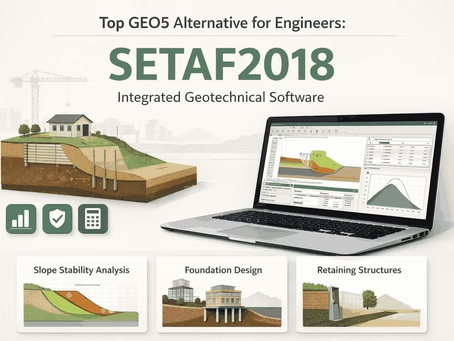
- The “Alternative” Landscape: Many users also consider SETAF2018 a strong GEO5 alternative because it avoids the “modular fatigue” of buying separate tools for every task, offering an all-in-one environment that mimics the power of PLAXIS but with the agility of a production tool.
Time-Saving Metrics: From 3-Day Modeling to 3-Hour Delivery
The true ROI of a software switch is measured in “hours reclaimed.” In a traditional, heavy FEA-centric workflow, the process is often fragmented:
- Days 1-2 (Modeling): Spending hours on manual mesh refinement, defining complex boundary conditions, and debugging convergence in a pure numerical environment.
- Day 3 (Post-Processing): Manually extracting nodal displacements and forces to create CAD drawings and calculation reports in external software.
The SETAF2018 Workflow Advantage: By utilizing a single-file integrated approach, SETAF2018 turns a 3-day modeling marathon into a 3-hour project delivery:
- Zero-Sync Design: Because the 3D model, analytical engine, and drawing tools exist in one environment, any change to a soil parameter ($c$ or $\phi$) updates the entire project globally.
- Automated Deliverables: The moment your analysis is verified, the software instantly generates your automated geotechnical reports and CAD-ready sections.
By reclaiming 70% of the time usually spent on administrative drafting and manual data entry, firms can increase their project volume without increasing headcount.
Ready to Modernize Your Geotechnical Workflow?
If you are tired of the modular bottlenecks and the “black-box” reporting of traditional FEA tools, it’s time to experience a workflow built for the modern engineer. Whether you need a more practical PLAXIS alternative for daily designs or an integrated tool that outperforms the standard modular suites, our team is here to help you transition to a faster, more transparent design process.
Contact us today to request a free trial or explore our licensing options.
FAQ: Common Questions on Switching to a PLAXIS Alternative
Why is SETAF2018 a strong alternative to PLAXIS 2D for daily production?
While PLAXIS is an industry titan for complex numerical research—utilizing advanced 2D and 3D finite element modeling—its specialized focus often creates a “bottleneck” in high-volume production environments where speed is critical. SETAF2018 serves as a pragmatic alternative by providing a hybrid environment that integrates targeted FEM logic (optimized for shoring analysis) with automated CAD drafting and equation-based reporting—tasks that are traditionally manual in PLAXIS.
This allows engineering firms to handle the 90% of mainstream projects, such as shoring and foundations, with significantly lower computational overhead and faster authority approval times. While PLAXIS excels at high-end non-linear simulations, SETAF2018 bridges the gap between analysis and site-ready deliverables, ensuring that your billable hours are spent on design judgment rather than complex mesh debugging.
Can I trust the results of a PLAXIS alternative?
Trust in geotechnical engineering is built on transparency and verification. Unlike “black-box” systems that offer a single numerical output, SETAF2018 is built on a Multi-Method Verification approach. This ensures that the most appropriate scientific method is applied to each specific geotechnical challenge: for deep excavations, the software utilizes targeted finite element logic (1D beam elements) to capture soil-structure interaction , while for 90% of daily tasks like settlement and slope stability, it relies on time-tested analytical methods such as Terzaghi, Meyerhof, and Limit Equilibrium. The results are further solidified by White-Box reporting, which displays the explicit mathematical substitutions and formulas used in every check. This dual-layer of verification ensures the engineer can verify the software’s logic at every step, providing the professional defensibility essential for submitting projects to municipalities or third-party auditors.
How does the drawing automation work compared to traditional workflows?
In a standard PLAXIS workflow, the software’s journey ends at the calculation result, leaving the engineer to manually draft plans and sections in a separate CAD environment. SETAF2018 functions as a geotechnical CAD automation tool by utilizing the data from the 3D geotechnical model to instantly generate professional-grade plans, cross-sections, and details. This automated pipeline ensures that the physical dimensions in your drawing are perfectly synced with the analytical model, eliminating transcription errors between the calculation and the final blueprint. Furthermore, it simultaneously generates a Bill of Quantities (BOQ), providing concrete and steel volumes that are construction-ready the moment the analysis is finalized.
Is SETAF2018 compliant with the latest seismic codes like Eurocode 7?
A major reason for choosing SETAF2018 over global tools is its native, deep integration with regional regulations such as the Eurocode 7. While general-purpose tools often require external spreadsheets to calculate seismic earth pressure or liquefaction triggering, SETAF2018 automates these assessments directly within the analysis workflow. It pre-configures seismic hazard maps and dynamic parameters to ensure that every shoring or foundation design is inherently “audit-ready” for local authorities. This localized intelligence saves hours of manual data entry and ensures that your reports meet the specific documentation standards required for rapid project approval.
How does SETAF2018 handle complex 3D topography and borehole data?
Efficient site modeling is the foundation of any reliable analysis, and SETAF2018 simplifies this by offering a unified 3D geotechnical modeling environment. The software allows you to import and interpolate multiple borehole logs to create a continuous subsurface profile, which then serves as the geometric basis for all subsequent stability and settlement analyses. Unlike fragmented systems where you must define the soil layers for each 2D section manually, SETAF2018’s single-file structure means a change to one borehole automatically propagates through every cross-section in the project. This ensures absolute data integrity across the entire site, allowing for more accurate spatial assessments of soil-structure interaction than traditional 2D modular tools.