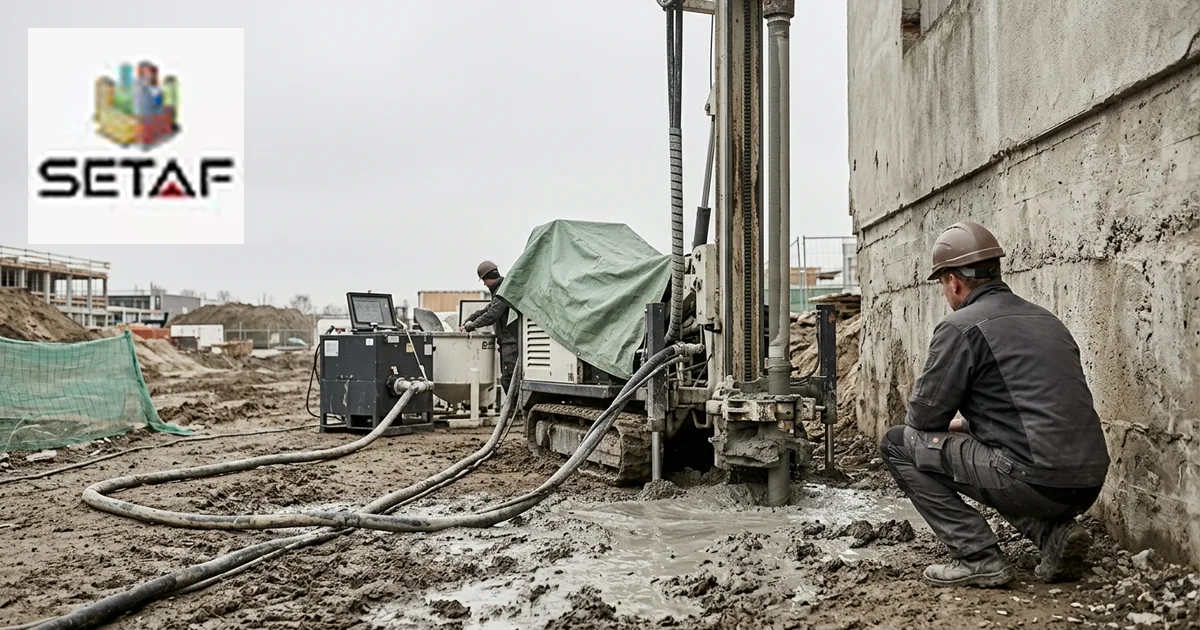
Jet grouting forms columns of cemented soil by injecting grout at very high pressure through nozzles on a rotating drill string. The jet erodes the soil in place, part of the eroded material is displaced to the surface as spoil, and the remainder is mixed with the grout to form a column of soil–cement.
The distinction from deep soil mixing is mechanical rather than chemical, and it determines where each technique is appropriate.
Deep soil mixing blends the soil. Jet grouting cuts it and partly replaces it.
Because the soil is eroded hydraulically rather than blended by a mechanical tool, jet grouting can be carried out in ground that mixing augers cannot penetrate, in confined spaces, beneath existing structures, and around obstructions. The cost of that flexibility is greater variability in the geometry and the properties of the result.
The Three Systems
| System | Fluids injected | Typical column diameter | Characteristics |
|---|---|---|---|
| Single fluid | Grout only | Smallest | Simplest and cheapest; least effective in cohesive soils |
| Double fluid | Grout shrouded in compressed air | Intermediate | Air extends the effective range of the jet |
| Triple fluid | Water jet with air, grout injected separately | Largest | Erosion and grouting separated; highest replacement, cleanest result |
The choice affects diameter, strength, spoil volume, and cost, and all four move together. A triple fluid system produces larger and more uniform columns in difficult soils but generates far more spoil and takes longer per column.
Column diameter is not specified in the way a pile diameter is. It is a result of the energy delivered by the jet against the resistance of the soil, and it varies with soil type along the length of a single column. Coarse granular soils erode readily and produce larger columns; stiff and plastic clays resist erosion and produce smaller, less uniform ones. Diameter is estimated from the system, the energy parameters, and experience in comparable ground, then confirmed by trial columns.
The Design Parameters
Design of a jet grout column addresses three questions: how large it is, how strong it is, and how stiff it is.
The strength side is carried by the unconfined compressive strength qu, which is the primary design quantity, together with the water-to-cement ratio w/c of the injected grout and the column efficiency coefficient βe that relates achievable strength to the soil and the system in use. From qu follows the shear strength Sc used in a total stress model.
The deformation side requires the elastic modulus Ec for settlement and composite analysis, the unit weight γc of the treated material, and Poisson’s ratio νc for the composite properties of the treated zone.
The three quantities that are chosen rather than derived — w/c, βe and qu — are treated in turn below.
The Water-to-Cement Ratio
The water-to-cement ratio of the injected grout governs the strength of the cemented matrix in the same way it does in concrete: a leaner grout produces a stronger column, at the cost of being harder to pump and to jet effectively.
The relationship is not as direct as in concrete, because the grout mixes with soil and with the water already present in that soil. The final water-to-cement ratio in the column is higher than the ratio at the pump, and the difference depends on the soil’s natural water content and on how much soil is replaced rather than mixed.
The βe Coefficient
Achievable strength depends on the soil being treated as much as on the grout. A jet grout column in clean sand and a column in high-plasticity clay, formed with identical grout and identical energy, do not have the same strength.
The βe coefficient carries that dependence. It is a tabulated efficiency factor, selected from the soil type and the jetting system, that relates the achievable column strength to the grout properties. Cohesive soils — particularly plastic clays, where clay lumps survive the jetting and are enveloped rather than dispersed — take substantially lower values than granular soils.
Column properties can therefore be established in one of two ways: from the water-to-cement ratio directly, or through the βe coefficient with the tabulated values for the soil and system in question.
A jet grout column is designed twice: once at the desk, and once by the ground it happens to encounter.
Strength and Stiffness
The shear strength used in analysis follows from the unconfined compressive strength on a total stress basis with the friction angle set to zero:
Sc = qu / 2
The elastic modulus is obtained from correlations with qu. As with all soil–cement materials, these correlations carry considerable scatter — greater for stiffness than for strength — which is why stiffness-sensitive designs justify site-specific testing rather than reliance on published relationships.
The Composite Modulus
A jet grouted zone consists of stiff columns within untreated soil, and the analysis represents both through an area-weighted composite modulus:
Ecom = ( n · Ac · Ec + ( A − n · Ac ) · Es ) / A
where A is the treated block area, n the number of columns, Ac the cross-sectional area of one column, Ec the column modulus, and Es the modulus of the untreated soil. The derivation assumes columns and soil deform equally in the vertical direction.
The soil profile is then re-layered with composite properties across the treated depth, and settlement analysis proceeds as for untreated ground.
The area ratio deserves attention here more than in deep soil mixing, because jet grout column diameter is itself uncertain. An assumed diameter that proves optimistic reduces the area ratio and the composite modulus together, and settlement increases accordingly. This is the principal reason trial columns are excavated or cored before production begins.
What Jet Grouting Is Used For
| Application | What the columns provide |
|---|---|
| Settlement reduction | Higher composite stiffness across the treated depth |
| Bearing capacity increase | Load carried through shaft and base resistance of the columns |
| Underpinning | Support installed beneath an existing structure without excavation |
| Excavation base plugs and cut-offs | Overlapping columns forming a low-permeability barrier |
| Liquefaction mitigation | Stiff inclusions attracting seismic shear stress from the soil |
| Treatment around obstructions | Columns formed where mechanical tools cannot reach |
Underpinning and works beneath existing structures are where jet grouting has no straightforward alternative. A drill string can be advanced at an angle from a confined position and form a column beneath a footing without excavating beside it — which is why the technique persists despite its variability and cost.
For liquefaction mitigation the mechanism is the same shear stress redistribution that applies to any stiff inclusion: because the columns are far stiffer than the surrounding soil, they attract a disproportionate share of the earthquake-induced shear stress, reducing the cyclic stress ratio in the soil between them.
Verification
The uncertainty in a jet grout column is geometric as much as material, and verification addresses both.
Trial columns formed before production and then exposed by excavation or cored give the achieved diameter and its variability with depth. Cores taken from production columns give strength and continuity. Spoil return is monitored during production, because a sudden change in spoil volume or character indicates that the ground has changed and the column being formed is not the column that was designed.
Where columns are intended to overlap — for a cut-off or a base plug — verticality tolerance becomes the governing constraint. Small deviations accumulate with depth, and two adjacent columns that overlap at the top may not overlap at the base. A designed overlap that does not account for drilling tolerance produces a barrier with windows in it.
Jet Grouting or Deep Soil Mixing?
| Jet grouting | Deep soil mixing | |
|---|---|---|
| Mechanism | Hydraulic erosion and partial replacement | Mechanical blending in place |
| Access | Small rigs; works in confined space and under structures | Requires larger equipment and headroom |
| Obstructions | Can work around them | Impeded by them |
| Column diameter | Variable, energy-dependent | Determined by tool diameter |
| Uniformity | Lower | Higher |
| Spoil | Substantial | Little or none |
| Cost per cubic metre of treated ground | Higher | Lower |
| Best suited to | Underpinning, confined sites, targeted treatment | Large open sites, volume treatment |
The comparison is set out in more detail alongside the deep soil mixing design method. The short version is that deep soil mixing is more economical where a large volume of open ground must be treated, and jet grouting is chosen where access, obstructions, or an existing structure make mixing impractical.
Common Errors in Jet Grouting Design
| Error | Consequence |
|---|---|
| Specifying a column diameter without trial columns | Assumed area ratio not achieved; composite stiffness overestimated |
| Using a single βe across a variable profile | Strength overestimated in the cohesive layers |
| Ignoring the soil’s natural water content in the effective water-to-cement ratio | Achieved strength lower than designed |
| Designing overlapping columns without a verticality allowance | Cut-off with gaps at depth |
| Treating stiffness correlations as reliable | Settlement prediction based on the most scattered parameter |
| Applying the equal-strain assumption beneath a flexible foundation | Load distribution between column and soil misrepresented |
| Selecting jet grouting on cost alone for large open sites | A more expensive technique used where mixing would serve |
Where SETAF2018 Fits
SETAF2018 treats jet grout columns as one of several rigid inclusion types within the same foundation model, alongside bored piles, micropiles, and deep soil mixing columns.
Column properties are defined on the material. The unconfined compressive strength qu can be entered directly or established from the grout water-to-cement ratio or the βe coefficient, with the tabulated βe data provided for selection by soil type and system. Shear strength is taken as qu/2 for a total stress model with the friction angle set to zero, and the elastic modulus Ec and unit weight are entered or obtained from correlations.
Columns are placed beneath rectangular, circular, or polygonal foundations, either individually by coordinate or as an automatically generated group at a chosen spacing, with layouts adjustable afterwards. The treated zone is re-layered with composite properties Ecom and νcom obtained by area weighting, and settlement is calculated through that profile. Bearing capacity of the columns is calculated by the same shaft and base methods used for piles, and where the surrounding soil is compressible, negative skin friction and the neutral plane are evaluated.
Where the ground is liquefiable, the effect of the columns is evaluated through the stress reduction factor derived from the area ratio and shear modulus ratio, for both compatible and incompatible deformation cases, connecting to the liquefaction assessment. Column layouts, quantities, and reports carrying the design equations are produced from the same model, within the wider foundation analysis workflow.
Frequently Asked Questions
What is jet grouting?
It is a ground improvement technique in which grout is injected at very high pressure through nozzles on a rotating drill string, eroding the soil in place and mixing with it to form a column of soil–cement. Part of the eroded soil is displaced to the surface as spoil.
What is the difference between jet grouting and deep soil mixing?
Jet grouting erodes the soil hydraulically and partly replaces it; deep soil mixing blends it mechanically in place. Jet grouting works in confined spaces, beneath structures, and around obstructions, but produces more variable columns and more spoil at higher cost per unit volume.
What are single, double and triple fluid systems?
Single fluid injects grout alone. Double fluid shrouds the grout jet in compressed air to extend its range. Triple fluid separates erosion from grouting, using a water jet with air to erode and injecting grout separately, producing the largest and most uniform columns and the most spoil.
What determines jet grout column diameter?
The energy delivered by the jet against the resistance of the soil. Coarse granular soils erode readily and give larger columns; stiff plastic clays resist erosion and give smaller, less uniform ones. Diameter varies along a single column and is confirmed by trial columns rather than specified.
What is the βe coefficient?
It is a tabulated efficiency coefficient relating achievable column strength to the soil type and the jetting system used. It carries the dependence of strength on the ground being treated, and takes substantially lower values in plastic cohesive soils than in granular soils.
How does the water-to-cement ratio affect column strength?
A lower ratio produces a stronger cemented matrix, as in concrete. The relationship is less direct because the grout mixes with the soil and the water already in it, so the effective ratio in the column is higher than the ratio at the pump.
How is a jet grouted zone represented in settlement analysis?
As a composite layer whose modulus is area-weighted between the columns and the untreated soil, assuming equal vertical deformation. The soil profile is re-layered accordingly and settlement analysis proceeds normally.
Why do trial columns matter so much?
Because column diameter is a result rather than an input, and the composite stiffness depends directly on it. A diameter that proves smaller than assumed reduces the area ratio and increases settlement. Trial columns, exposed or cored, are the only reliable confirmation before production.