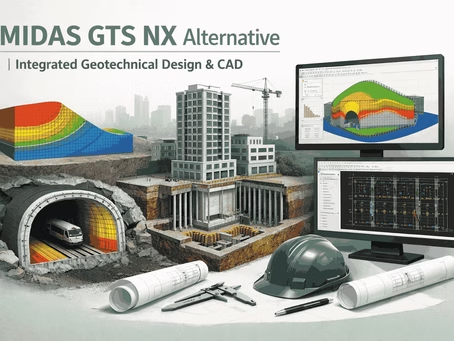
In the specialized field of geotechnical engineering, MIDAS GTS NX has long been regarded as the “Academic Titan”—an unrivaled powerhouse for high-end finite element modeling (FEM) in Tier-1 infrastructure projects, such as subsea TBM tunnels or massive dam monitoring systems. Its capacity to resolve complex non-linear deformations and soil-structure interactions is unparalleled for purely numerical simulations. However, for the modern engineering office, a critical “Production Bottleneck” often emerges when deep numerical research begins to slow down commercial project delivery.
The reality of the 2026 market is that 90% of daily engineering tasks—such as standard shoring systems, retaining walls, and routine soil improvements—require workflow velocity more than theoretical extremity. When a deadline is measured in hours rather than months, spending days perfecting a mesh for a standard analytical calculation is a significant drain on resources.
This is why high-velocity firms are increasingly seeking a MIDAS alternative that bridges this gap—not by abandoning scientific rigor, but by automating the secondary tasks that consume the majority of an engineer’s time. SETAF2018 redefines this landscape by moving from a research-centric mindset to a production-centric one. While traditional FEA tools end their journey at a numerical result, SETAF2018 focuses on delivering authority-ready project packages and professional CAD drawings directly from the 3D analysis environment. It is a strategic response to the systemic friction points of heavy-duty suites, ensuring that high-level design remains grounded in practical, “Survey-to-Site” application.
Why Engineers are Seeking a MIDAS Alternative for Daily Production
There is no denying that MIDAS GTS NX is a premier solution for complex geotechnical problems. Its sophisticated element libraries and ability to perform non-linear time history analysis make it indispensable for high-stakes, specialized projects like the Bosporus Third Bridge. However, the very depth that makes it an “Academic Titan” creates systemic friction in a high-volume production environment.
The modern engineering office operates on tight margins where the goal is a safe, compliant, and constructible design. For the 90% of projects that constitute an office’s “daily bread”—such as urban excavations and standard foundations—the theoretical overhead of high-end FEM can become a liability. Engineers are increasingly pivoting toward SETAF2018 not because they lack appreciation for numerical depth, but because they need a tool that speaks the language of the construction site as fluently as the language of soil mechanics.
The shift toward a more integrated alternative is driven by two primary friction points:
- The Specialization Barrier: Mastering a pure FEA environment like MIDAS requires a steep investment in training to correctly define boundary conditions and avoid mesh convergence errors. SETAF2018 addresses this by being application-oriented; it encapsulates complexity within an intuitive interface, allowing practicing engineers to focus on professional judgment rather than debugging a mesh.
- The “Rainbow Map” vs. The Project Package: In a MIDAS workflow, the primary output is often a colorful stress-strain contour (the “rainbow map”), which still requires the engineer to manually draft sections in CAD and calculate material volumes in spreadsheets. SETAF2018 closes this “Production Gap” by functioning as a geotechnical CAD automation tool.
- Workflow Velocity: While heavy-duty FEM tools often leave the engineer as the “manual bridge” between analysis and drafting, SETAF2018 instantly generates professional project drawings and a detailed Bill of Quantities (BOQ) directly from the model.
- Transparent Reporting: Reviewers and municipal auditors often struggle with “black-box” numerical outputs; SETAF2018 provides “white-box” reporting that displays explicit mathematical steps and variable substitutions for analytical checks.
- Modular Integration: Unlike fragmented suites where a change in a borehole log requires manual re-syncing across separate programs, SETAF2018 utilizes a unified single-file approach where data propagates globally.
Strategic Comparison: Production-Focused FEM vs. Research-Focused FEM
The technical distinction between MIDAS GTS NX and SETAF2018 lies in their core analytical philosophies. MIDAS is engineered as a pure Finite Element Method (FEM) environment, designed to solve complex non-linear problems by discretizing entire 3D volumes into high-resolution meshes. While this provides unparalleled precision for unique geological anomalies, it can be “too sensitive” for routine production work, where minor mesh irregularities can lead to convergence errors.
SETAF2018, by contrast, utilizes a Hybrid Analysis Engine. This approach integrates advanced FEM logic for soil-structure interaction—such as shoring analysis—with time-tested classical soil mechanics (e.g., Terzaghi, Meyerhof, and Limit Equilibrium Methods). For the practicing engineer, this hybridity acts as a built-in “sanity check,” allowing them to verify complex numerical results against analytical benchmarks within a single environment.
Engineering Production Focus: SETAF2018 vs. MIDAS
The following table highlights the strategic trade-offs between these two platforms, emphasizing why firms seeking a cost-effective production tool are pivoting toward integrated workflows.
| Feature | SETAF2018 | MIDAS GTS NX |
| Workflow Structure | Single Integrated File: All modules (Shoring, Foundations, Slope) in one | Pure FEA Environment: Analysis-focused; requires external tools for CAD/BOQ |
| Analysis Methodology | Hybrid: FEM + Classical Engineering (Terzaghi/Meyerhof) | Pure FEM: High-resolution numerical simulation |
| Standard Structures (%90) | Optimized: Rapid delivery for routine daily projects | Challenging: High setup time for standard tasks |
| Reporting Style | White-Box: Step-by-step equations and variable substitutions | Black-Box: Numerical summary tables and stress contours |
| Drafting Output | Automated: Full CAD Drawings & Bill of Quantities (BOQ) | Manual: Analysis only; drafting required in external software |
| Learning Curve | Application-Oriented: Lower barrier for practicing engineers | Research-Oriented: Steep curve requiring FEA specialists |
By deploying FEM where it matters most—such as capturing displacements in shoring design—while utilizing high-speed analytical methods for bearing capacity and settlement, SETAF2018 ensures that rigor does not come at the expense of speed. This makes it a pragmatic MIDAS alternative for firms that need to move from raw data to a construction-ready project package without the administrative friction of a research-grade suite
The “White-Box” Advantage: Ending the Era of Geotechnical “Black-Boxes”
One of the most persistent pain points in high-end finite element analysis is the “reporting gap”. While MIDAS GTS NX excels at producing complex numerical tables and colorful stress-strain contours, these outputs are often perceived as a “black box” by external auditors. The underlying arithmetic remains hidden within the software’s engine, making it difficult to verify the results without re-running the entire model.
SETAF2018 redefines professional defensibility through White-Box Reporting. Instead of asking a reviewer to “trust the software,” it generates automated geotechnical reports that display the explicit mathematical steps and variable substitutions used for critical analytical checks.
Traceability and Authority Approvals
For engineering firms, regulatory compliance is the non-negotiable foundation of every project. The transparency of SETAF2018 is a strategic advantage when dealing with global standards such as Eurocode 7.
- Explicit Formulas: Unlike MIDAS, which typically outputs summary results, SETAF2018 prints the actual equations used, such as the Terzaghi or Meyerhof bearing capacity formulas.
- Variable Substitution: The reports show the exact values substituted into these equations (e.g., $c’$, $\phi$, and unit weight), allowing a reviewer to follow the logic manually.
- Audit-Ready Documentation: This level of detail transforms the software from a hidden calculator into a transparent extension of the engineer’s expertise, specifically formatted to pass through municipal or ministry audits without the typical back-and-forth regarding methodology.
- Reduced Verification Time: By providing a traceable path to the final result, firms can significantly reduce the time spent justifying “black-box” outputs to third-party checkers.
By moving away from raw numerical outputs and toward Equation-Based Reporting, SETAF2018 ensures that your designs are not just mathematically sound, but “submission-ready” for international markets governed by Eurocode 7
Dominating the “90% Market”: Shoring, Foundations, and Slope Stability
In the geotechnical industry, a clear distinction exists between “Research Tools” and “Production Tools.” While high-end FEA software like MIDAS GTS NX is indispensable for the specialized 10% of projects—such as complex tunnel-structure interactions—the vast majority of an office’s “daily bread” consists of standard shoring, foundations, and slope stability. SETAF2018 is engineered specifically to dominate this 90% market by automating the secondary tasks that traditionally consume the bulk of an engineer’s billable hours.
Shoring & Excavations: Advanced Modeling without the Setup
Deep excavation design requires a delicate balance between safety and cost-efficiency. While MIDAS offers sophisticated material laws, the manual setup of 3D solid meshes and complex boundary conditions can be cumbersome for routine urban pits.
- 1D Beam-Spring Efficiency: SETAF2018 utilizes targeted finite element logic (1D beam elements) to capture soil-structure interaction, allowing for rapid iteration during the design phase.
- Reliable Material Models: The software utilizes the widely-trusted Mohr-Coulomb material model within its framework, providing reliable stress-strain results for standard production work.
- Stage-Wise Automation: It automates the transition between excavation stages and support activation, ensuring the workflow remains fluid compared to the heavy setup required in global FEA tools.
3D Foundation Interaction: Unified Modeling
Traditional workflows often stop once the settlement is calculated, leaving the engineer to manually determine the structural requirements. SETAF2018 bridges this gap by turning analytical data into construction-ready intelligence.
- Unified Foundation Modeling: SETAF2018 solves all foundations entered in the model as an interactive and integrated system.
- Global Updates: It performs settlement calculations at user-defined points; any change to subsurface data propagates globally across the model to determine differential settlements instantly.
- Interactive Evaluation: This allows engineers to evaluate foundation interaction, settlement behavior, and soil capacity within a single unified workflow rather than disconnected modules.
Slope Stability: The Practicality of LEM vs. Pure FEM
While the Finite Element Method (FEM) is powerful for understanding internal stress distribution, the Limit Equilibrium Method (LEM) remains the industry standard for daily slope stability due to its speed and intuitive safety factors.
- Efficiency in Daily Work: SETAF2018 utilizes LEM for slope stability, which is often more practical for routine projects than the computationally expensive and sensitive “phi-c reduction” methods used in pure FEM suites like MIDAS.
- Rapid Iteration: For projects requiring high reliability, SETAF2018 leverages the speed of LEM to perform thousands of iterations in seconds to identify the critical slip surface.
- Complex Support: Even with the high-speed LEM approach, the software supports complex layered soil profiles and various reinforcement types like anchors or soil nails.
By focusing on these core production areas—deploying targeted FEM logic where it matters most and high-speed LEM where efficiency is key—SETAF2018 serves as a cost-effective geotechnical solution that delivers the entire project package.
From Analysis to the Site: Automated Geotechnical CAD & BOQ
Perhaps the most significant “Production Gap” in traditional geotechnical finite element software is where the software stops. In a MIDAS GTS NX workflow, the “result” is typically a numerical value or a deformation map; the engineer must then manually draft the sections in CAD and calculate material volumes in spreadsheets. SETAF2018 functions as a geotechnical CAD automation tool by instantly generating professional project drawings directly from the 3D model.
The Drafting Assistant: Eliminating Manual CAD Bottlenecks
Traditional tools often end their journey at the calculation result, leaving the engineer stuck in a loop of manual drafting. SETAF2018 redefines this process:
- Direct CAD Generation: Unlike MIDAS, which requires external tools for drafting, SETAF2018 creates plan views and cross-sections that are ready for implementation.
- Automated Output: The software provides a near-complete automated output, designed to bring a project from analysis to the site in record time.
- 3D to 2D Pipeline: The 3D environment serves as the source for automated project drawings, ensuring the physical dimensions in the blueprint are perfectly synced with the analytical model.
- Workflow Efficiency: While most projects are delivered directly to authorities with the software’s native output, SETAF2018 typically handles 90% to 100% of the drafting workload automatically.
Instant Metraj: Turning Engineers into Project Managers
By moving from a research-centric mindset to a production-centric one, SETAF2018 provides construction-ready intelligence that traditional FEA suites lack.
- Automated Bill of Quantities (BOQ): The software instantly calculates concrete volumes, steel weights, and excavation areas directly from the 3D model.
- Cost Estimation Support: Concrete and steel volumes are construction-ready the moment the analysis is finalized, providing project managers with immediate data for estimation.
- One-Click Schedules: Unlike tools that only provide a numerical “check,” SETAF2018 can move from analysis directly to automated reinforcement schedules.
- Resource Reclamation: By reclaiming the time previously lost to manual material take-offs, firms can increase project volume without increasing headcount.
By automating the transition from raw analysis to ready-to-construct deliverables, SETAF2018 transforms the software from a simple calculator into a comprehensive production assistant.
The ROI Factor: Is a $500/Year Alternative Enough for Professional Firms?
In the business of geotechnical consulting, the “best” tool is the one that offers the highest return on investment (ROI) without compromising safety. While enterprise-grade suites like MIDAS GTS NX are essential for specialized, non-linear infrastructure simulations, their high maintenance costs and technical overhead often eat into the profit margins of standard projects. This is why many firms are pivoting to SETAF2018 as a high-performance MIDAS alternative that balances advanced logic with industrial-speed delivery.
Cost Efficiency: Enterprise FEA vs. Production Tools
The financial disparity between traditional FEA suites and modern integrated platforms is significant:
- Equipping the Entire Team: A typical license for high-end geotechnical finite element software can cost thousands of dollars annually.
- Scalable Access: At approximately $500/year, SETAF2018 allows firms to equip their entire engineering team rather than relying on a single “specialist” workstation.
- Lower Hardware Barriers: While heavy FEM tools require high-performance hardware for mesh convergence, SETAF2018 is optimized to run complex designs on standard engineering laptops without specialized GPU requirements.
Reclaiming Billable Hours: From 3-Day Modeling to 3-Hour Delivery
The true ROI of a software switch is measured in “hours reclaimed” from administrative tasks. In a traditional, heavy FEA-centric workflow, the process is often fragmented between modeling, debugging, and manual post-processing.
- Zero-Sync Design: Because the 3D model, analytical engine, and drawing tools exist in one environment, any change to a soil parameter updates the entire project globally.
- Automated Deliverables: The moment your analysis is verified, the software instantly generates automated geotechnical reports and CAD-ready sections.
- Increased Volume: By reclaiming up to 70% of the time usually spent on administrative drafting and manual data entry, firms can increase their project volume without increasing headcount.
At a competitive price point, SETAF2018 offers a high-return investment for firms looking to modernize their “daily bread” projects—shoring, foundations, slope stability, and soil improvement—without the overhead of overly complex systems.
Ready to see the ROI for yourself? Contact us today to request a free trial and explore how a unified environment can change your project timelines.
Final Verdict: When to Choose SETAF2018 vs. MIDAS
Choosing between these two powerhouses isn’t about which software is “better,” but which is more appropriate for the specific geotechnical challenge at hand. A productive office knows that using a high-end FEA suite for a simple retaining wall is as inefficient as using a spreadsheet for a complex tunnel-structure interaction.
Use MIDAS GTS NX for:
- Complex Infrastructure & Tunnels: Large-scale underground projects requiring detailed analysis of TBM face pressures, lining segment stresses, and complex 3D soil-structure interactions.
- Advanced Research & Non-Linearity: Highly specialized projects involving time-dependent creep, transient heat flow, or complex dynamic responses that require a pure, high-resolution FEM environment.
- Dam & Embankment Monitoring: Critical structures where long-term consolidation, pore pressure dissipation, and flow-deformation coupling are the primary design drivers.
- Academic & High-End Consultancy: When the goal is an exhaustive numerical investigation rather than rapid project delivery or CAD production.
Use SETAF2018 for:
- High-Velocity Production: When you need to deliver 100% compliant, authority-ready project packages—including CAD drawings and BOQ—for shoring, foundations, and soil improvement in hours rather than days.
- Standard Structures (The 90% Market): Routine bearing capacity, 3D settlement profiles, and shoring systems where practical engineering judgment must be backed by fast, verifiable math.
- Regulatory Submissions: Specifically for projects governed by Eurocode 7, where transparent, equation-based reports are mandatory for municipal approvals.
- Integrated 3D Modeling: When you need a unified, single-file environment where 3D modeling is an “Application” tool for the construction site, not just a visual aid.
By strategically selecting the right tool for your mainstream work, you can reserve your high-end FEA resources for the projects that truly demand them, optimizing both your office’s billable hours and its technical accuracy. For the modern engineering office, SETAF2018 stands out as the most pragmatic alternative for engineers who need to move from “survey to site” without the manual bottlenecks of the past.
FAQ: Choosing the Best MIDAS Alternative for Your Firm
Why is SETAF2018 considered a high-velocity MIDAS alternative for daily engineering production?
While MIDAS GTS NX is an industry titan for complex numerical research—utilizing advanced 3D finite element modeling for mega-structures—its specialized focus often creates a “bottleneck” in high-volume production environments. SETAF2018 serves as a pragmatic MIDAS alternative by providing a hybrid environment that integrates targeted FEM logic with automated CAD drafting and equation-based reporting—tasks that are traditionally manual and time-consuming in MIDAS. This allows firms to handle 90% of mainstream projects, such as shoring and foundations, with significantly lower computational overhead and faster authority approval times.
Can I trust the results of a MIDAS GTS NX alternative?
Trust in geotechnical engineering is built on transparency and verification rather than “black-box” outputs. Unlike pure numerical engines that offer a single result, SETAF2018 is a MIDAS alternative built on a Multi-Method Verification approach; it allows engineers to verify complex FEM results against time-tested analytical methods like Terzaghi and Meyerhof within the same environment. The results are further solidified by White-Box reporting, which displays the explicit mathematical substitutions used in every check, providing the professional defensibility essential for municipal audits.
How does the drawing automation in this MIDAS alternative compare to traditional workflows?
In a standard MIDAS workflow, the software’s journey ends at the calculation result, leaving the engineer to manually draft plans and sections in a separate CAD environment. As a specialized alternative to MIDAS, SETAF2018 functions as a geotechnical CAD automation tool by utilizing data from the 3D model to instantly generate professional-grade plans and cross-sections. This automated pipeline ensures that the physical dimensions in your drawing are perfectly synced with the analytical model, eliminating transcription errors while simultaneously generating a precise Bill of Quantities (BOQ).
Is SETAF2018 a cost-effective alternative to MIDAS for firms focused on Eurocode 7?
Yes, for firms looking for a cost-effective MIDAS alternative, SETAF2018 provides native-level integration for Eurocode 7, ensuring that all seismic and static assessments are inherently “audit-ready.” While global tools often require external spreadsheets to align seismic parameters with regional standards, SETAF2018 automates these assessments directly within the workflow. This localized intelligence, combined with a significantly lower annual license fee, makes it the ideal choice for offices that need to maintain high technical standards without the enterprise-level costs of heavy FEA suites.