

3D Geotechnical Modelling: What the Model Gives and What It Does Not
What a 3D geotechnical model provides – sections, drawings, quantities, clash detection – and why the analysis behind it is usually still sectional.

Geotechnical Drawings: From Analysis Model to DWG and Quantities
How geotechnical drawings and quantity take-off are produced from the analysis model, and why the manual transfer between them is where errors reach site.

Geotechnical Calculation Reports: Equations, Assumptions, Checking
What a geotechnical calculation report has to show – method, inputs, equations and assumptions – so an independent checker can verify the result.
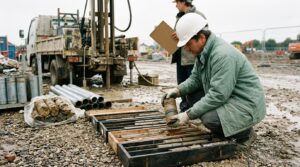
Geotechnical Report: What Goes Into It and How It Is Produced
What goes into a geotechnical report – investigation, laboratory data, design parameters and analysis – and why two reports on one site can differ.

Free and Open-Source Geotechnical Software: What You Actually Get
What free and open-source geotechnical software offers, where it works well, what it leaves to the engineer, and when a paid tool is the cheaper choice.

Oedometer (Consolidation) Test: Casagrande, t50/t90 and cv
How the oedometer test gives Cc, Cr, σ′c and cv — the compression curve, Casagrande’s construction, the log-time and root-time methods, and field correction.
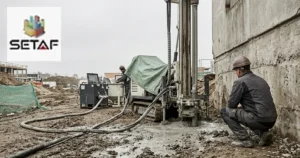
Jet Grouting Column Design: qu, w/c and the βe Coefficient
How jet grout columns are designed: single, double and triple fluid systems, the water-to-cement ratio, the beta-e coefficient and the composite modulus.
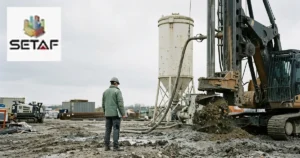
Deep Soil Mixing (DSM): FHWA Mixture Design Step by Step
How deep soil mixing columns are designed: dry and wet mixing, binder factor, water-to-binder ratio, volume ratio and the composite modulus used in settlement.
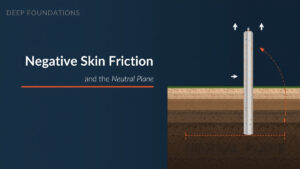
Negative Skin Friction and the Neutral Plane
Negative skin friction is shear stress acting downward on the shaft of a pile, developed when the surrounding soil settles more than the pile does. Instead of resisting the load on the pile, the soil in that zone hangs on it and adds to it. The accumulated force is called drag load, and the additional settlement it produces is called
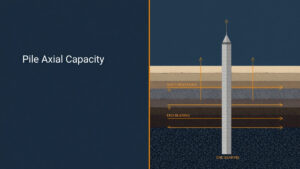
Pile Axial Capacity: Alpha, Beta and Lambda Methods + Group Efficiency
Pile axial capacity is the maximum load a pile can transfer to the ground before failure, made up of shaft resistance developed along its length and end bearing developed at its base. For a floating pile, the ultimate capacity is: Qu = Qs + Qb − Wp where Qs is the shaft resistance, Qb the end bearing, and Wp the


Seismic Earth Pressure: Mononobe–Okabe vs Equivalent Static
How seismic earth pressure is calculated — the Mononobe–Okabe method, the equivalent static approach, seismic coefficients kh and kv, and why passive resistance falls while active thrust rises.
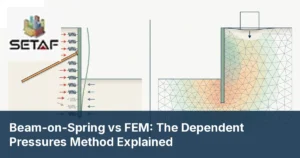
Beam-on-Spring vs FEM: The Dependent Pressures Method Explained
The dependent pressures method derives wall pressure from calculated displacement. How a beam-on-spring model differs from FEM, and when each is right.
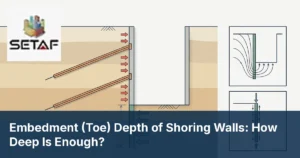
Embedment (Toe) Depth of Shoring Walls: How Deep Is Enough?
The embedment depth of a shoring wall is set by three separate checks: horizontal equilibrium, hydraulic failure at the base, and vertical capacity.
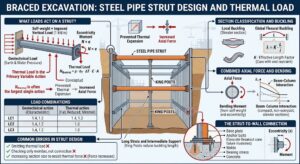
Braced Excavation: Steel Pipe Strut Design and Thermal Load
A braced excavation is supported by compression members spanning between opposing walls, or between a wall and a foundation, rather than by tension elements installed into the ground behind it. The struts carry the earth and water pressure that the wall cannot resist on its own, transferring it across the excavation instead of into the surrounding soil. Bracing is chosen
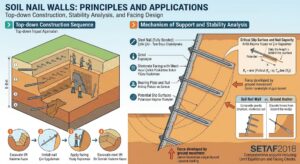
Soil Nail Wall Design: Pullout, Tendon Rupture and Facing
A soil nail wall is an excavation support system in which closely spaced passive steel elements are installed into the ground as excavation proceeds downward, reinforcing the soil mass rather than restraining it from beyond. Each nail consists of a steel bar grouted along its full length, connected at the excavation face to a bearing plate and a facing that
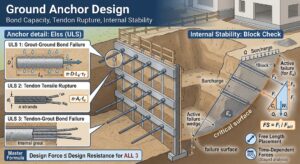
Ground Anchor Design: Bond Capacity, Tendon Rupture, Internal Stability
A ground anchor is a tensile element installed into the ground behind a retaining structure, transferring load from the structure into a grouted bond zone located beyond the soil mass that is trying to move. It consists of a tendon, a free length that transfers load without engaging the surrounding ground, and a bond length in which load is transferred
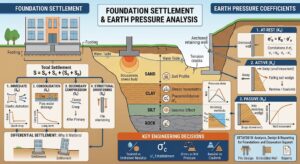
Earth Pressure Coefficients: Rankine vs Coulomb vs At-Rest (K0)
An earth pressure coefficient is the ratio between the horizontal effective stress acting on a wall and the vertical effective stress at the same depth. It converts a known vertical stress into the horizontal pressure that a retaining structure must resist, and its value depends on how far, and in which direction, the wall has moved. Three states are distinguished.
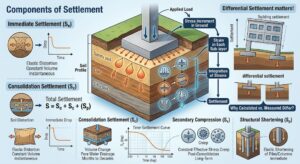
Foundation Settlement Analysis: Immediate, Consolidation and Time
Foundation settlement analysis predicts how much a foundation will move downward under load, and how that movement develops over time. It combines an immediate response that occurs as the load is applied, a consolidation response that develops as pore water drains from fine-grained layers, and in some soils a long-term creep component. Engineers perform this analysis because the serviceability of
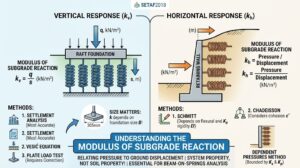
Modulus of Subgrade Reaction: How to Determine kv and kh
The modulus of subgrade reaction is the ratio between the pressure applied to the ground at a given point and the displacement produced at that point. It is expressed in force per unit volume, typically kN/m³, and it allows the ground to be represented as a system of independent elastic springs rather than as a continuous medium. Engineers use this
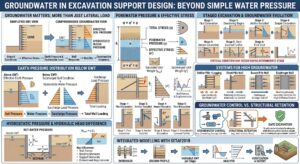
Excavation Support Below the Groundwater Table: Design, Pressure and Stability
Groundwater can fundamentally change excavation-support design because it affects both the stresses within the soil and the hydraulic loads acting on the retaining system. Once an excavation extends below the groundwater table, water becomes part of the soil–structure interaction rather than a secondary condition considered after the wall has been designed. Groundwater influences the system through two main mechanisms. First,
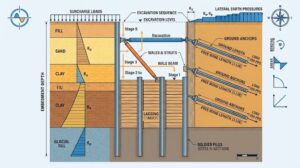
Soldier Pile Wall: Design, Construction and Excavation Support
A soldier pile wall is an excavation support or earth-retaining system consisting of vertical soldier piles installed at intervals, with lagging placed between the piles as excavation progresses. The system is also commonly called a soldier pile and lagging wall, king post wall, or Berlin wall in certain configurations and regions. The retaining system can be understood as a connected
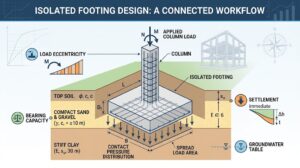
Isolated Footing Design: Pad Foundations, Bearing Capacity and Settlement
An isolated footing is a shallow foundation designed to transfer the load from an individual column, pier, or structural support to the underlying soil. Also commonly referred to as a pad footing, spread footing, or isolated pad foundation, it distributes a concentrated structural load over a larger area so that the ground can safely support it. Although the geometry of
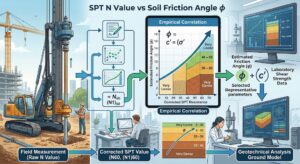
SPT N Value vs Friction Angle: Correlations for Soil Parameter Estimation
The SPT N value and soil friction angle (φ) are empirically related, particularly in granular soils such as sands, where both parameters can reflect aspects of soil density and resistance. In general, higher penetration resistance may be associated with a higher friction angle, but this relationship must be interpreted carefully. SPT does not directly measure the friction angle. Instead, engineers
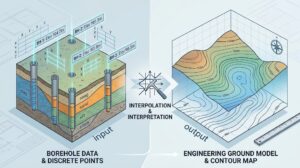
Contour Map Plotter: From Data Points to Engineering Ground Models
A contour map plotter is a tool or method used to convert spatially distributed data points into contour lines that connect locations with equal values. At its simplest, the process can be represented as: X Coordinate + Y Coordinate + Measured/Defined Value → Contour Map The plotted value may represent ground elevation or another parameter that varies spatially across a
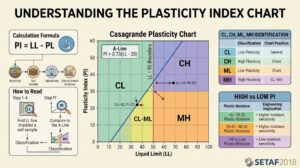
Plasticity Index Chart: How to Read and Interpret Soil Plasticity
A plasticity index chart is used in geotechnical engineering to evaluate and classify fine-grained soils based on two laboratory-derived parameters: the Liquid Limit (LL) and the Plasticity Index (PI). The plasticity index is calculated from the Atterberg limits using the relationship: PI = LL − PL where PL is the Plastic Limit. The resulting PI represents the range of water
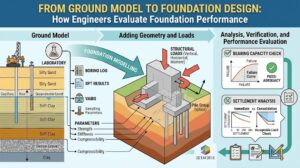
From Ground Model to Foundation Design: How Engineers Evaluate Foundation Performance
A foundation model cannot be defined by footing or pile geometry alone. The behaviour of a foundation depends on the ground supporting it, the loads transferred from the structure, groundwater conditions, and the way stresses and deformations develop within the soil. A foundation that provides adequate resistance against failure may still be unsuitable if the resulting settlement exceeds acceptable limits.
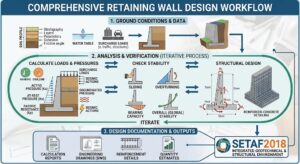
From Earth Pressure to Stability: How Retaining Wall Design Decisions Are Made
Calculating lateral earth pressure is only one part of designing a retaining wall. The wall must resist the actions generated by the retained soil, but its performance can also be influenced by groundwater pressure, surcharge loads, seismic effects, foundation conditions, and the structural capacity of the wall itself. Determining an earth-pressure diagram therefore does not, on its own, demonstrate that
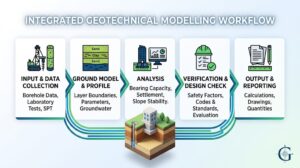
From Soil Data to Design: How Geotechnical Models Support Engineering Decisions
A geotechnical investigation can produce a substantial amount of information about a site: borehole logs, soil descriptions, groundwater observations, SPT results, laboratory test data, and interpreted engineering parameters. Yet none of these inputs, on their own, define how the ground will behave beneath a foundation, behind an excavation support system, or along a potential slope failure surface. That requires an

Pile Foundation FEM: When Is Finite Element Analysis Necessary?
Pile foundations are designed to transfer structural loads safely through soil layers whose behavior is often far more complex than the structure they support. Unlike steel or concrete, soil is naturally variable, and its response depends on factors such as layering, groundwater conditions, stress history, loading sequence, and the interaction between neighboring piles. As a result, predicting the performance of
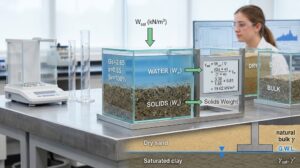
Saturated Unit Weight of Soil: Formula, Calculation & Typical Values
Saturated unit weight of soil (γsat) is the unit weight of a soil when all of its voids are completely filled with water (degree of saturation, Sr = 100%). Expressed in kN/m³, it represents the combined weight of soil solids and pore water per unit volume under fully saturated conditions. Saturated unit weight is a fundamental parameter in geotechnical engineering
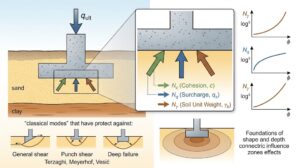
Bearing Capacity Factors: Nc, Nq and Nγ Explained
Bearing capacity describes the ability of soil to support foundation loads without experiencing shear failure or excessive deformation. In classical foundation design, this resistance is commonly expressed through bearing capacity factors—dimensionless coefficients used within bearing capacity equations to represent different components of soil resistance. The three primary factors are Nc, Nq, and Nγ, which are associated with cohesion, surcharge, and

What Is Finite Element Analysis (FEA)? A Guide for Engineers
Finite element analysis (FEA) is a numerical engineering technique used to predict how a structure, component, or physical system will behave under specific loads and boundary conditions. It works by dividing a complex model into smaller regions called finite elements, solving the governing equations for each element, and combining those results to estimate the behavior of the complete system. Engineers
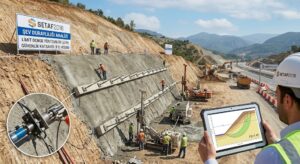
Terzaghi’s Bearing Capacity Theory: Engineering Mechanics, Code Compliance & SETAF2018 Implementation
The role of shallow foundations—such as isolated, strip, and raft footings—is fundamental to structural engineering, as they transfer superstructural loads directly to the upper soil strata. The safety of any structure depends not only on the structural capacity of its reinforced concrete elements, but critically on the ability of the underlying soil to support these applied stresses without undergoing shear

Safe Solutions in High Groundwater: Sheet Pile Retention Design Guide
In deep excavation projects, one of the most critical challenges geotechnical engineers face is a high groundwater table. Retaining wall designs executed in saturated soils carry severe risks, including heavy lateral hydrostatic pressures, water seepage issues, hydraulic heave, and piping hazards. A failure like hydraulic heave or piping at the base of an excavation not only compromises the stability of

Geotechnical Finite Element Software: When Do You Actually Need FEM?
Finite element analysis has changed what engineers can model in geotechnical engineering. Complex soil–structure interaction, nonlinear soil behavior, construction stages, irregular geometries, and detailed stress and deformation patterns can all be investigated at a level that simpler analytical approaches may not provide. That capability, however, can lead to a misleading assumption: that more advanced numerical modeling is automatically the better

Trenching and Shoring Software: A Guide to Safe Excavation Design
Excavation design becomes more complex the moment the surrounding ground has to remain stable while soil is being removed. What may appear to be a straightforward trench or excavation can quickly become a soil–structure interaction problem involving changing earth pressures, groundwater, surcharge loads, nearby structures, retaining walls, anchors, struts, and multiple construction stages. This is where trenching and shoring software

Can Civil Engineering Software Handle Geotechnical Analysis?
Civil engineering software covers an increasingly broad part of the engineering workflow, from structural modeling and design to project documentation. But geotechnical engineering introduces a different set of problems. Soil is not simply another structural material, and a foundation model is not the same thing as a complete understanding of the ground beneath it. So, can civil engineering software handle
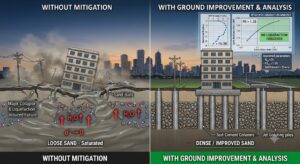
Liquefaction Analysis in Geotechnical Engineering: A Practical Guide
Earthquake-induced ground failure is not limited to structural instability or bearing capacity problems. In saturated, loose granular soils, cyclic earthquake loading can rapidly increase pore water pressure, reducing effective stress and causing the soil to lose a significant portion of its strength and stiffness. This behavior, known as soil liquefaction, can lead to settlement, lateral deformation, loss of foundation support,

How Much Is Geotechnical Engineering Software? 2026 Pricing Guide
Geotechnical engineering software can cost anywhere from a few hundred dollars for a specialized calculation tool to more than $20,000 per year for advanced 3D finite element analysis platforms. The final price depends on what the software is designed to do, whether tools are sold individually or as part of a complete package, the licensing model, and the level of
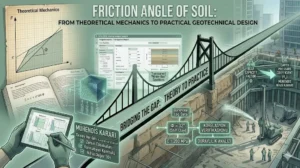
Friction Angle of Soil: From Theoretical Mechanics to Practical Geotechnical Design
In every geotechnical textbook, the friction angle of soil ($\phi$) is presented through the elegant geometry of the Mohr-Coulomb failure envelope. But as every field engineer knows, there is a vast gap between a circle on a graph and the messy reality of a borehole log. On-site, you aren’t just calculating a property; you are determining the safety of a
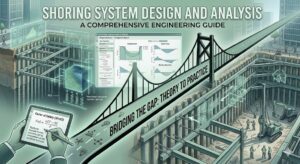
Shoring System Design and Analysis: Bridging the Gap Between Theory and Practice
In high-density urban environments, shoring system design and analysis is no longer just about holding back dirt—it is about surgical precision. Whether you are excavating next to a historic building or managing deep groundwater tables, the stability of your excavation is the only thing standing between a successful project and a catastrophic structural failure. The challenge for modern engineers lies
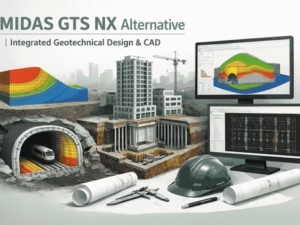
MIDAS GTS NX Alternative | Integrated Geotechnical Design & CAD
In the specialized field of geotechnical engineering, MIDAS GTS NX has long been regarded as the “Academic Titan”—an unrivaled powerhouse for high-end finite element modeling (FEM) in Tier-1 infrastructure projects, such as subsea TBM tunnels or massive dam monitoring systems. Its capacity to resolve complex non-linear deformations and soil-structure interactions is unparalleled for purely numerical simulations. However, for the modern engineering

Top 5 Geotechnical Engineering Software [2026 Buyer’s Guide]
The landscape of civil infrastructure is undergoing a radical transformation, and at the heart of this evolution lies a fundamental shift in how we approach the earth itself. As we navigate 2026, the reliance on fragmented legacy systems is fading, replaced by a sophisticated integration of data science and structural mechanics. However, for many firms, the promise of digital transformation

Top PLAXIS Alternative for Geotechnical Production: SETAF2018 Integrated Software
In the specialized field of geotechnical engineering, PLAXIS has long been regarded as the gold standard for high-end geotechnical finite element software. Its capacity to resolve complex non-linear deformations and soil-structure interactions in multi-phase environments is unparalleled for Tier-1 infrastructure projects, such as subsea TBM tunnels or massive dam monitoring systems. However, for the boutique firm or the project manager overseeing

Top GEO5 Alternative for Engineers: SETAF2018 Integrated Geotechnical Software
Geotechnical engineering is evolving toward a framework where geotechnical statistics and high-fidelity modeling enhance our traditional design methods. This shift is not about moving away from the efficiency of 2D section analysis—which remains the backbone of shoring and retaining wall design—but rather about empowering these calculations with probabilistic methods. By quantifying the inherent variability of soil properties, engineers can now


